
Monday, six-thirty in the morning. The alarm rings, and your body, which still thought it was the middle of the night, receives the order to get up, wash, and be pleasant in a meeting before the first cup of coffee. For most of us, that is a mood. For a heart with one artery already carrying a fragile plaque, it is sometimes the last morning.
Cardiologists have been measuring it for more than thirty years: heart attacks prefer Mondays, and they prefer them mainly among people who work. It is not a curse of the calendar. It is the price of a week we invented ourselves, one that restarts millions of people at the same time, from a cold start.
An alarm clock has never killed anyone. It gives the signal. What the studies below measure is an excess risk, in percentages, not a body count; and they look at the morning on one side, and Monday on the other, never Monday morning by itself.
The Monday excess risk of heart attack, measured by two studies
% excess risk on MondayWhat your body does when the alarm rings
Morning is already the hour of the heart. In 1985, James Muller's team recorded the time of first pain in nearly 3,000 patients hospitalized for a heart attack: episodes clustered between six in the morning and noon, and in the group where the onset of the attack was timed by a blood test (measuring an enzyme, CK-MB), they were three times more frequent at the morning peak than at the late-evening trough. Among patients who were taking beta-blockers, medications that blunt adrenaline, the rhythm disappeared. The morning culprit therefore leaves a chemical signature.
When you get up, adrenaline speeds up the heart and raises pressure in the arteries. Cortisol, the waking hormone, climbs too, and not with the same force every day: in Trier, researchers measured saliva samples from 219 volunteers immediately upon waking for six days in a row. Those who reported feeling overloaded and consumed by worry saw their cortisol rise more sharply on weekdays, but not on weekends. Your body knows what day it is. It does not need to check the calendar.
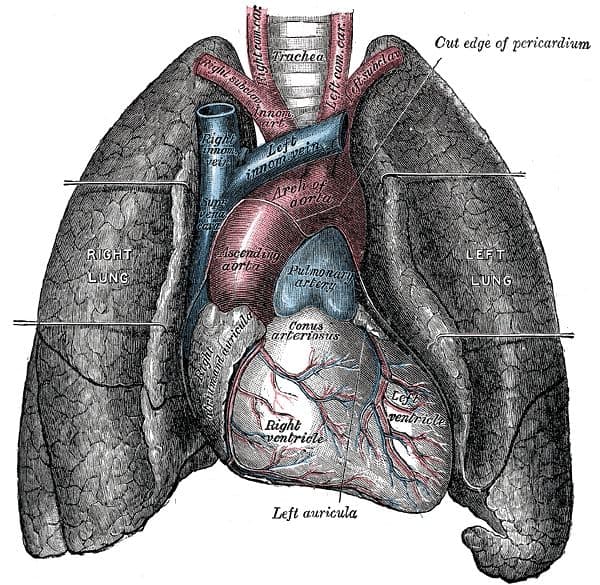
The heart in place between the two lungs, front view : the coronary arteries run across the surface of the ventricles
Henry Vandyke Carter, Gray's Anatomy (1918 edition), public domain
The blood, meanwhile, grows sticky. An hour after getting up, platelets clump together more readily than at dawn, and that spike does not occur in volunteers who remain lying down without moving: science has proved what everyone suspected, that getting out of bed is dangerous. In a coronary artery lined with atheroma, fatty deposits built up over the years, the surge in pressure can crack the most fragile plaque. Platelets rush in to seal the breach, clump together too fast, and form a clot that blocks the artery. Deprived of oxygen, the heart muscle begins to die: that is a heart attack, and if it turns into cardiac arrest, every minute without chest compressions counts.
The weekend may make matters worse. Chronobiologists in Munich named this shift in 2006: "social jetlag," the gap between the time kept by your internal clock and the schedule society imposes on workdays. If you got up three hours later on Sunday, a six-thirty alarm rings, as far as your internal clock is concerned, at around three-thirty in the morning. You never boarded a plane, yet you land three time zones to the east. No study directly measures the effect of the weekend shift on heart attacks: it is a lead, not a finding.
Yet a full-scale natural experiment does exist: daylight saving time, which moves an entire country's alarm clock forward at once. In 2008, Imre Janszky and Rickard Ljung, at the Karolinska Institute, published data in the New England Journal of Medicine covering Swedish heart attacks since 1987. In the week following the spring shift to daylight saving time, on the last Sunday of March, heart attacks rose by about 5%, especially during the first three days; the autumn return to standard time, which gives back an hour of sleep, reduced risk on the Monday, though slightly less than it rose in the spring. Janszky saw in this a possible explanation for the Monday peak: the stress of the new workweek, but perhaps also the disrupted sleep of the weekend.
Augsburg :a peak reserved for the working population
The most troubling evidence comes from Bavaria. From 1985 to 1990, a registry there tracked every heart attack in a region of 330,000 inhabitants, and Stefan Willich's team published its analysis in Circulation in 1994. Among working people, the relative risk of a heart attack increased by a third on Mondays, while Sunday marked the trough. Among those who did not work, that peak did not appear.
It is not proof, but it is a strong clue. Monday is dangerous only for people who have somewhere to go.
The same registry adds a nuance that is often forgotten: sudden cardiac deaths, for their part, were evenly distributed across the week. There, the start of the week produced heart attacks; it did not strike more people dead on the spot.
Evenly distributed across the week, whereas heart attacks among working people peaked on Monday; the 5,596 patients in the registry, heart attacks and sudden deaths combined, averaged 63 years of age, and seven in ten were men; the monitored population was aged 25 to 74
Belfast, thirty years later
In June 2023, at the British Cardiovascular Society conference in Manchester, cardiologist Jack Laffan presented data covering the entire island of Ireland: more than ten thousand patients hospitalized between 2013 and 2018 for the most severe form of heart attack, in which a coronary artery is completely blocked. The peak still fell at the start of the week, culminating on Monday, 13% above expected levels. Sunday also exceeded the norm, whereas it had marked the trough in Augsburg: on that day, the two studies do not agree.
Laffan called it a "curiosity" that remains to be explained, no doubt by several causes, and judged it "reasonable" to suppose a biological clock component. Nearly thirty years later, the Monday peak was back for the most severe heart attacks; the study does not say whether working people alone accounted for it.
Scotland :among people under fifty, the Monday excess is strongest
To know whether Monday kills, rather than merely filling emergency rooms, you have to count the dead. A Scottish team reviewed every coronary death in the country from 1986 to 1995 and published the result in the BMJ in 2000 under a title that did not look for nuance: "I don't like Mondays." Across all deaths combined, the Monday excess was slim, barely 3%.
It became sharp when looking at who died. They were deaths occurring outside the hospital, among people with no previous hospital admission for coronary heart disease: death that strikes without warning. And it was among people under fifty that the excess was strongest: among men, Monday exceeded the daily average by a fifth.
The authors had a suspect, and it was not the boss. Hospital admissions for alcohol abuse peaked on Saturday, and the peak in deaths followed two days later. Monday may in part be paying Saturday night's tab, even if, as they noted, work-related stress may also play a role.
Scotland, 1986-1995: deaths outside the hospital, with no prior cardiac admission, above the daily average; on Saturdays, hospital admissions for alcohol abuse exceeded the average by 64%
Heart attacks are not the only deaths that follow this calendar. In 2024, an international team published in the BMJ data on suicides across 740 locations in 26 countries between 1971 and 2019: 1.7 million deaths. In every country, Monday was the weekday with the highest risk, up to 17% above Wednesday in Chile; risk also rose on New Year's Day in most countries. The authors put forward one of the leads raised in Scotland: work pressure at the start of the week.
When Monday was a holiday
Three centuries ago, Monday had nothing to do with going back to work: it was the day people did not show up. At the end of the seventeenth century, Parisian artisans had already formed the habit of taking Monday off, and even every other Tuesday; around 1730, journeyman printers in Lyon did not start their week's work until Thursday. Paid on Saturday, workers celebrated their wages, and according to historian Robert Beck, "taverns, open-air dance halls, and public balls were indeed the favorite places to spend Monday" (our translation from the French).
It was called Saint Monday. Religious, economic, and moralist elites fought it in the name of work, family, and thrift. It died out at the end of the nineteenth century, because workers themselves chose to rest on Sunday rather than Monday, and the French law of July 13, 1906 extended weekly rest to all employees.

Model T chassis lined up on the assembly line at the Ford plant in Highland Park, Michigan, in 1913, thirteen years before the five-day workweek
Library of Congress, public domain
Then the factory invented the weekend. As early as 1922, a Ford announcement put it in the New York Herald: "Every man needs more than one day a week for rest and recreation." In September 1926, the Ford Motor Company moved its plants to a five-day, forty-hour week. Two days of rest was progress; the week simply had to restart somewhere. We decided that millions of people would restart their engines from cold on the same day, at the same hour, and dance-hall Monday became ambulance Monday.
Monday, or going back to work?
If the culprit is returning to work, and not just Saturday night, it should follow the return wherever it moves. Remote work spares the commute and the crack-of-dawn alarm; the four-day week shortens the workweek without eliminating its first morning. To our knowledge, no study has yet measured what they do to that peak.
If the social jetlag lead is the right one, the remedy within everyone's reach follows from it: do not shift your weekend, and get up on Saturday as if it were a workday. That is an individual patch on a collective organization problem, and nobody has yet gone on strike for the right to wake up early on Saturdays.
The day someone counts the heart attacks at a company that starts its week on Tuesday, we will finally know whether it is Monday that is cursed, or the order to submit to it.
The workweek does not begin with a team meeting. It begins with natural selection at seven in the morning.
Need help. In the United States, call or text 988, the Suicide & Crisis Lifeline: free, confidential, 24/7. In France, if you are experiencing suicidal thoughts, or worried about someone close to you, call 3114, the national suicide prevention hotline, free and reachable 24 hours a day, 7 days a week (24/7). In case of immediate danger, call 911 in the United States, or 15 or 112 in France.