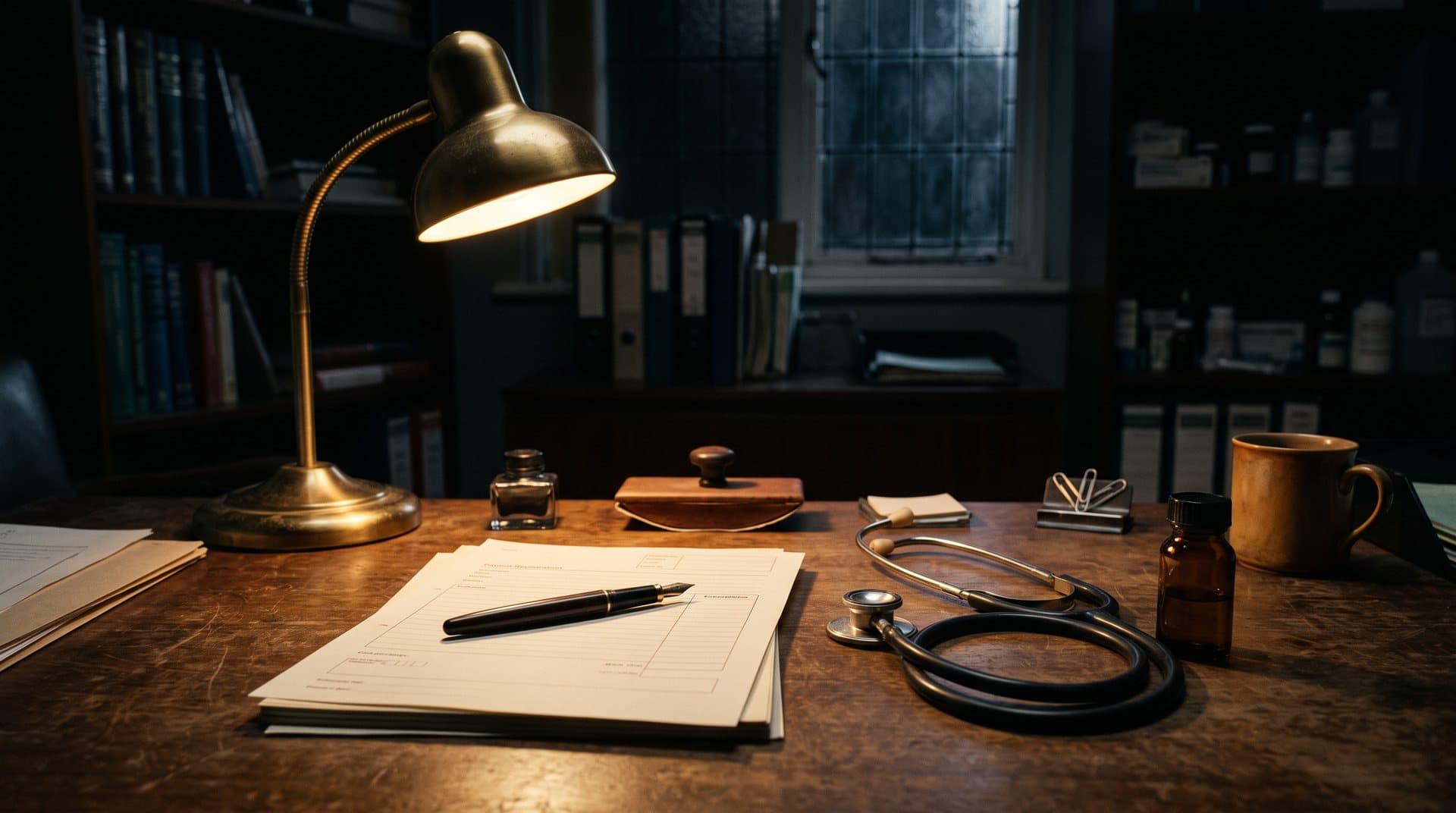
On April 2, 1998, in Hyde, near Manchester, a funeral director made an appointment to see the family doctor whose female patients his firm was burying in such numbers. Alan Massey was accusing no one: he was convinced of the doctor's innocence and had come only to tell him that people in town were talking about the number of his deaths. Relaxed, Dr. Harold Shipman pulled out his book of death-certificate counterfoils, showed him names and causes of death, and told him the book was open to inspection by "anybody concerned." The undertaker left reassured. To find out whether the doctor was killing people, they had asked the doctor.
This well-regarded general practitioner did not kill in the shadows. For twenty-three years, he killed his own patients—mostly elderly women in good health—and then wrote down himself what they had died of. A signature was enough: in England, nobody really checked what a doctor wrote about the death of an old lady. He betrayed their trust "in a way and to an extent unparalleled in history," concluded Dame Janet Smith, the judge who chaired the public inquiry.
Fifteen women, killed between 1995 and 1998: the only ones the courts ever tried
At least, out of 888 deaths re-examined by the public inquiry; 45 others remain suspected
Across his entire career, hospital years included, according to the inquiry's final report in 2005: an estimate, not a sum, that could reach 284
▸In Brief : Harold Shipman
Born in 1946 in Nottingham, Harold Shipman became a general practitioner in Todmorden in 1974, then in Hyde, near Manchester, starting in 1977. From 1975 to 1998, he killed his patients, mostly elderly women, by injecting diamorphine; the public inquiry estimated that he had begun during his hospital years. The forged will of Kathleen Grundy brought him down in 1998, and he was convicted of 15 murders in 2000. He took his own life in prison in 2004.
A Criminal Record Nobody Opened
Harold Shipman was the son of a Nottingham truck driver. At seventeen, he watched a doctor at home ease the pain of his mother, who was dying of lung cancer, with morphine; she died in June 1963. After graduating in medicine at Leeds in 1970, he worked at Pontefract General Infirmary and then became a general practitioner in Todmorden, Yorkshire, in 1974.
In 1976, he was caught: he had been obtaining pethidine, an opioid, with forged prescriptions and injecting himself. Magistrates fined him £600, he spent time in a psychiatric unit near York, and the General Medical Council (GMC), Britain's medical regulator, did not strike him off: a warning was deemed enough. His conviction for forgery and drug offenses remained on the Police National Computer; one day, all anyone would have to do was read it.
In 1977, he joined the Donneybrook practice in Hyde. In August 1992, he set up practice alone at 21 Market Street, with more than three thousand patients on his list. At No. 20, right across the street, colleagues from the Brooke Practice set up shop: they would be the ones signing his cremation forms, and he would sign theirs.
The Afternoon Home Visit
The weapon was an end-of-life drug. Diamorphine, the medical name for heroin, is used in the United Kingdom to relieve cancer pain; in high doses, it shuts down consciousness, then breathing. Shipman killed mainly during home visits, and an abnormally high number of deaths clustered around the same time of day—that of his afternoon rounds. On occasion, he also killed right in his own office.
Renate Overton shows what the drug does. One evening in February 1994, he came to treat this forty-seven-year-old woman at home for an asthma attack; she collapsed in front of him, in cardiac and respiratory arrest, while her daughter was in the house. Paramedics restarted her heart, yet she never woke up: she lived for fourteen months in a persistent vegetative state and died in April 1995. Shipman himself had noted in her medical file that he had given her diamorphine.
Ordinarily, his female patients were found at home, alone, fully dressed, without having seemed ill—and it was often Shipman himself who "found" them. To relatives, he said he knew the cause of death, saw no need to trouble the coroner—the official to whom questionable deaths are reported—and pointed out that any autopsy the coroner might order would delay the funeral. When someone expressed surprise at so sudden a death, he would reply, according to the inquiry, that the death might have been unexpected to them, but not to him. He was telling the truth.
All that remained was to prepare the file. Shipman altered medical records so that his patients appeared to have been in poor health, making their deaths look like the end of a long decline.
What Nobody Proofread
Shipman filled out the death certificate with care, and the registrar had no reason to turn it down. Since 1985, "old age" alone had been acceptable as a cause of death past the age of seventy. At the coroner's office before 1998, the only question asked, according to a staff officer, was age: from seventy-five upward, old age passed without further inquiry. An old lady in robust health therefore had every right to die of old age, provided she was old enough.
Out of all those murders, the coroner was aware of only two. For a cremation, the law did require a second doctor to confirm the cause of death: Form C. It carried a fee, and the profession nicknamed it ash cash. In most cases, that second doctor questioned only Shipman. "They trusted him as a respected colleague. He lied to them; they believed him," wrote the judge.
Between 1987 and 1998, Susan Booth, a neighborhood general practitioner, signed forty-one Forms C for Shipman's patients. She must have noticed that a great many of them were dying; she and her partners, the judge believed, explained it away by the large number of elderly patients on his list. It is now known that twenty-nine of the forty-one had been killed by him.
Susan Booth answered for those signatures before the General Medical Council alongside five other Hyde doctors. Two of them were cleared in December 2004, and the other four, including Booth, in July 2005. Between the four of them, they had signed 214 Forms C for Shipman's deceased patients between 1979 and 1997; 124 of those patients had been killed. They could not reasonably have been expected, the council found, to suspect behavior "as extraordinary" as his; and general practice in England, as in Hyde, was not to make further inquiries before countersigning. The custom was to ask nothing; the council therefore found nothing to fault.
In 2005, however, the regulator did discipline the two consultants who had co-directed intensive care at Tameside General Hospital in 1994. They had admitted a patient of Shipman's who remained in a vegetative state until her death fourteen months later, without notifying the relevant authorities. Geraint Brown, whose evidence to the public inquiry was found to have been dishonest, was suspended for a year; Murtaza Husaini, who had misled the inquiry, received a reprimand.
The fee for the second medical opinion before a cremation; the crematorium medical referee who authorized it received £5.50
The People Who Counted the Bodies
The alarm came from the people whose trade was handling the dead. In early 1998, Deborah Bambroffe, Alan Massey's daughter and a partner in the family funeral home, shared her unease with the doctors across the street: too many elderly women found dead at home, apparently alone, fully dressed. On March 24, one of those doctors, Linda Reynolds, went to the coroner. She had done the math: in three months, Shipman had signed sixteen cremation forms, whereas her own practice, with a patient list three times the size, had recorded fourteen deaths.
Could a statistical monitor have done that calculation? The public inquiry commissioned a team at Imperial College London to test death-rate monitoring across 1,009 general practitioners in five health authorities. The charts flagged twelve doctors whose patients were dying at an "unacceptably" high rate; Shipman was one of them. For the other doctors whose follow-up investigations were known, the excess mortality was explained by a nursing home in their practice list. The statistical monitor caught Shipman, and eleven other colleagues along with him.
Subsequent simulations run on Scottish practices confirmed the flaw: a high rate of false alarms, and doctors switching practices too frequently to be tracked. Mortality monitoring, the authors concluded, could only ever serve as a backstop; reforming the system of checks is what must stop a doctor who kills.
Greater Manchester Police assigned a discreet inquiry to a detective inspector, David Smith. He did not check the Police National Computer; the judge believed he saw no point in looking for a criminal record on a man like Shipman. The officer later remarked that it was not uncommon to find doctors who had stolen controlled drugs. Two murdered patients were then lying at the funeral director's and could have been autopsied: he did nothing about them, and Lily Higgins and Ada Warburton were cremated on March 25 and 30.
A medical adviser from the health authority, who knew and respected Shipman, reviewed fourteen patient files and reassured the detective. The investigation was closed on April 17, 1998, without a written report; senior officers would later call it "appropriate at that time." Tipped off by Alan Massey's visit on April 2, right in the middle of the inquiry, Shipman stopped killing for a brief spell, then resumed: Winifred Mellor on May 11, Joan Melia on June 12, Kathleen Grundy on June 24. Had the police and the coroner acted with reasonable expedition, those three women would probably have lived, the inquiry concluded.
One Will Too Many
Kathleen Grundy was eighty-one, a former mayoress of Hyde, and everyone who knew her knew she was in vigorous health. She was found dead at home on June 24, 1998; Shipman was the last person to see her alive. Lacking any plausible illness, he decided to put down "old age." He telephoned the coroner's office; the call lasted two minutes and eleven seconds, and old age was accepted.
Then came what the judge would call a "crude forgery" that "made detection inevitable"—so crude that she wondered whether he had wanted to draw attention to his crimes. A typewritten will disinherited Kathleen Grundy's daughter and grandchildren and left £386,000 to her doctor. Her daughter, Angela Woodruff, happened to be a lawyer: she knew how to read a will. In July, police opened an investigation. More than two hundred murders without getting caught, and the man brought himself down for an inheritance.
Kathleen Grundy had been buried, not cremated. Exhumed on August 1, 1998, her body gave the autopsy the true cause of death: an overdose of morphine or diamorphine. Shipman claimed his patient had been a drug user and pointed to his computerized records as proof; forensic examination of the computer showed that those entries had been typed after her death. He was arrested on September 7: police found a Brother typewriter of the model used to type the forgery and, in his garage, more than £10,000 worth of jewelry.
Fifteen Names, Then Two Hundred and Fifteen
The trial opened in Preston on October 5, 1999. On January 31, 2000, the jury found him guilty of fifteen murders and of forging the will; Mr. Justice Forbes handed down fifteen life sentences and recommended that he never be released. Shipman maintained his innocence to the end.
The public inquiry then reopened eight hundred and eighty-eight deaths. It attributed at least two hundred and fifteen to Shipman: 171 women and 44 men, aged forty-one to ninety-three. Most were elderly women in good health, the sort whose deaths surprise nobody. "The true number is far greater and cannot be counted," the judge warned as early as 2002.
Her final report reached all the way back to Pontefract General Infirmary. Shipman, she concluded, is said to have killed for the first time six months after starting there, at age twenty-five, claiming ten to fifteen probable victims there, including a four-year-old girl. Across his entire career, the total would be roughly two hundred and fifty deaths, perhaps as high as two hundred and eighty-four: an estimate by the judge, not the sum of the preceding figures.
Shipman took his own life in his cell at Wakefield Prison on January 13, 2004, the day before his fifty-eighth birthday, without ever confessing. Victims' families said they felt cheated: there would be neither confession nor explanation. His widow, Primrose, received a full NHS pension—to which she was entitled only because he died before turning sixty.
Twenty-One Years for a True Second Look
The General Medical Council struck Harold Shipman off the medical register on February 11, 2000, eleven days after the verdict. Its 1976 warning had spanned his entire career as a killer. In 2005, Health Secretary John Reid ordered a review of the regulator: "We want to put an end to the idea that the GMC is a representative body for doctors."
On death certification itself, the judge had delivered her verdict back in 2003: the cremation procedure, as practiced almost everywhere, was "of very little value." She called for a new certification system covering all deaths, whether followed by burial or cremation. In England, it came into force on September 9, 2024: an independent medical examiner now scrutinizes deaths not referred to a coroner.
Shipman had killed for twenty-three years; it took twenty-one years, from the 2003 report to the 2024 regulations, for an independent pair of eyes to be placed by law over the deaths a doctor signs. His patients had not died of old age, but of a doctor whom nobody ever proofread.
A DOCTOR SIGNED THE DEATHS OF HIS PATIENTS UNDER A SINGLE OVERSIGHT: HIS OWN