
Before every takeoff, a flight attendant shows you the emergency exits, the seatbelt, and the oxygen mask that will drop from the ceiling. At night, in your bedroom, nobody shows you a thing. No safety briefing for the bed, no life vest under the box spring, no black box in the nightstand.
We fear the sky, where people die rarely, together, and in front of the cameras. We do not fear the house, where people die far more often, from a fall from standing height or from the edge of the bed. The death that terrifies us is spectacular; the one waiting for us is domestic, and it strikes mainly the old, without ever making the front page.
In 2025, commercial aviation tracked by IATA (aircraft of 5.7 metric tons and above) lost 394 people on board. In 2023, falls among Americans aged 65 and older alone killed 41,400, more than a hundred times as many. The comparison limps, and it should be said upfront: one country against the planet, all falls against a single piece of furniture. It gives only an order of magnitude, and by no means do all of those falls begin at the edge of the mattress. Yet in France, nearly eight in ten falls that send an older adult to the emergency room happen at home.
The sky keeps its books
Air transport knows its dead by their flight number. In 2025, according to IATA, the airlines' trade association, eight accidents were fatal out of 38.7 million flights. Two disasters, Air India Flight 171 and PSA Airlines Flight 5342, accounted by themselves for more than three-quarters of the year's victims.
Every accident triggers an investigation, and every investigation makes the next one rarer. Over 2012-2016, there was one fatal accident for every 3.5 million flights; over 2021-2025, one for every 5.6 million, on average. At that pace, someone who flew every single day would wait an average of more than fifteen thousand years before boarding the wrong plane.
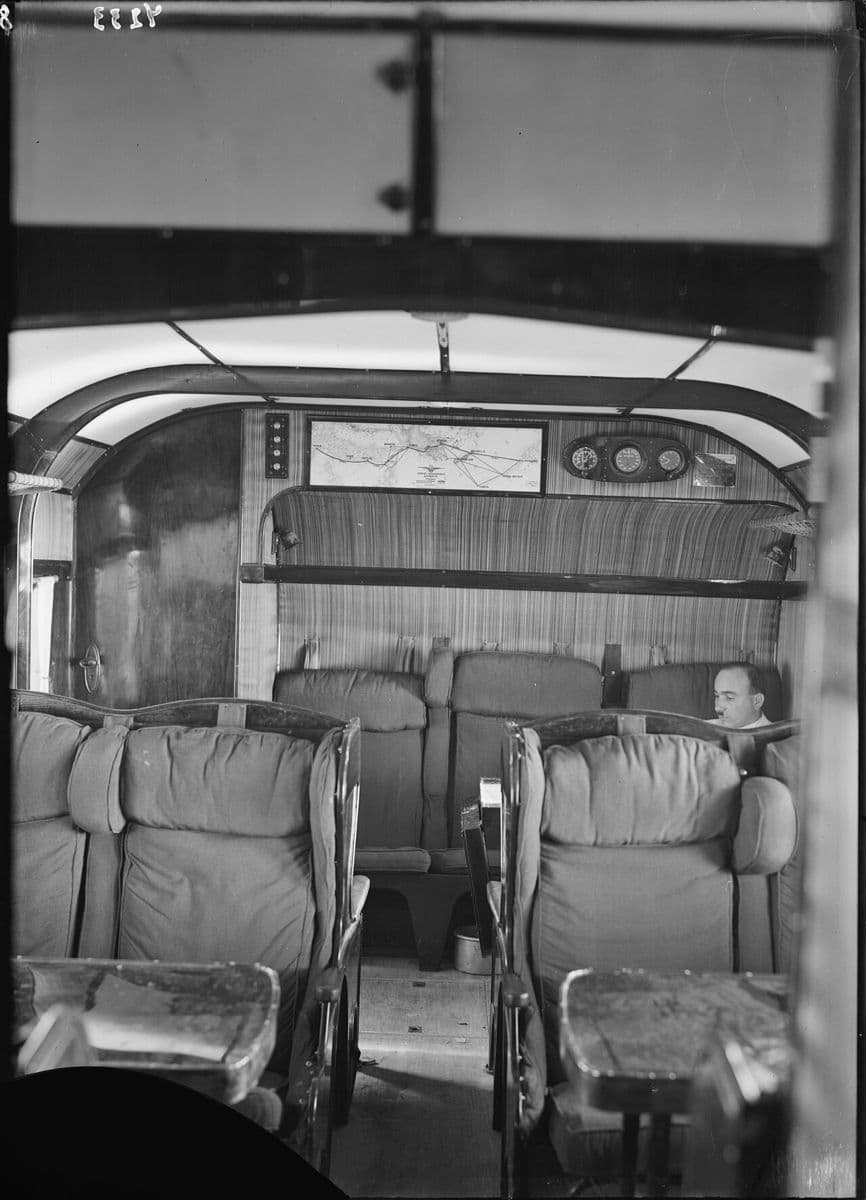
Passenger cabin of an Imperial Airways flying boat : upholstered armchairs, route map, and instrument dials in the background
Matson Collection, Library of Congress, public domain
That is a five-year average. 2025 was a bad year: eight fatal accidents out of 38.7 million flights, and an onboard fatality risk index, calculated by IATA, that rose from 0.06 per million flights in 2024 to 0.17
The bed has no tally; it has a code
Nobody publishes an all-causes death toll for the bed: taken literally, the question in the title has no numerical answer. Yet the bed has its own line in the WHO's classification of causes of death: W06, "fall involving bed," filed between the wheelchair and the chair. The chair has its own code too: seen through the eyes of the WHO, a house is a catalog of furniture you can fall off.
What gets counted are falls. In the United States, they are the leading cause of injury death after age 65. In France, everyday household and leisure accidents, falls included, killed 21,470 people in 2012, more than five times the road traffic deaths that year, and two-thirds of the victims were 75 or older.
The bed has a third toll, which owes nothing to falling: fire. In the United States, from 2019 to 2023, home fires starting in a mattress or bedding accounted for only 2% of fires, yet caused 12% of home fire deaths, according to the National Fire Protection Association (NFPA). One in twenty-five bedding fires killed someone. Per thousand fires of this type, people today die more than twice as often as in the early 1980s. In fires that start in a bedroom, roughly a third of the deaths trace back to smoking materials.
At the other end of life, babies are counted too. The WHO classification has a line for them, W75, "accidental suffocation and strangulation in bed." In the United States in 2024, the CDC counted 947 deaths of infants under one year old under that heading, out of roughly 3,400 babies who died suddenly and without an obvious cause, most often during sleep or in their sleep area; the rest were classified as sudden infant death syndrome or remained of unknown cause. For that single country and that single cause, the figure is nearly five times the 198 onboard deaths that global commercial aviation records in an average year. Across the states surveyed by the CDC in 2015, 61.4% of mothers reported sharing their bed with their baby at least sometimes, and 38.5% left soft bedding where the baby slept.
The rest is a matter of exposure. Most travelers spend a few hours a year on a plane; every one of us spends every night lying down. Across billions of hours, a tiny hourly risk ends up producing steady deaths, night after night. That is an argument, not a measurement: none of the sources cited here counts the hours spent in bed. And the table below does not compare like with like: it sets the world, the United States, and France side by side, across three years and three ways of counting.
| Event | Deaths | Benchmark |
|---|---|---|
| Commercial flight accidents (worldwide) | 394 in 2025 (198 per year on average, 2021-2025) | 1 fatal accident per 5.6 million flights |
| Fatal falls among people aged 65 and older (United States) | 41,400 in 2023 | 339.5 per 100,000 after age 85 |
| Everyday household and leisure accidents (France) | 21,470 in 2012 | two-thirds among people aged 75 and older |
More than a hundred a day, for a single country and a single age group
Two-thirds were 75 or older; road traffic killed fewer than 4,000 people the same year
Sixty centimeters
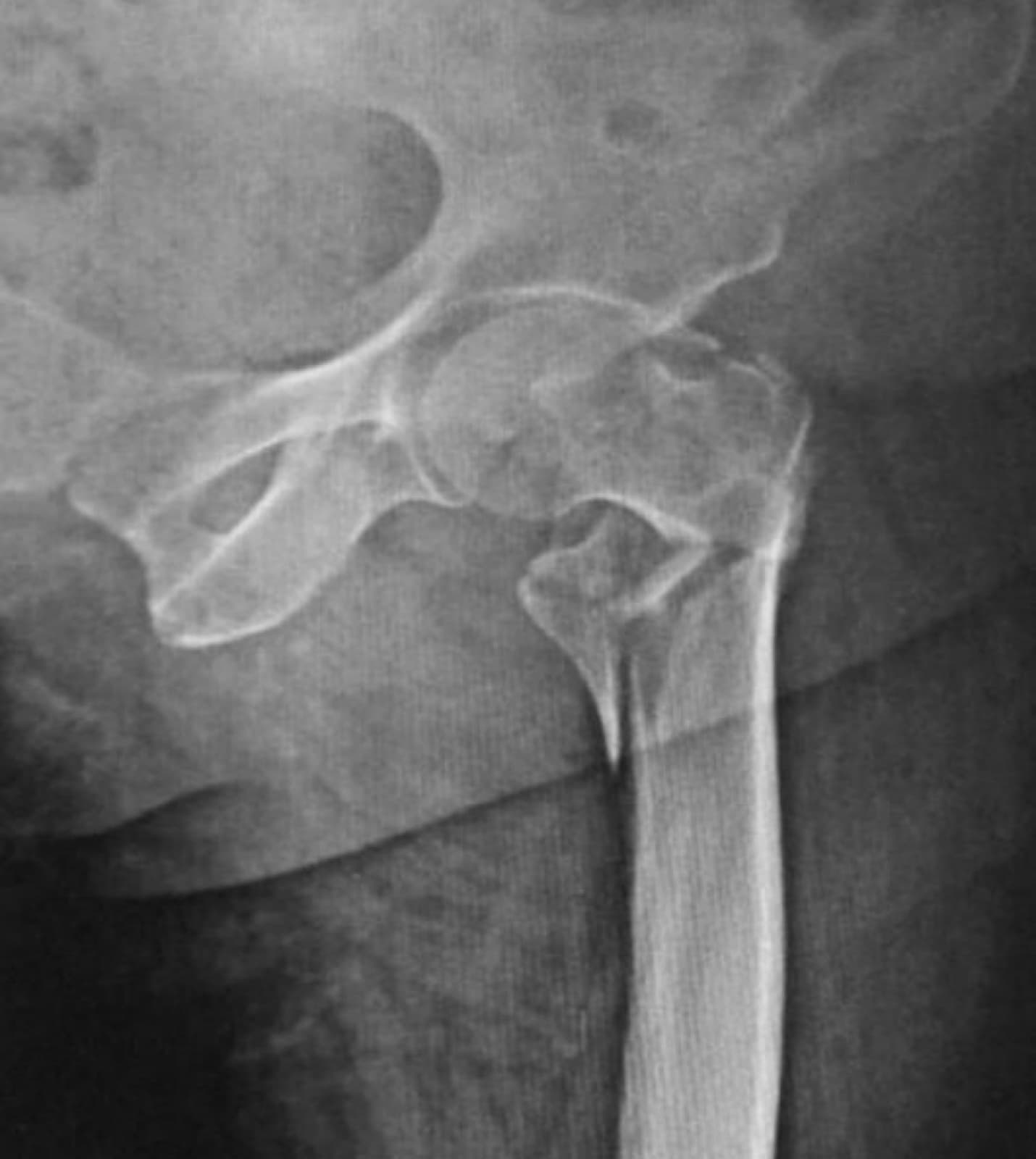
X-ray of a comminuted hip fracture
Memon, Patel, and Juvar, CC BY 4.0
At twenty-five, slipping off your mattress ends with a curse word and a bruise. At eighty-five, the same half-meter can be the last. Danger waits when you get up: people get out of bed at night to go to the bathroom, and those who go often fall slightly more than others.
The body adds its own traps. More than one in five people over sixty see their blood pressure plummet when they stand up: blood pools in the legs, the brain is briefly starved of it, and the room spins. Sleeping pills and anti-anxiety medications, prescribed to help people sleep, also make them fall more often.
Then physics does its work. A seventy-kilogram body falling sixty centimeters carries about 400 joules of energy; it takes at least ten times less to break an old femur. On blood thinners, a simple fall from standing height is also enough to start bleeding beneath the skull, between the brain and its membrane: a subdural hematoma.
Most of the time, however, death takes its time. In France, one in five women and one in three men die within the year following a hip fracture. The worst comes in the first three months, when the risk of dying is five to eight times that of people the same age. People die of the fall in the hospital, weeks later, long after the bedroom has been tidied up.
Only a fraction strikes the hip; in the laboratory, 11 to 39 joules were enough to break the femurs of ten elderly donors, struck as in a sideways fall
Nearly 95,000 patients over 54 followed in France in 2008-2009, three-quarters of them women; baseline health at the time of the fracture weighed more heavily than the type of fracture or treatment
The oldest, and more and more of them
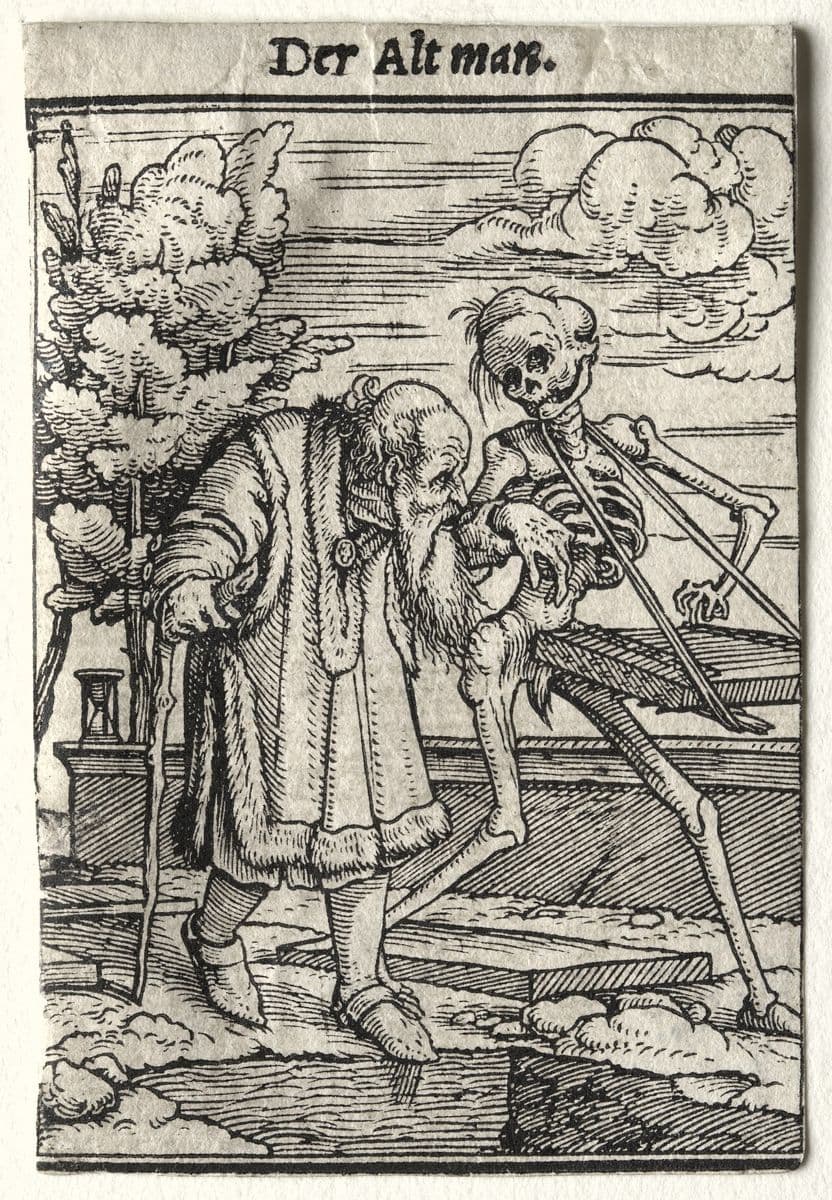
Death, as a skeleton, supports an old man leaning on his cane and leads him toward an open grave : "The Old Man," woodcut from the Dance of Death by Hans Holbein the Younger (circa 1526)
Cleveland Museum of Art, CC0
The risk does not merely rise with age: it takes off. In the United States, past age 85, people die from a fall nearly eighteen times as often as between 65 and 74.
| Age group | Fall deaths per 100,000 population (United States, 2023) |
|---|---|
| 65–74 | 19.2 |
| 75–84 | 74.7 |
| 85 and older | 339.5 |
At every age, men die of falls more often than women, and in every bracket the rate has climbed over the past twenty years. The population is aging: those fall deaths have no reason to recede on their own.
In 2023, roughly one in 295 Americans aged 85 or older died from a fall
The rail that strangles
To prevent falls from bed, people install bed rails. In July 2019, in an Iowa nursing home, a 76-year-old woman died trapped in her bed rail. In November 2023, in South Carolina, an 87-year-old woman died the same way in a residential care facility. On May 30, 2024, the manufacturer Medline recalled the model, sold in about 1.5 million units since 2009. It was called the Bed Assist Bar.
What gets attached to the mattress to prevent a fall can kill in turn. In the United States, according to the Consumer Product Safety Commission, portable bed rails trap and kill an average of seventeen people a year. Eight in ten victims were 70 or older, seven in ten were women, and half of those deaths happened at home. A mandatory federal standard did not take effect until August 2023.
A plane that goes down triggers an investigation around the world. Medline's model killed two women, in 2019 and in 2023, before being recalled, and as its sole remedy, the recall offered buyers a refund.
More than half of the victims suffered from at least one underlying illness, such as Alzheimer's or Parkinson's
Why the sky scares us

The Bedroom, by Pieter de Hooch
public domain
In 1973, psychologists Daniel Kahneman and Amos Tversky showed that we judge the probability of an event by how easily examples come to mind. A crash supplies images for weeks: the wreckage, the families, the recovered black boxes. An elderly woman who falls in the middle of the night supplies none. No evening news broadcast opens with a broken hip.
Two years later, Ellen Langer described the illusion of control: we believe we are in command of what we do ourselves. On a plane, you are strapped in, passive, handed over to pilots you cannot see, and that is where the fear comes from. In your bedroom, you believe you are in command of every step, right up to the last.
Upon landing, people still sometimes applaud the pilot. Nobody applauds when waking up in bed. At eighty-five, though, it would be well deserved.
The airplane has its investigators, its black boxes, and its safety briefingsThe bed has a code, W06, and a nightstand with hard corners