On October 31, the same story is told everywhere: the Celts believed that on that night the veil between the living and the dead grew thin; they lit great bonfires and wore disguises to fool the spirits; the Church later covered the festival over with All Saints' Day, and the Irish exported it to America.
Part of that story is true, another part was constructed much later without a shred of documentary evidence, and the Celtic dead of Samhain come down to a handful of legendary figures written by monks. The very real dead of this story were Irish peasants driven out by starvation, who carried their turnip lanterns to America.
The Cave of Oweynagat :A Hanged Man Who Was Thirsty
At Rathcroghan, the cave of Oweynagat was held to be a gateway to the Otherworld. A tenth-century tale sends Nera there one Samhain night: King Ailill promises a prize to whoever will tie a withe around the foot of a captive hanged the day before. The captive begins to speak: "I was very thirsty when I was hanged." Nera carries him on his back to a house; the dead man drinks, scatters the last sip from his lips into the faces of the people in the house, and they all die.
There is the revenant of Samhain as the monks wrote him: not an ancestor coming home to visit his kin, but a hanged man who wants a drink. In these tales, Samhain is the festival of November 1 that opens winter, the season of assemblies and encounters with the Otherworld. It is also a bad night to be a king: Muirchertach mac Ercae and Diarmait mac Cerbaill each die on Samhain wounded, burned, and drowned. For Muirchertach, the annals specify: in a vat full of wine.
Yet these texts date from centuries after Christianization. Historian Ronald Hutton points out that nothing in them shows a great pan-Celtic festival, and not one portrays a religious ceremony. The "pagan festival of the dead" comes from anthropologist James Frazer, who inferred it without any documentary record. Older than those texts, the Gaulish Coligny calendar (second century) bears a month named SAMON: a name, not a narrative.
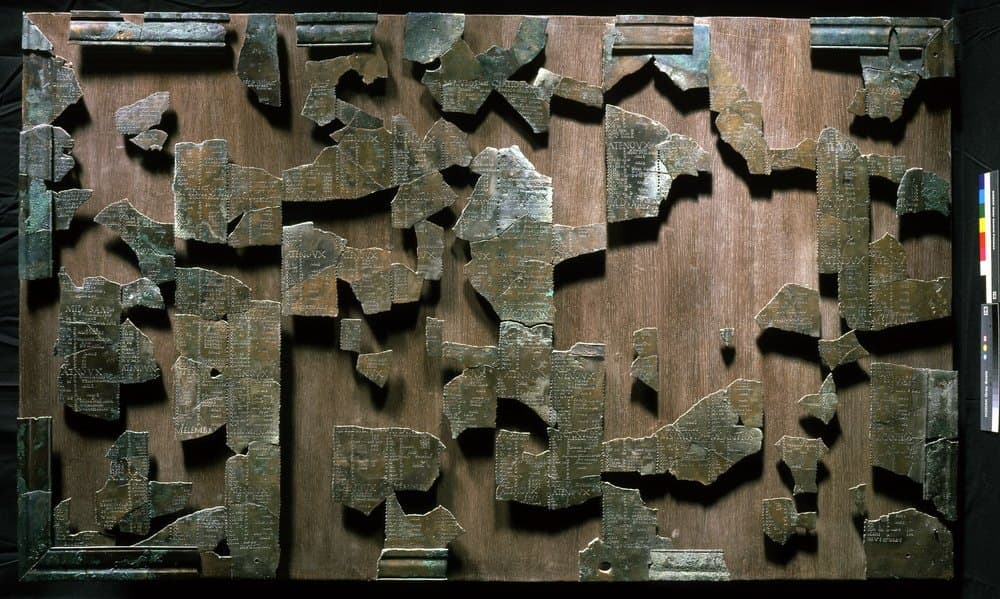
The Gaulish Coligny calendar (second century), showing a month named SAMON
Lugdunum Museum, public domain
Tlachtga :Ashes, but No Proof
Tradition places the great bonfire of Samhain on the Hill of Ward in County Meath: the site of Tlachtga. Excavations there unearthed evidence of large-scale burning and bones from feasting, in a phase dated to the period of Ireland's conversion, around 400–520. Archaeologists find it tempting to see the fires of Samhain there, and difficult to prove conclusively: metalworking, pottery firing, or glassmaking also leave ashes behind.
As for the fire from which every hearth in Ireland was supposedly relit, no known medieval text mentions it. It appears in the work of historian Geoffrey Keating, drawn from a source that no one has ever found.
More than a thousand years after the pagan era; for Ronald Hutton, the only historical mention of pagan rites at Samhain
Near Armagh, at Navan Fort, another frequently cited site, excavators even unearthed the skull of a Barbary ape from North Africa, likely a pet: a visitor from another world, that one at least. Ancient Ireland had its ceremonial sites; what is missing is a proven link with the night of October 31.
All Saints' Day, the Ideal Suspect
In Rome, the feast of all martyrs originally fell on May 13, a date some scholars connect with the Lemuria: on those nights, according to Ovid, the head of the household walked barefoot at midnight spitting black beans over his shoulder to drive away restless ghosts. The connection is debated, yet the feast of the dead that the Church supposedly covered over may well have been Roman.
November 1 became mandatory in 835 throughout the Frankish Empire as the feast of All Saints: All Hallows' Day. Ronald Hutton sees a Germanic rather than a Celtic idea in that choice: nothing shows that the Church sought to cover over Samhain. Its vigil, October 31, All Hallows' Eve, merely lent its name to the holiday: Hallowe'en.
The Church does, however, have a day of the dead with a date and an author: November 2. Odilo, abbot of Cluny, established it for his abbey and its dependent monasteries—in 998 according to tradition, more likely after 1030 according to the Catholic Encyclopedia—and the whole Church subsequently adopted it. The feast of the dead attributed to the Celts without a document was written down in black and white by monks, on the day after All Saints' Day.
Turnips in the Kitchens of Scotland and Ireland
Disguises and door-to-door rounds, for their part, are attested, though in the modern era: guising, the costumed round, was first recorded in sixteenth-century Scotland, and later in Ireland. That it served to fool the dead is an explanation, not an established fact.
In England, the custom has an ancestor that truly does look toward the dead: souling. Around All Saints' tide, the poor went from house to house asking for a soul cake, a small round spiced cake marked with a cross; for each cake received, a prayer was owed for the dead. Shakespeare alludes to it in The Two Gentlemen of Verona: "to speak puling, like a beggar at Hallowmas." The Reformation suppressed prayers for the dead, yet the house-visiting custom did not vanish in most parts of England until the nineteenth century.
If one is looking for a documented ancestor to "trick or treat," here is one: a cake in exchange for a prayer for the dead.
The lantern was a hollowed-out turnip, carved with a grotesque face and holding an ember inside, common in nineteenth-century Ireland and the Scottish Highlands. Anyone who has ever hollowed out a raw turnip understands why the pumpkin won.
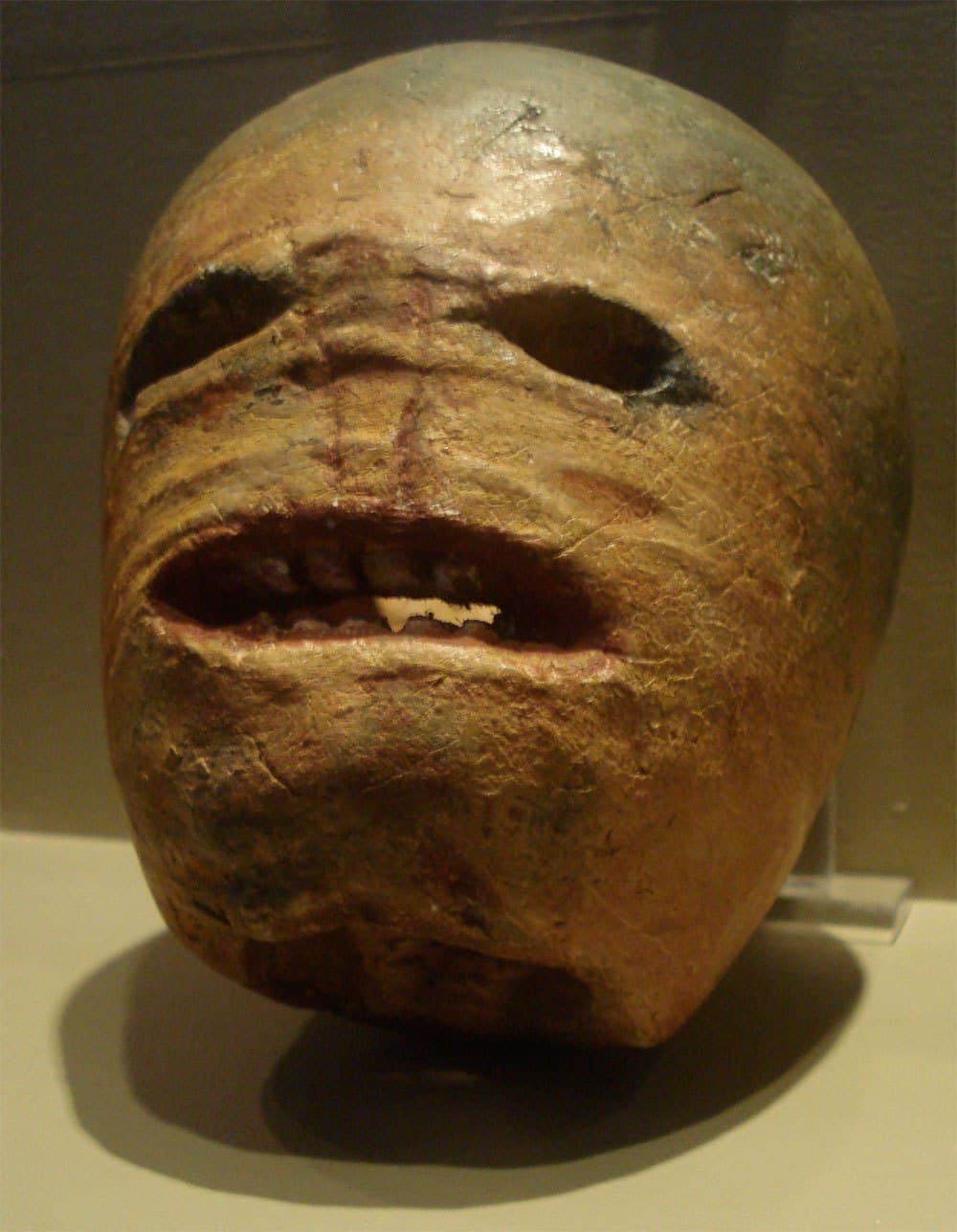
Traditional Irish Halloween lantern carved from a turnip
Rannṗáirtí anaiṫnid, Wikimedia Commons (CC BY-SA 3.0)
The Coffin Ships
The crossing to America, by contrast, has dead bodies and dates. Between 1845 and 1852, the Great Famine killed roughly one million Irish people and drove more than a million others into exile. For landless peasants, as one historian sums it up, it meant emigration or extinction. Many sailed from western ports aboard overcrowded, poorly provisioned vessels—the "coffin ships"—where mortality was high.
First famine, then exile; some towns lost up to two-thirds of their inhabitants
Along with the survivors traveled their autumn customs, blended with those of the Scots. In America, the turnip became a pumpkin.
What Remains of the Night of the Dead
In the twentieth century, the United States turned it into a commercial holiday and then exported it everywhere. In 2026, according to the National Retail Federation, three in four Americans plan to celebrate it. For pets, the favorite costume is the pumpkin: the turnip of Irish peasants ended up on the backs of cats and dogs.
Three spending categories for Halloween, out of $13.5 billion projected (United States, 2026)
billion USD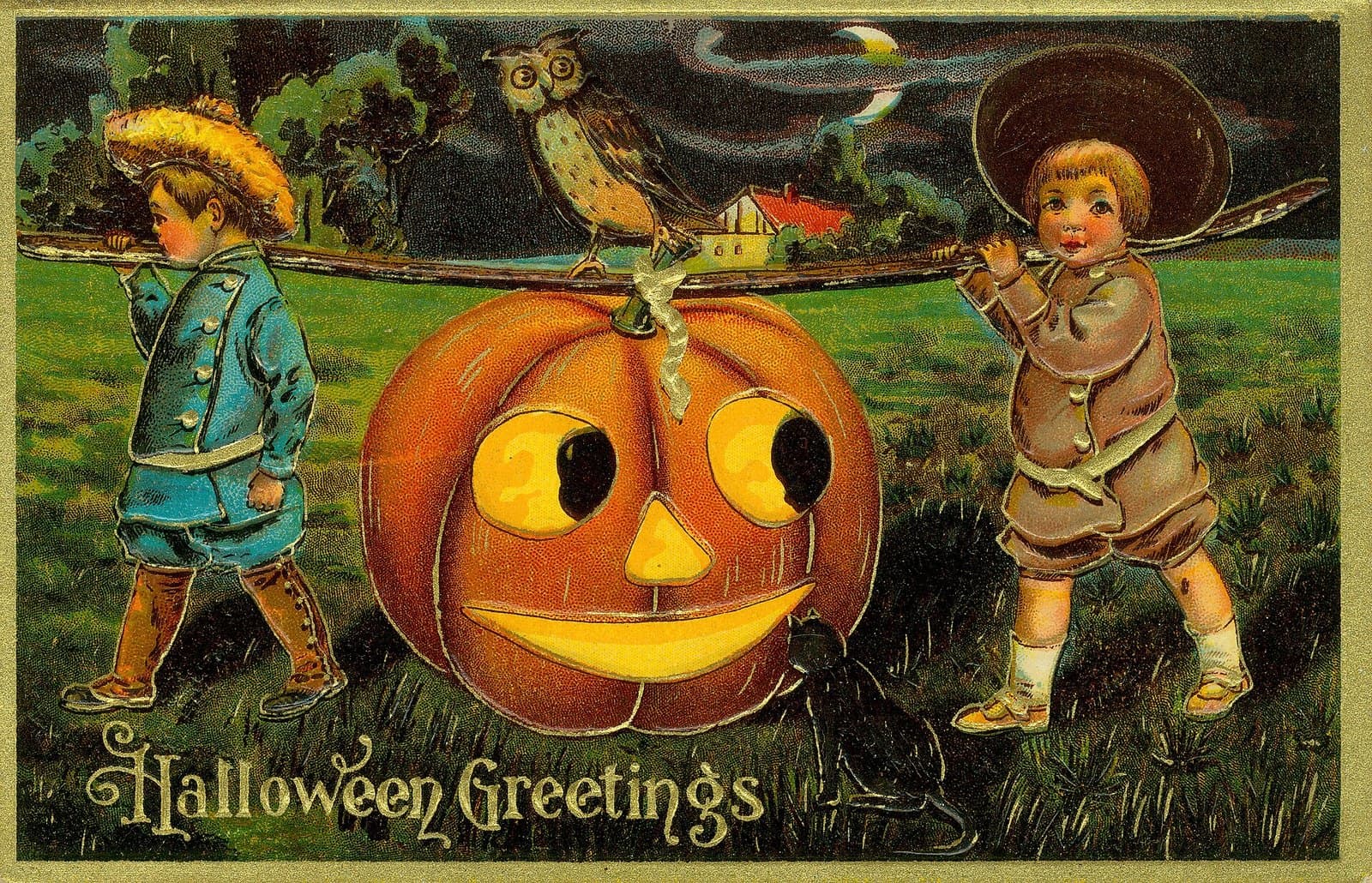
Early twentieth-century American "Halloween Greetings" postcard
public domain
Samhain was probably never the "night when the veil grows thin" of social media: it was anthropologist James Frazer who gave the Celts, without a document, that tailor-made night of the dead. A festival about which we know almost nothing now weighs in, according to American retail projections, at 13.5 billion dollars. What we celebrate on October 31 is not the memory of the Celts. It is the memory of a story we invented for them.