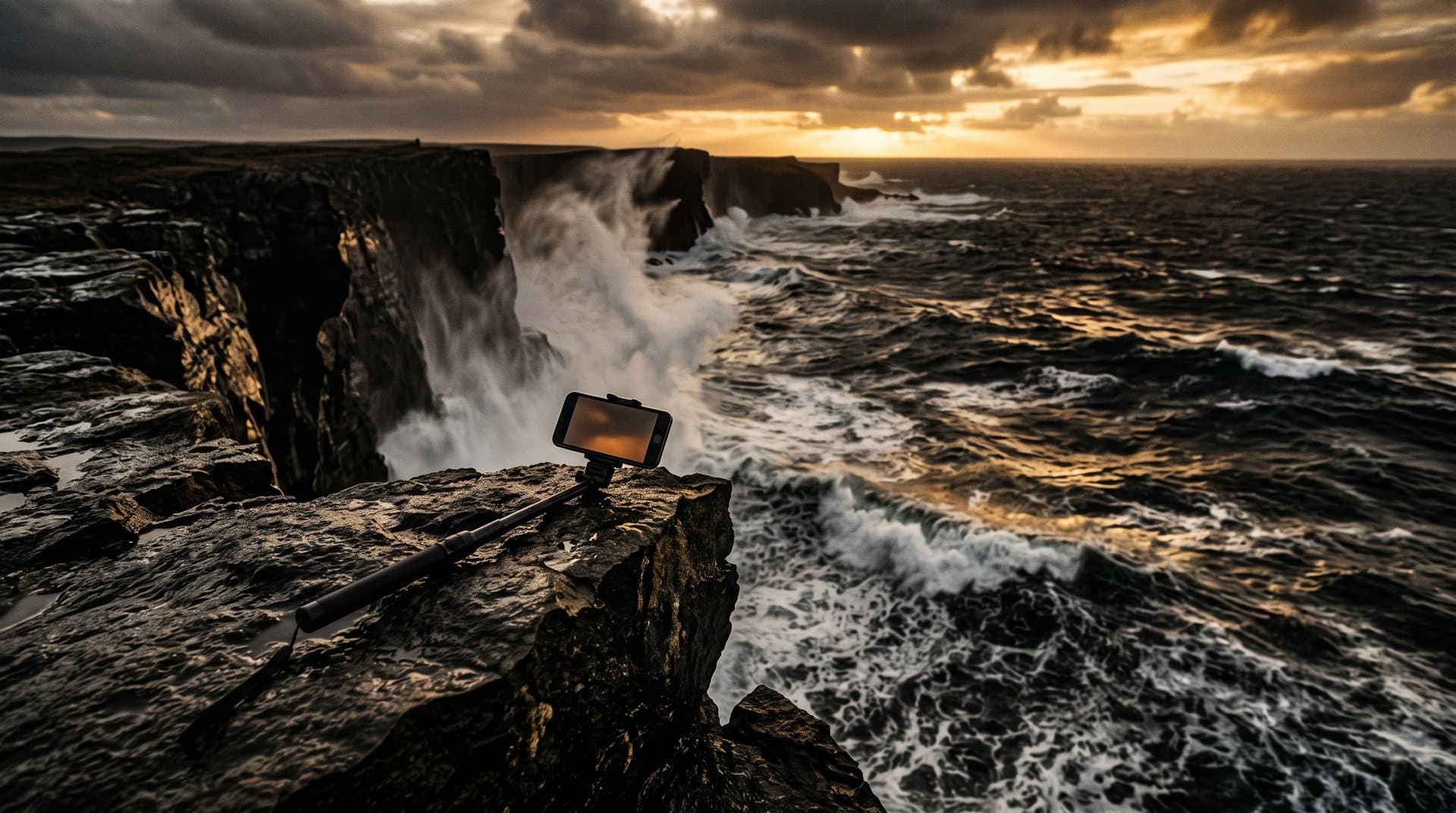
One Saturday in January 2016, in Mumbai, a young woman and two friends climbed onto the rocks at Bandra Bandstand to take pictures of themselves in front of the Arabian Sea. They fell into the water. A thirty-seven-year-old passerby, Ramesh Walanju, dived in and brought back the two friends, before the swell swept him away: his body was found on Monday in a nearby creek. The eighteen-year-old woman was not found.
That is what a selfie death looks like. Not a lone idiot at the edge of a cliff, but a group of young people by the water, and sometimes the person who jumps in to save them. We are afraid of the shark, which got its own movie and its own poster. The phone kills without theme music.
And it kills more people. Between late 2011 and late 2017, the press around the world reported at least 259 selfie deaths; over the same period, sharks killed about fifty. Five times fewer. Homo sapiens is the first known species to step backward toward a drop to get a better look at itself.
In 137 incidents counted in English-language press articles: a floor, not a full tally
Selfies and sharks, same period (2011-2017)
deathsFear is looking the wrong way
The shark has a clerk. At the University of Florida, the International Shark Attack File keeps a record of every bite on the planet: the species, the beach, what the victim was doing. Its conclusions are reassuringly dull: over the last five years, an average of eight deaths a year, and the risk of being bitten "remains extremely low." Selfie deaths are recorded by no one; it takes researchers to track them down one by one in the newspapers.
The headline formula was born before the researchers arrived. In September 2015, the US site Mashable counted twelve selfie deaths since the start of the year, against at least eight shark deaths logged by Shark Attack Survivors; four of those twelve deaths were falls. Nine months, a dozen news items, a shark count that did not come from the Florida registry: the comparison went around the world's newsrooms before it had a method. The serious counts — the 2018 Indian study, then that of the iO Foundation — came afterward.
The selfie, for its part, has a peculiarity. The shark comes to you; the photographer walks to the scene of the accident on their own two feet, smile included.
Global average 2020-2024; nine in 2025, right on the average
One step back

Photograph : Weimarer Stadtschlosses Innenhof - Drohnen-Selfie-0945. © Raimond Spekking / Wikimedia Commons (CC BY-SA 4.0).
People die first by falling. A Spanish team at the iO Foundation sifted through more than five thousand newspapers: from January 2008 to July 2021, it counted 379 selfie deaths, including 216 from falls. That tally covers a longer period, yet yields fewer deaths per year than the Indian study, about 28 versus 43: each team sees only what its newspapers reported, and neither can say whether the phenomenon is rising or falling. The mechanism fits in a single gesture. To fit the scenery into the frame, you step back, and the screen shows your face and the view, never the edge.
Why does everyone take them? In 2017, the Munich psychologist Sarah Diefenbach surveyed 238 people about their selfies and gave her study a title that sums up the species: "Nobody Seems to Like Them Yet Everyone Has Reasons to Take Them." Her participants judged their own selfies more authentic and more self-ironic than other people's. Mine is ironic, yours is ridiculous; the precipice cannot tell the difference.
A crowd feels reassuring, and it shouldn't. In July 2015, at Yellowstone, a forty-three-year-old American woman visiting with her daughter turned her back on a bison less than six meters away to pose; park rules require twenty-three. The bison tossed her with its head, she got away with minor injuries, and the park logged its fifth encounter of the year. She and her daughter knew they were doing something wrong, the spokeswoman explained, but thought it was fine because other people were nearby. She was lucky: bison have injured more visitors at Yellowstone than any other animal. Near Bangalore, a twenty-eight-year-old man who entered a restricted area of a park to take a picture with an elephant was trampled to death. In those stories, the animal that kills is not the shark.
The leading cause, far ahead of transport and drowning, out of 379 deaths recorded in the world press
Young men in their twenties, in groups, by the water
The fatal selfie has a composite sketch. In the 2018 Indian study, seven in ten victims are men; the average age drops to twenty-three, and the youngest are ten. Nor are they primarily lost tourists: in the Spanish count, nearly two in three of the dead were in their own country.
People rarely die alone by the water. In the Indian study, drowning is one of the two accidents that kill the most people at once, and the Delhi researchers note that these drownings more often involve groups. On Mangrul Lake in India, ten young people out in a boat wanted a photo; the boat tipped, and seven died. At Bandra, it was the passerby who jumped in to save them who never came back up. Then comes the train: most transport deaths are young people posing in front of a moving locomotive.
In the Indian study (2011-2017); the longer Spanish count finds 58%, with an average age of 24
India, the sea, and the trains
India bears the heaviest share. According to the Indian study, the country accounts for roughly half of the deaths; the AFP notes 159 there, far ahead of Russia and the United States. In the days following the Bandra drowning, Mumbai police designated sixteen spots where taking a selfie had become dangerous, from Bandra Bandstand to Marine Drive and Girgaum Chowpatty beach, with planned patrols, warning signs, and lifeguards requested from the city.
Goa followed in June 2018, after two tourists from Tamil Nadu died on the same day in two separate accidents: state lifeguards marked out twenty-four "No Selfie" points along its beaches. Researchers, meanwhile, gave the phenomenon a name. In 2016, a team from IIIT-Delhi and Carnegie Mellon titled its study "Me, Myself and My Killfie," then launched an app, Saftie, that sends a text message when a user approaches a dangerous spot. A text message to warn you that the cliff is a cliff.
The sea cares very little about your follower count
Countries hardest hit by fatal selfies (2011-2017)
deathsRussia invents the highway code for selfies
The year 2015 had started badly. In January, in the Urals, two young men photographed themselves with a hand grenade after pulling the pin and blew themselves up; the phone survived as evidence in the case file. In May, in Moscow, a twenty-one-year-old woman shot herself in the head while posing with a pistol, and survived. That same month, in the Ryazan region, a teenager who climbed onto a railway bridge touched a live wire and died.
In July, the Interior Ministry rolled out its warning signs, one for each situation to avoid: no leaping across subway tracks, no posing with a tiger, no Russian roulette, no climbing high-voltage pylons. The slogan fits in a single sentence — "A cool selfie could cost you your life" — and an aide to the minister noted that accidents among "lovers of self-photography" were constantly rising. Firearm deaths during a selfie nevertheless remain, according to the Indian study, a primarily American specialty.
A cool selfie could cost you your life
Narcissus, mobile edition
Narcissus drowned alone, leaning over a spring, without an audience. His successor falls in front of his friends, and his death may get more views than his photo. The president of the iO Foundation, Manuel Linares Rufo, puts it bluntly: "Social networks reward the most extreme content."
They reward it handsomely. In the first seven months of 2021 alone, the foundation recorded 31 fatal selfie accidents, meaning at least 31 deaths — roughly one accident a week. Sharks kill eight people a year.
The most recent case does not yet appear in any tally, and nothing about it is established except the death itself. On Saturday, October 10, 2026, at Yorkshire Wildlife Park near Doncaster, a man climbed over the fence into the Siberian tiger enclosure. He died at the scene; the big cat, which stayed inside its enclosure, was not put down. According to a recording cited by the British press, the man had just asked visitors to take a picture of him with the animal — police have confirmed neither his identity nor his motives. What we do know, however, is that people filmed it.
It took millions of years of evolution to teach a primate not to step backward toward a drop. All it took was a screen to make him step back smiling.
Roughly one a week, according to the latest count by the iO Foundation