That night, Mary Ann Nichols didn't have enough money for a bed. The common lodging-house deputy turned her away, and she walked off showing off a new bonnet: "I'll soon get my 'doss' money; see what a jolly bonnet I've got now." Around half past two, a friend ran into her drunk on Whitechapel Road and urged her to come back and sleep with her. She refused. A little over an hour later, on the morning of August 31, 1888, a carter found her body in Buck's Row, her throat cut.
It is all right there: poor women killed in a district where a bed cost fourpence, then erased by the legend of the man who killed them. In ten weeks, in Whitechapel, five women had their throats cut: Mary Ann Nichols, Annie Chapman, Elizabeth Stride, Catherine Eddowes, and Mary Jane Kelly. The killer was never identified. His moniker, most likely from the pen of a journalist, circled the globe; the top hat and the fog came later.
On the scale of serial killers, this is small. Yet no case has fed so many books, films, and guided tours. The unknown man gained a myth; they lost their lives a second time, reduced to five names on a list and to one word, "prostitutes."
An English family doctor, Harold Shipman, killed at least 215 of his patients, mostly women, without becoming a legend
The lowest price of a night in one of Whitechapel's 233 common lodging-houses, where some 8,500 people slept each night
Whitechapel, 1888 :The Empire at Fourpence a Night
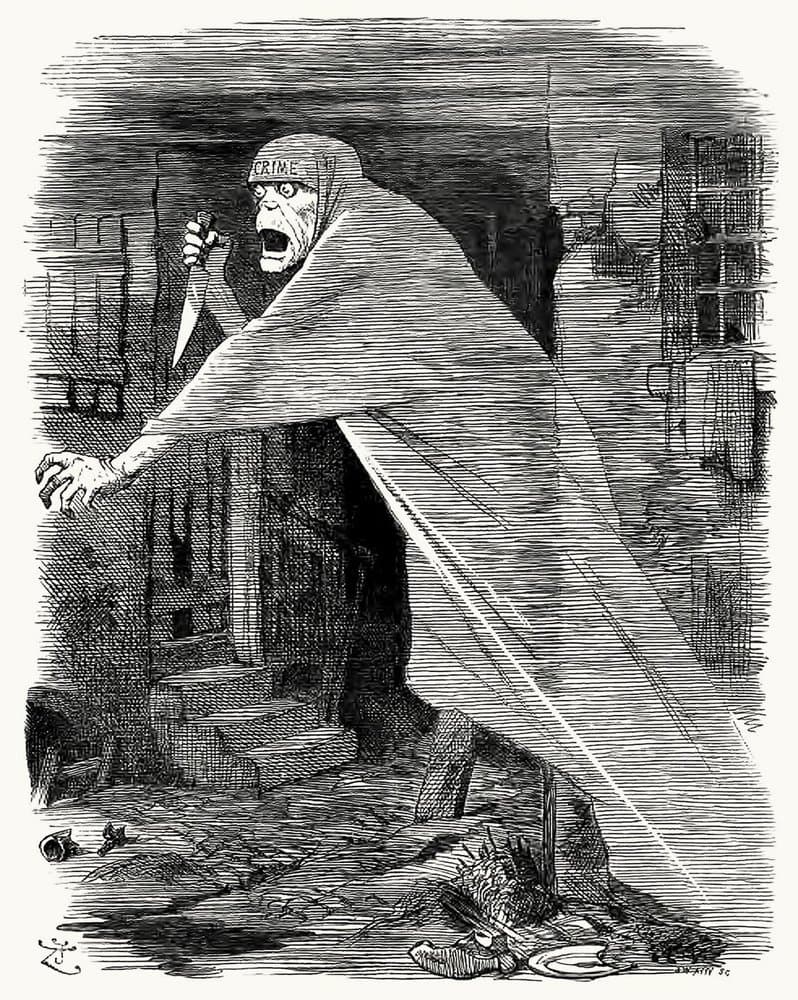
John Tenniel, The Nemesis of Neglect (Punch, September 29, 1888) : the phantom of the murderer emerging from the squalor of Whitechapel
On the doorstep of the City, Whitechapel crammed nearly eighty thousand residents into a maze of unlit alleys, narrow passages, and unsewered courtyards, hemmed in between the docks, the slaughterhouses, and the tanneries: a killer could strike there in the dark and reach the crowd of a thoroughfare in a few seconds. Stevedores and day laborers rubbed shoulders with Jewish immigrants fleeing the pogroms of the Russian Empire. Whoever had no housing rented a bed by the night in a lodging-house; whoever had no fourpence slept outdoors.
In October 1888, the Metropolitan Police estimated that the district had 1,200 prostitutes and 62 brothels. The word stuck to the five victims. What they shared was simpler: four of them were in their forties, a broken marriage or widowhood, alcohol, and nights spent searching for enough to pay for a bed.
In 2019, historian Hallie Rubenhold showed that for three of the five, nothing proves they engaged in prostitution: Mary Jane Kelly lived by it, and Elizabeth Stride had done so in the past, without anyone knowing whether she had returned to it. Her thesis is debated, but she restored to the five a life before: Annie Chapman had married a gentleman's coachman and lived on an estate near Windsor, Catherine Eddowes roamed the country writing and selling ballads, Elizabeth Stride had run coffee houses in Poplar with her husband. And she shifts the question: three of them frequently slept on the street, for lack of money for a lodging-house.
Five Lives, Ten Weeks
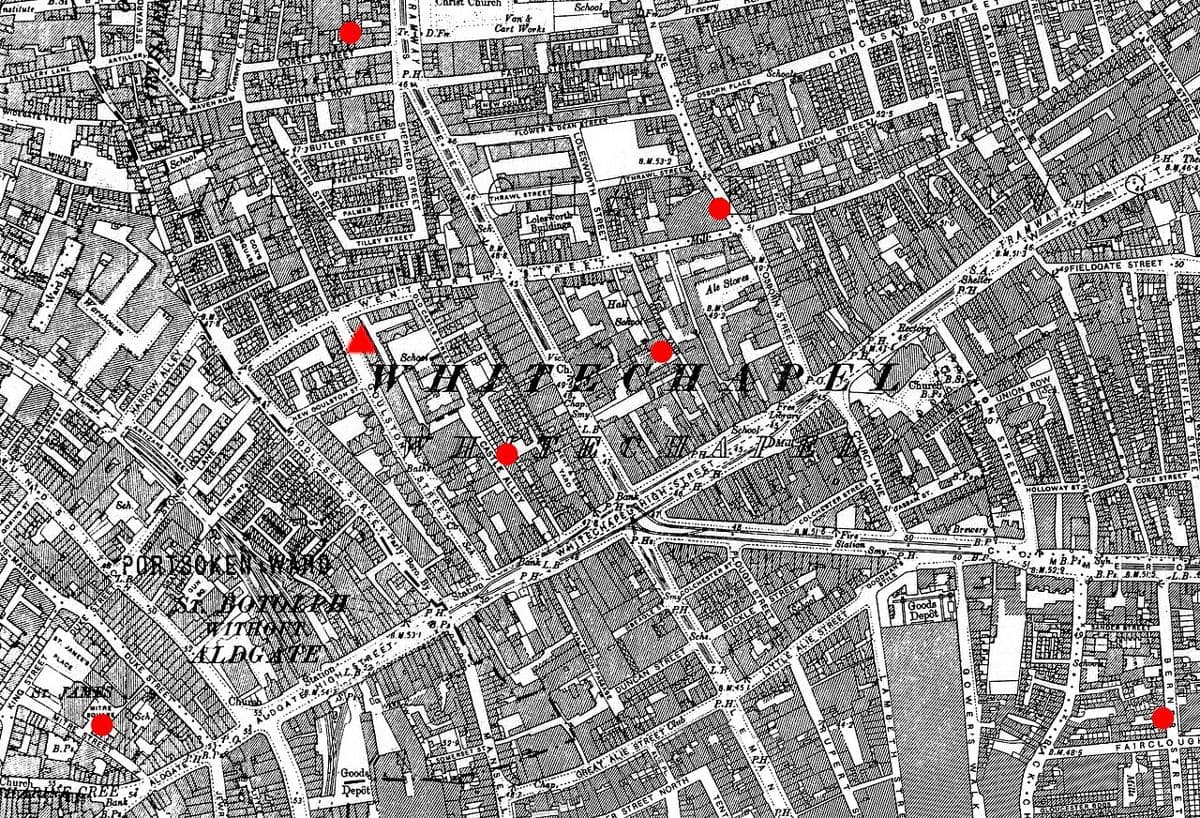
Whitechapel on the 1894 Ordnance Survey map : the six red dots mark six murders of women in Whitechapel, including only three of the five canonical victims (Buck's Row and Hanbury Street lie off-map), and the triangle marks the site of the Goulston Street graffito
Ordnance Survey, public domain (annotations added)
Mary Ann Nichols was the mother of five children. Her husband, separated from her for more than eight years, told the coroner she drank and that he had given up taking her back; she was 43 years old. She had known the Lambeth workhouse, then a position as a domestic servant in Wandsworth, left while taking stolen clothes. Her killer cut her throat and slashed her abdomen.
Annie Chapman was 47 years old. The widow of a coachman, she did crochet work and sold flowers, according to a friend. The surgeon who examined her found her suffering from advanced disease of the lungs and membranes of the brain, and noted "signs of great deprivation": she had been poorly fed. Shortly before two o'clock on September 8, she left her Dorset Street lodging-house for lack of money: "I have not any money now, but don't let the bed; I will be back soon." At daybreak, she was found in the backyard of 29 Hanbury Street; the killer had carried away the uterus.
Elizabeth Stride, 44 years old, was born near Gothenburg and had lived in London for more than twenty years. She said she did cleaning "among the Jews" of the neighborhood and said she had lost her husband in the sinking of the Princess Alice on the Thames. On September 30, around one in the morning, the manager of a working men's club entered Dutfield's Yard with his cart, and his horse shied before her. Her throat was cut and she still held a packet of breath cachous in her left hand. The killer, likely disturbed, did not mutilate her.
Catherine Eddowes, 46 years old, was returning from the Kent hop fields with her partner, John Kelly, who had pawned his boots to buy tea and sugar. The previous evening, an officer had picked her up drunk on an Aldgate sidewalk. Released around one in the morning under a false name, she called out to the jailer: "I shall get a d----- fine hiding when I get home." At 1:44 a.m., an officer discovered her in Mitre Square, in the jurisdiction of the City, her face slashed, the left kidney carried away. Her daughter had not seen her for more than two years.
Two women killed in less than an hour, about a kilometer from each other; the name comes from the "Saucy Jacky" postcard, received the next day
Mary Jane Kelly was about 25 years old. She said she was born in Limerick, grew up in Wales, and married a miner there at sixteen, killed a year or two later in an explosion. She was the only one to rent a room, at 13 Miller's Court, and owed 29 shillings in rent. Shortly before midnight, a neighbor wished her good night; Mary Jane answered that she was going to sing, and was still singing a quarter of an hour later. On November 9, between half past ten and a quarter to eleven, the man sent to claim the rent looked through a broken pane and first saw two pieces of flesh lying on the table. Behind a closed door, the killer had had all his time: it is the most mutilated body of the series.
After Miller's Court, the series stopped. Yet the police file brings together eleven women killed in the district or nearby between April 1888 and February 1891, without anyone knowing which were the work of the same man. Before the five, Emma Smith, assaulted on the night of April 3, 1888, had said she was attacked by two or three men; Martha Tabram, on August 7, had received thirty-nine stab wounds.
After them, Rose Mylett, found on December 20, 1888, whom four doctors considered murdered and the head of the criminal investigation department, Robert Anderson, hanged by accident; Alice McKenzie, on July 17, 1889, killed with a shorter blade, of whom the coroner said that "if the same person has not committed this crime, it is clearly an imitation of the other cases"; a woman whose torso alone was found on Pinchin Street on September 10, 1889, never identified; Frances Coles, on February 13, 1891, whose suspect, James Sadler, was released for lack of evidence. Each carries the reason why we cannot count: a gang, an imitation, a nameless body.
"Yours Truly, Jack the Ripper" :A Name from a Newsroom
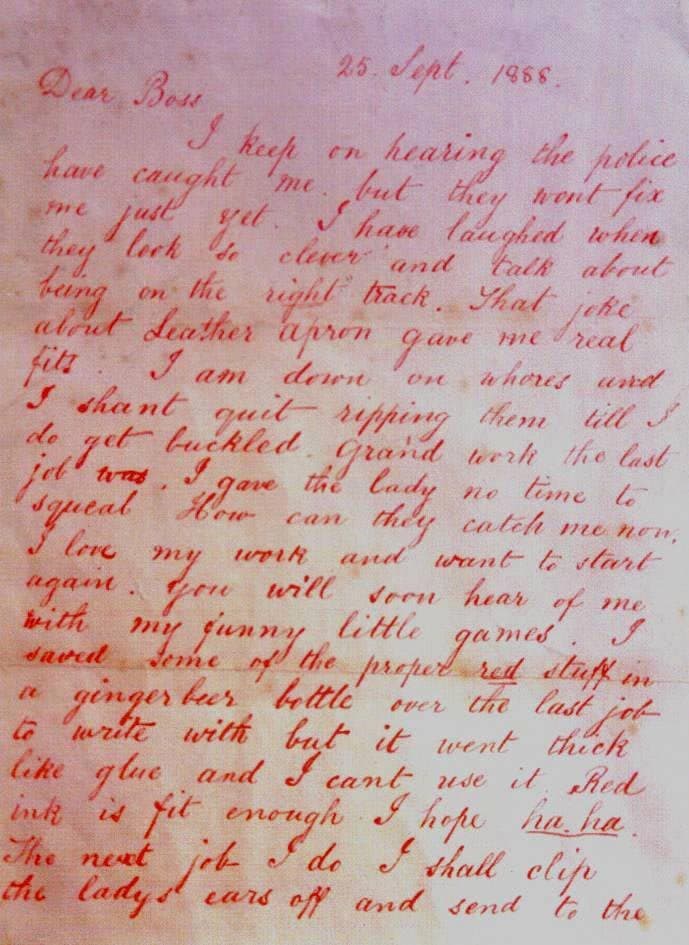
The "Dear Boss" letter, received by the Central News Agency on September 27, 1888
The National Archives (Kew), public domain
On September 27, 1888, between the second and third murders, London's Central News Agency received a letter in red ink. It opened with "Dear Boss" and closed with a signature that would circle the earth:
On October 1, a postcard in the same handwriting, signed "Saucy Jacky," claimed responsibility for the "double event" of the day before. Several police officers on the investigation considered the letter a hoax, written by a journalist to sell papers. In 2018, a linguistic analysis by Andrea Nini concluded that the two texts that created the character of Jack the Ripper were very likely by the same author; it does not say who.
On October 16, George Lusk, chairman of the local vigilance committee, received in the mail a box containing half a human kidney preserved in alcohol, with a letter beginning with "From hell": its author claimed to have fried and eaten the other half. The link to Catherine Eddowes was never established. The newspapers published the letter and the postcard. The faceless killer now had a voice and a signature, which others had perhaps lent him.
Preserved in the Metropolitan Police files at the British National Archives; only one, "Dear Boss," gave the killer his name
A Police Force Without Fingerprints, a District Looking for Someone to Blame
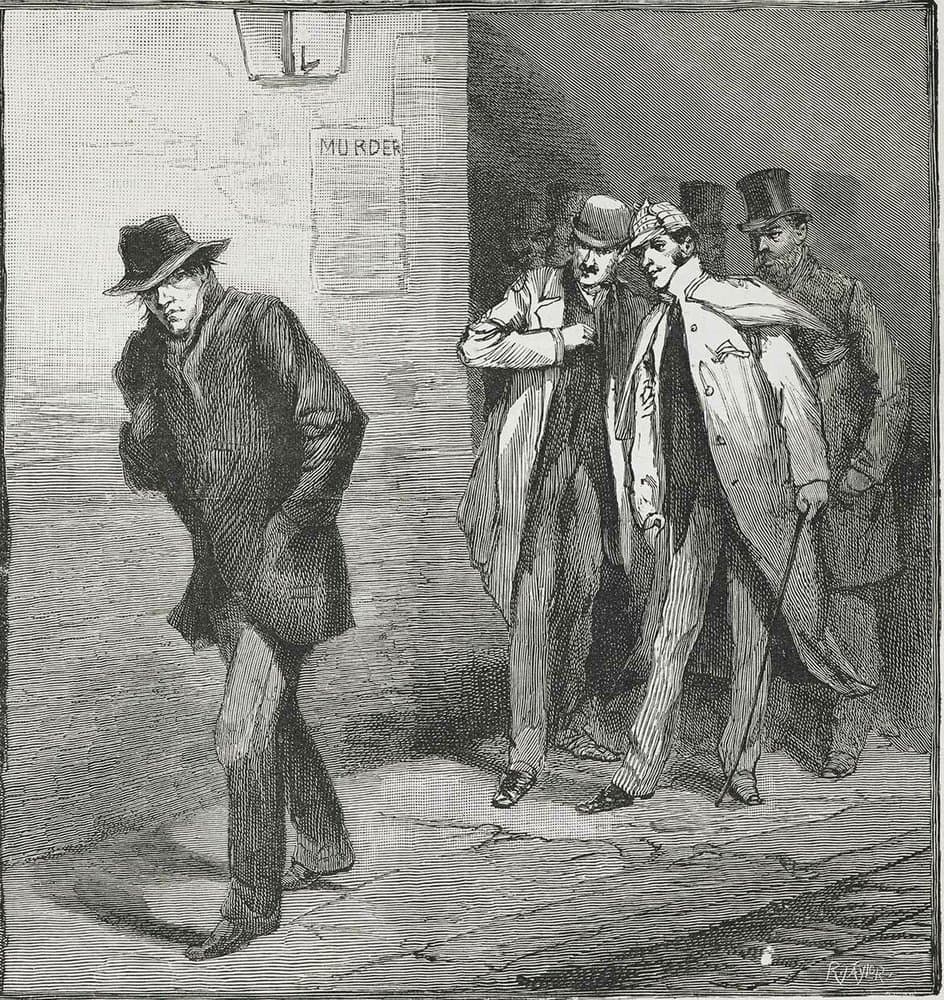
Night patrol of the Whitechapel Vigilance Committee hunting for a suspect (The Illustrated London News, October 1888)
Coroner Wynne Baxter, in charge of the inquests on Mary Ann Nichols, Annie Chapman, and Elizabeth Stride, attributed a scholarly motive to Annie's death: an American had supposedly offered twenty pounds apiece to the sub-curator of a pathology museum for specimens of the removed organ. On the victim, he had only one sentence: "She had evidently lived an immoral life for some time." The magistrate who imagined a scholarly sponsor summarized the life of a malnourished sick woman in a single moralizing line.
Meanwhile, shopkeepers formed a vigilance committee around George Lusk that patrolled at night. The night of the double murder, in Goulston Street, an officer found a piece of Catherine Eddowes's apron under a chalk inscription: "The Juwes are The men That Will not be Blamed for nothing" ("The Jews are the men who will not be blamed for nothing"). That was the reading of Constable Alfred Long; City Detective Daniel Halse read "The Juwes are not the men who will be blamed for nothing," and other contemporary copies diverged further: depending on the place of the not, the sentence accused or exonerated.
Fearing antisemitic riots, the head of the Metropolitan Police, Sir Charles Warren, had it erased at 5:30 a.m., without waiting for the photographer. Before the coroner, Halse testified under oath that "the fear on the part of the Metropolitan police that the writing might cause riot was the sole reason why it was rubbed out." The body lay in the City, the inscription was in metropolitan territory: the only writing perhaps chalked by the killer was destroyed by the police that did not have the body.
The doctors agreed no better. For Dr. Frederick Gordon Brown, who examined Catherine Eddowes, the killer "must have had a good deal of knowledge as to the position of the abdominal organs, and the way to remove them." On November 10, 1888, Dr. Thomas Bond concluded the opposite in his report: "in each case the mutilation was inflicted by a person who had no scientific nor anatomical knowledge," and he described "a quiet inoffensive looking man probably middleaged." Three authorities read the same wounds and delivered incompatible conclusions: no profile could ever hold.
Nothing, then, allowed a crime scene to speak. The two police forces, the metropolitan and that of the City, each investigated on their own; Scotland Yard would not create its fingerprint bureau until July 1901, under the impetus of Edward Henry, and it was only in that same year that the German biologist Paul Uhlenhuth would invent the test making it possible to distinguish human blood from animal blood in a district full of slaughterhouses.
In 1888, no one could yet distinguish human blood from that of a slaughterhouse ox
Over a Hundred Suspects, and a Memo That Settled the Count
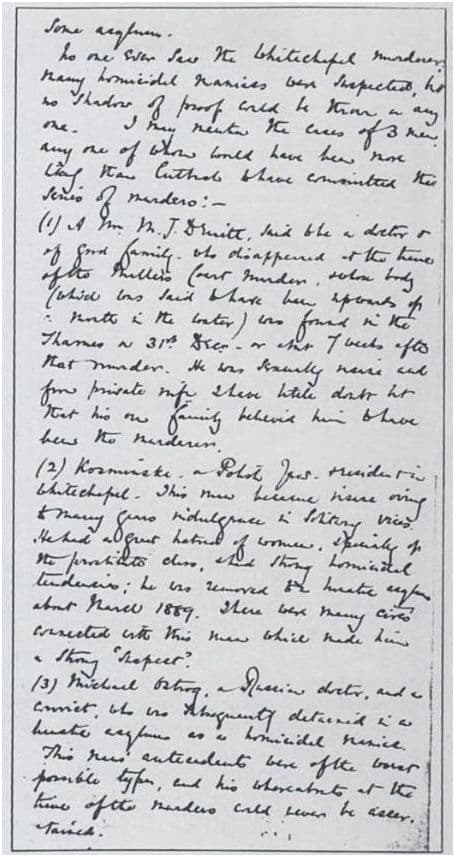
A handwritten page of the Macnaghten Memorandum (1894) : the three numbered suspects, "Mr M. J. Druitt," "Kosminski, a Polish Jew," and "Michael Ostrog"
Metropolitan Police, public domain
In 1894, in a confidential memorandum, Melville Macnaghten, assistant chief constable of the CID, wrote that the Whitechapel murderer had "5 victims – & 5 victims only." The canon comes from there. He named three suspects: Montague John Druitt, a 31-year-old lawyer pulled from the Thames in late December 1888, whom his family believed guilty; Aaron Kosminski, a Polish Jewish barber from Whitechapel, committed in 1891; Michael Ostrog, a Russian swindler whom historian Philip Sugden showed was imprisoned in France in 1888, during the series of murders.
Since then, Ripperologists have put forward more than a hundred names, up to Queen Victoria's physician, her grandson, and the painter Walter Sickert. In 2019, Jari Louhelainen and David Miller believed they had closed the case in the Journal of Forensic Sciences from the mitochondrial DNA of a shawl attributed to Catherine Eddowes and compared with descendants of Eddowes and Kosminski. But nothing proves that this shawl came from Mitre Square, and mitochondrial DNA is shared by an entire maternal line. The science of 2019 produced what the press of 1888 produced: one more name, not a proof.
None has ever been charged with these five murders
What They Left Behind
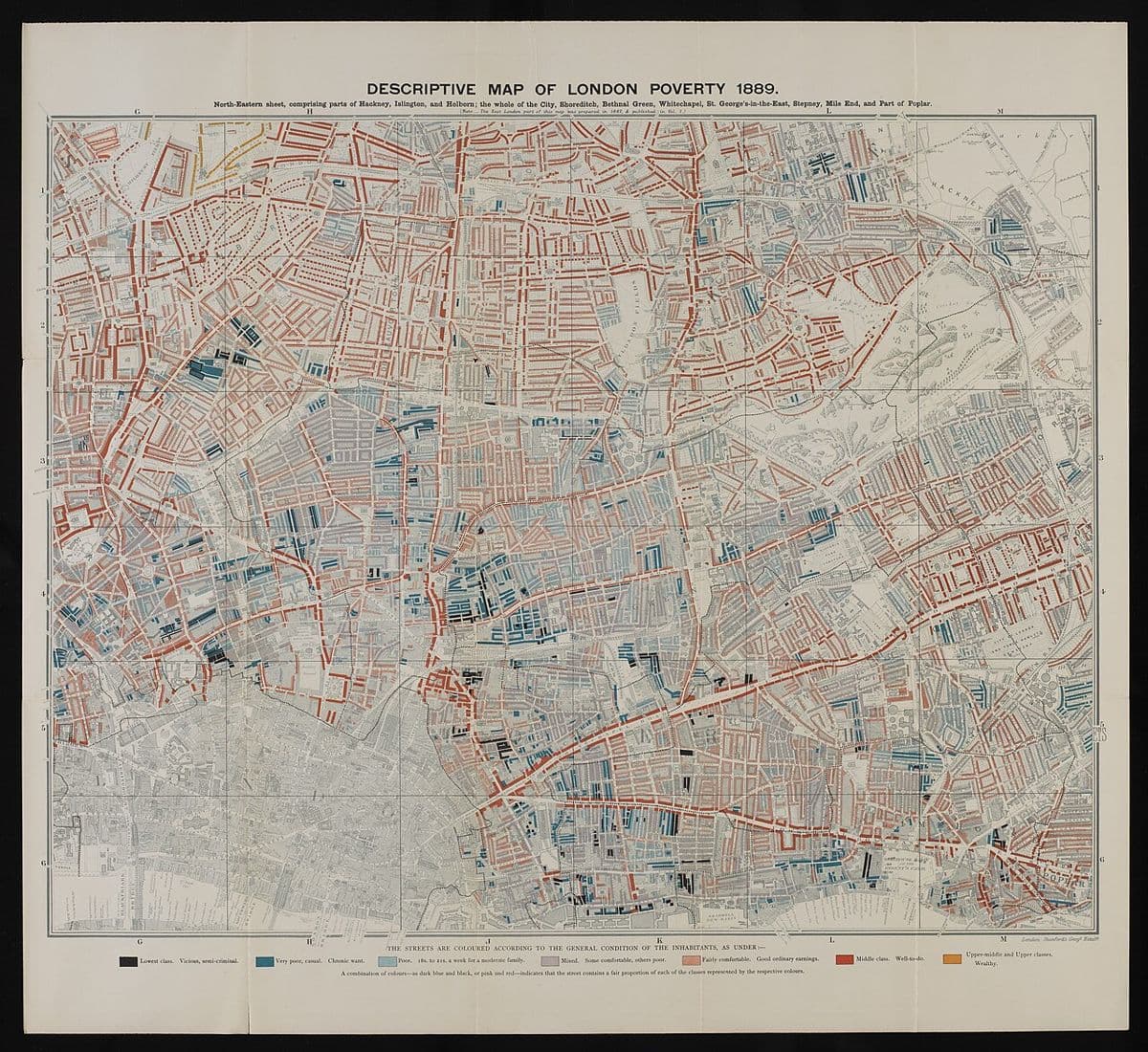
Charles Booth's London poverty map of 1889 (North-Eastern sheet) : each street is color-coded by the condition of its inhabitants, from black for the most destitute to yellow for the wealthy; Whitechapel concentrates the blues and blacks
Wellcome Collection, CC BY 4.0
On September 24, 1888, even before the double murder, George Bernard Shaw quipped in The Star: while Social Democrats were wasting their time educating, an "independent genius," by disemboweling four women, had converted the press to "an inept sort of communism." The murders put the East End before the eyes of London. In 1890, Parliament passed the Housing of the Working Classes Act, the worst slums fell, and the Old Nichol gave way in 1900 to the Boundary Estate, one of the capital's first public housing developments.
Yet the legend took the place of the women. In 2015, an East End museum announced to tell the history of women opened dedicated to Jack the Ripper; its architect denounced "salacious, misogynist rubbish." In 2019, when Hallie Rubenhold's book on the five lives received the Baillie Gifford Prize, the historian was taken to task by Ripperologists.
They died with their throats cut at the end of lives no one had looked at, and it was their killer's moniker the world remembered.
One hundred and thirty-eight years later, the man still has no face; they still have names: Mary Ann, Annie, Elizabeth, Catherine, and Mary Jane