In the H. H. Holmes case file, a single pair of objects tells almost the whole story: a little spinning top and a tin man, bought at the Chicago World's Fair by a father for his son, found in the summer of 1895 inside an empty house in Irvington, near Indianapolis. That is the only trace of the great 1893 Exposition anywhere in the investigation. The boy's name was Howard Pitezel, and his teeth were in the chimney.
Legend remembered something else: a labyrinthine hotel built near the fairgrounds, gas chambers, trapdoors, chutes leading down to a crematorium, two hundred tourists swallowed whole. The archives describe a man less theatrical and more ordinary in his cruelty. Holmes did not hunt strangers: he killed out of his address book. A mistress and her young daughter, a secretary, two sisters, a business partner and three of his children—dead because they were worth money or because they knew too much.
And it was not a murder investigation that got him arrested. It was an insurance company that wanted its check back.
Eight confirmed murders and one probable, versus 27 claimed in a confession sold to the newspapers
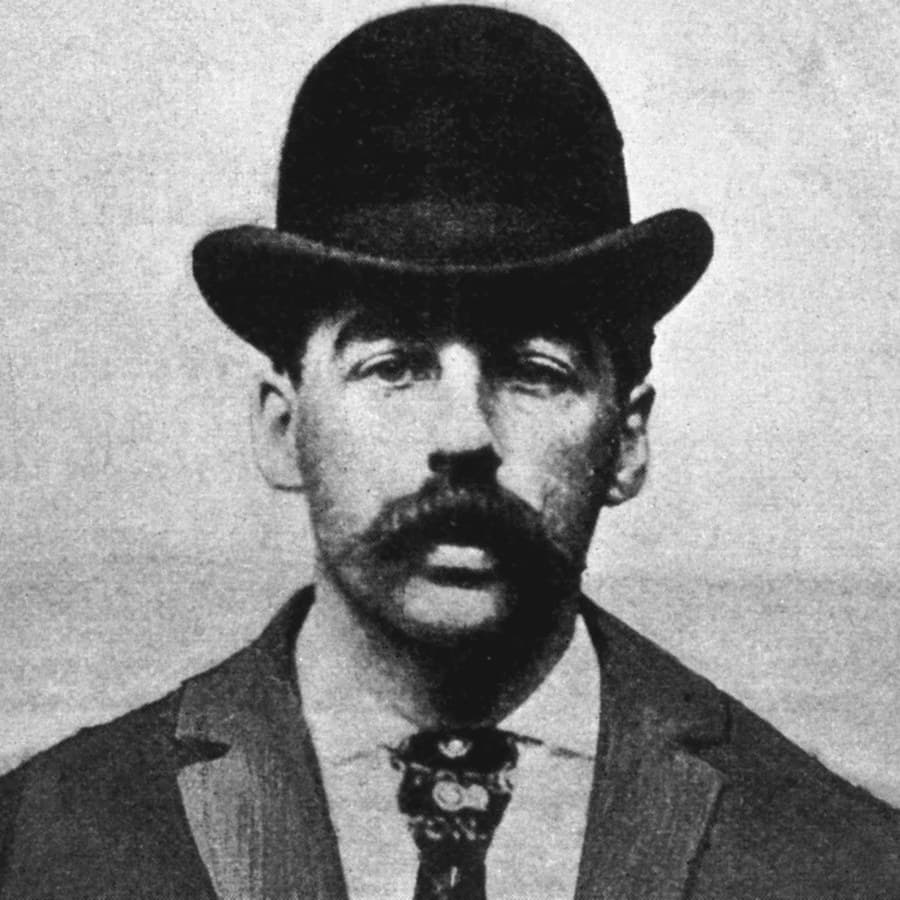
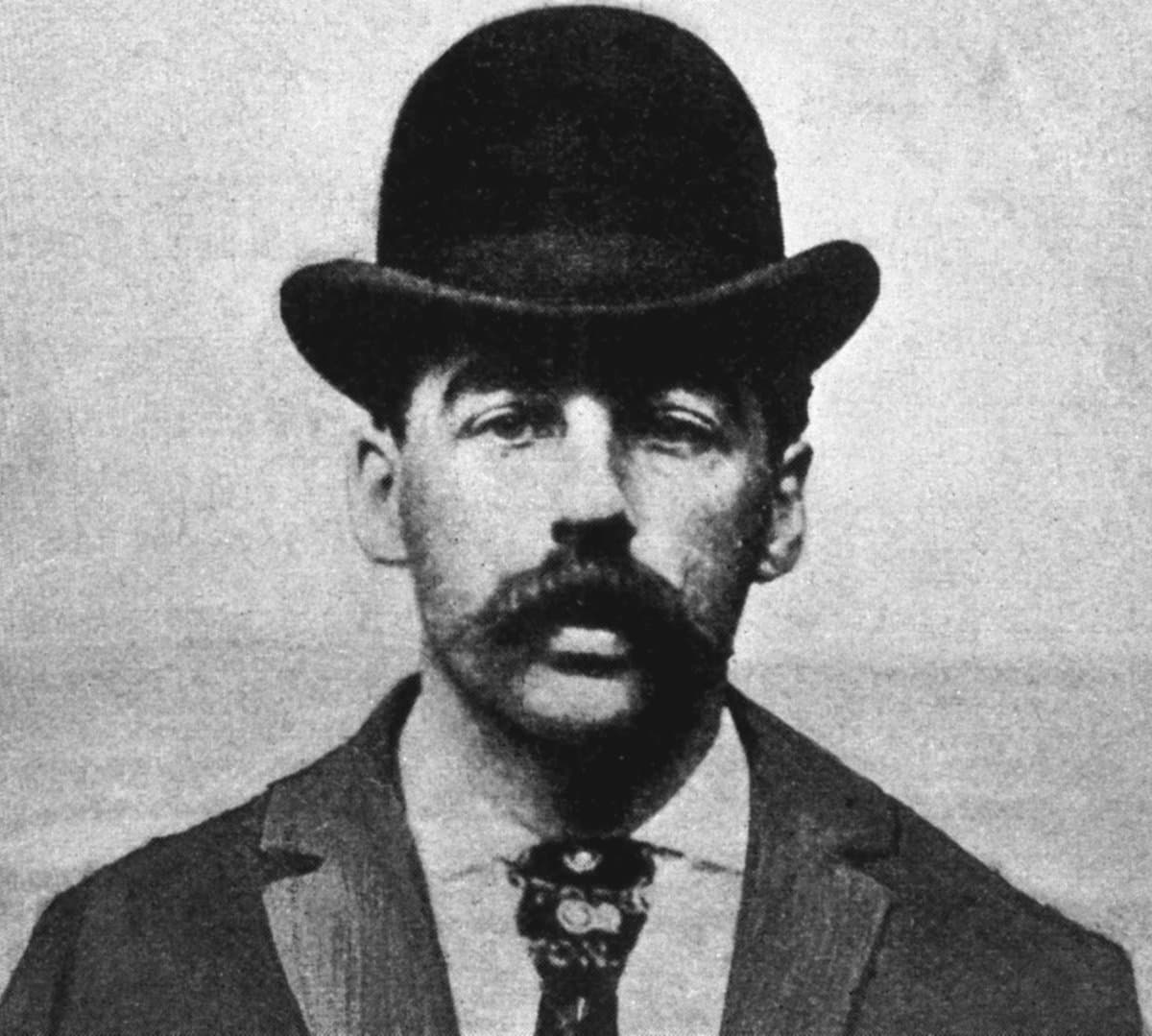
H. H. Holmes during his incarceration in Philadelphia in 1895
Police mugshot of Herman Webster Mudgett, alias H. H. Holmes, taken in Philadelphia in 1895.
A Castle Full of Unpaid Furniture
The con man started out in a white coat. After graduating from the University of Michigan medical school in 1884, he would later admit that even as a student he had defrauded insurance companies using cadavers. In 1886, he arrived in Chicago, began calling himself Holmes, and took a job at Elizabeth Holton's drugstore in the Englewood neighborhood. Eventually he bought the business.
Across the street, starting in 1887, he had a building put up: two stories at first, with shops on the ground floor and apartments rented by the year above. Yet Holmes paid nobody: as early as 1888, the architects and a steel supplier sued him, and construction bogged down in disputes with the builders.
In 1892, he added a third floor, pitched to investors as a hotel for the upcoming World's Fair. According to historian Adam Selzer, that floor was never finished, never furnished, and never opened to the public. The famous secret rooms, on the other hand, really did exist: they were used to hide from creditors the furniture he had bought on credit and had no intention of paying for. The Murder Castle was first and foremost a storage locker for swindled suppliers.
The gas chambers, chutes, and crematorium came out of the sensationalist press of 1895, and not one of them survives the case file. What remains is colder: Holmes really did trade in skeletons, and a Chicago skeleton articulator admitted having mounted three of them for him. As for the two hundred tourists, they come from no investigation; there is no evidence that he ever murdered a single Exposition visitor inside his walls.
The legend enjoyed a second youth more than a century later. In 2003, Erik Larson published The Devil in the White City, weaving together the building of the World's Fair and Holmes's crimes; in hardcover and then paperback, the book spent more than three years on the New York Times bestseller lists. Newsweek critic Malcolm Jones pointed out that the chapters describing the murders are "merely conjecture built on a handful of facts"—something the author acknowledges only in the back-of-the-book notes. It is through that narrative, far more than through the court record, that most readers today have met Holmes.
The building itself was damaged by fire in August 1895, at the height of the press frenzy. Even so, it outlived its own legend and remained standing until it was torn down in 1938.
Damaged by fire in August 1895, the building remained in use for more than forty years
The People Who Trusted Him
Julia Conner had an affair with Holmes; her husband left, and she kept their daughter, Pearl. Mother and child vanished at Christmas 1891. Holmes would give several versions of what happened, before claiming that Julia had died during an abortion he was performing and that he had poisoned the little girl. The remains of a child were later found in his cellar.
Emeline Cigrand, aged twenty-three, became his secretary in May 1892. In December, she vanished. Her family was told she had gone off to marry a certain "Robert Phelps."
Minnie Williams, a former actress, owned land in Fort Worth, Texas. Holmes hired her as a stenographer, then had her sign the deed over to one "Alexander Bond," one of his aliases. In July 1893, right in the middle of the World's Fair, her younger sister Nannie wrote that she was leaving for Europe with "Brother Harry"—Holmes, as the two sisters called him. Neither sister was ever seen again; Holmes, for his part, kept using Minnie's name in future swindles.
The pattern never varied. They entrusted him with their work, their lives, or their property; then they vanished, and Holmes always had a story ready for the families.
Benjamin Pitezel, a $10,000 Corpse
Benjamin Pitezel was Holmes's accomplice in his swindles, and he drank. In 1894, the two men set up their biggest score yet: insuring Pitezel's life for $10,000 with the Fidelity Mutual Life Association of Philadelphia, and then faking his death. Pitezel set up shop at 1316 Callowhill Street under a patent dealer's sign in the name of "B. F. Perry."
Holmes decided it was simpler to make the death real. On September 2, 1894, he killed his partner and burned the body to make it look like an accident. The corpse was found two days later; the coroner's physician smelled chloroform in the stomach, yet the unknown man was buried as "Perry" in the potter's field. His fourteen-year-old daughter Alice was brought to Philadelphia to identify her father's exhumed body. The insurer paid out, and a lawyer collected the money on the family's behalf.
The company paid out $9,715.85 to the family's lawyer before suspecting fraud
What brought Holmes down was not a corpse: it was his tongue. Jailed for a few days in St. Louis over another swindle, he had outlined his scheme to a train robber named Hedgepeth, who tipped off the authorities by letter. The insurance company had its own detective department, hired the Pinkertons, and on November 17, 1894, Holmes was arrested in Boston—on a telegram from Fort Worth charging him with horse stealing.
Facing the insurer's representative, Holmes threw up his hands: he guessed he was wanted in Philadelphia by Fidelity, and not in Texas "for the horse business." He had no desire to revisit Fort Worth, where, as Detective Frank Geyer would note, horse thieves and swindlers received "much more peremptory" attention from the local populace. Given the choice between the insurance company and a lynching, he chose the insurance company. In June 1895, he pleaded guilty to fraud. At that point, the Pitezel case was still a matter of money, and nobody was yet looking for three children.
The Letters That Were Never Mailed
We have to rewind to before the arrest. In the autumn of 1894, Holmes had persuaded Carrie Pitezel to entrust him with three of her five children—Alice, Nellie, and Howard. For weeks, he trailed them from Cincinnati to Indianapolis, from Detroit to Toronto, while their mother traveled separately with the baby and the eldest daughter, lodged at different addresses without ever crossing paths with them.
The girls wrote letters. Nellie had seen "two great big ostriches alive" and asked why buffaloes had big rings in their noses. Alice had just finished Uncle Tom's Cabin, "a nice book." In Indianapolis, a hotelkeeper who spoke no English frequently found them crying in their room; she assumed they were orphans. The children gave their letters to Holmes to mail. When he was arrested, ten or twelve of them were found inside a tin box.
In June 1895, the district attorney sent a Philadelphia police detective, Frank Geyer, to find the children. He retraced the journey city by city, photograph in hand, from one hotel register to the next; his book would speak of "nine hundred clues" run out. On July 15, in Toronto, in the cellar of 16 St. Vincent Street, he dug up Alice and Nellie. In the confession he later sold to the newspapers—the very same confession in which several "dead" victims turned out to be alive and well—Holmes said he had locked them inside a large trunk connected to a gas line.
On August 27, in Irvington, he took apart the base of a chimney and sifted the soot through an old fly screen. Out came an almost complete set of teeth and a piece of jawbone. Carrie Pitezel identified her son's overcoat, which she had mended, and then the spinning top and the tin man she had packed into the children's trunk with her own hands.
Twenty-Seven Murders, Wholesale Price
The trial opened in Philadelphia in October 1895, and it covered only the murder of Benjamin Pitezel. Holmes was found guilty and sentenced to death. All he had left to sell was his most valuable asset: his story.
The Hearst newspapers bought it from him for $7,500. In it, Holmes claimed twenty-seven murders across Chicago, Indianapolis, and Toronto, plus six attempted murders. A few of them were checked: some of the "dead" were in fine health, including one Kate Durkee. Less than $300 a murder, resurrections included. In prison, he also wrote: "I was born with the devil in me."
Paid by the Hearst newspapers for 27 claimed murders, several of whose "victims" were still alive
On May 7, 1896, at Moyamensing Prison, the devil changed his story. On the scaffold, Holmes declared himself innocent of the deaths of the entire Pitezel family. He admitted only to two women who had died as the result of a "criminal operation" at his hands; newspapers named Julia Conner and Emeline Cigrand. Twenty-seven murders when he was being paid for them, two for free, and not the one for which he was being hanged.
Neck unbroken, convulsions for about ten minutes, death pronounced fifteen minutes after the trap was sprung, according to the Pottsville Republican of May 7, 1896; other papers that same day wrote the opposite
He was afraid of body snatchers. His coffin was embedded in concrete, ten feet underground, at Holy Cross Cemetery in Yeadon. The man who had skeletons mounted for sale took care that nobody would ever sell his. Rumors that he had escaped execution persisted for more than a century, until 2017: at the request of his descendants, a team from the University of Pennsylvania Museum exhumed the grave, and his teeth confirmed it was indeed him.
What the Legend Erased
The castle has its legend, its trapdoors, and its ghosts by the hundreds. The victims barely get a line. Their names were Julia and Pearl Conner, Emeline Cigrand, Minnie and Nannie Williams, Benjamin, Alice, Nellie, and Howard Pitezel.
Holmes also has his title: "America's first serial killer." No court and no historian ever bestowed it on him; the label has circulated at least since 1994, as the subtitle of a paperback by Harold Schechter, Depraved, published a century after the events. A reference encyclopedia in 2024 calls him the first only "arguably," and only among "well-documented" killers. Historian Adam Selzer, who attributes at least nine deaths to him, sees the murder of Julia Conner not as bloodlust, but as a "necessary part" of his swindles.
What doomed his victims was not a labyrinth: it was trust, in a country where a man could change his name at every train station. What doomed him was an insurer counting its dollars, a train robber who talked too much, and a detective who followed, city after city, the trail of three children.
HHHolmes never ran a labyrinth hotel for World's Fair tourists: this con man killed at least eight people who trusted him—for property, an insurance policy, or silence—and it was an insurance company, not a murder investigation, that had him arrested