Dying of a broken heart is not a figure of speech. It is a diagnosis, with its own code in the US classification of diseases (I51.81, Takotsubo syndrome, named after the narrow-necked, round-bottomed Japanese pot used to trap octopuses): bad news hits, the nervous system floods the heart with adrenaline, and the tip of the left ventricle stops beating.
BROKEN HEART SYNDROME: WHEN A SIMPLE BREAKUP DEFORMS THE LEFT VENTRICLE INTO AN OCTOPUS TRAP
What the patient feels looks point for point like a heart attack: the chest gripped in a vise, shortness of breath, an electrocardiogram that sets emergency doctors scrambling. What it says about us is more unsettling. The mechanism meant to save us from a predator is the very one that knocks us flat. The brain makes no distinction between a big cat, a court summons, the death of a spouse, or a speech in front of a crowd: it hits the same big red button.
Yet since you are neither going to sprint away nor strangle the person who just dumped you, that tide of hormones has nowhere to go except into your own heart muscle. That is where the irony turns lethal. You can run half-marathons on Sundays, worship steamed vegetables, and have coronary arteries as clear as a German autobahn at three in the morning: none of it will protect you.
Takotsubo strikes mainly women, most often after menopause. It is no theatrical fainting spell: it kills in the hospital, and it still kills years later. Most patients survive it, and grief is not its leading trigger; yet a bereavement can set it off, and it can kill: that is all the headline claims, and that is what has been proved. Fear keeps its own stopwatch, from the moment the news breaks to the years that follow.
The trigger :a bereavement, a party, or nothing at all
News of a death. An armed robbery. A car crash, a court appearance, fear of public speaking, a surprise party. Those were the shocks a Johns Hopkins team recorded in 2005 among its nineteen patients for a study in the New England Journal of Medicine.
The surprise party is not a typo. Heart muscle does not read context; it gauges only intensity. The international registry has cataloged hearts broken by happiness: a birthday party, a wedding, the birth of a grandchild, a win by a favorite rugby team. People who survived forty years of bosses, mortgages, and in-laws, and whose hearts deform with joy, in the clinical sense of the term, at the exact moment everyone yells "Surprise!"
Twenty cases out of 485 in the international registry, including a surprise farewell party: according to the authors, joy and grief may travel down the same pathways
Even so, grief does not come first. In the registry's landmark 2015 study, physical stress preceded more cases than emotion: surgery, acute illness, a body already pushed to its limit.
Triggers of Takotsubo Syndrome (InterTAK Registry, NEJM 2015)
%And in more than a quarter of patients, doctors find nothing at all. No bereavement, no firing, no earthquake, no winning lottery ticket — at least nothing anyone could identify. The brain simply decides, on a Tuesday morning in the pasta aisle of the supermarket, to unleash a chemical apocalypse and snap the octopus trap shut.
Grief also kills without going through the octopus trap, and that can be measured across an entire population. A study published in 2014 in the Journal of Public Health followed 12,316 married Americans aged 50 and older from 1998 to 2008. In the three months following the death of their spouse, widowers faced a risk of dying 1.87 times that of men who remained married; among widows, the increase (1.47) was not statistically certain, and by one year the gap had fallen back to 1.16. That is the widowhood effect. It counts deaths from all causes: nothing says how many of them are Takotsubo.
The first minutes :the tip of the heart goes dark
The phone rings at three in the morning. Within moments, the body drowns in its own stress hormones: among the Johns Hopkins patients, adrenaline and its cousins, the catecholamines, were circulating at seven to thirty-four times normal levels, two to three times higher than in victims of a severe heart attack.
The myocardium is studded with beta-adrenergic receptors, tiny antennas that pick up adrenaline and order the muscle to pump harder. Those antennas are more numerous at the apex of the heart than at its base: that is what a team measured in rat cells in 2012, and today it remains the strongest hypothesis to explain what happens next.
At ordinary doses, adrenaline speeds up the heart. At massive doses, the receptors switch pathways and brake. The apex freezes. It may not be a breakdown so much as a survival reflex: in rats, blocking that braking mechanism caused more animals to die. To avoid burning out in overdrive, the tip of the heart takes itself offline.
Meanwhile, the base, less densely equipped with antennas, never got the memo and keeps pumping frantically. Blood pools in the paralyzed apex, which balloons outward: the ventricle takes on the shape of an octopus pot. In severe forms, blood pressure collapses into cardiogenic shock, all without a single cubic millimeter of cholesterol blocking the smallest pipe. It is your own chemistry of dread strangling you from the inside.
Why women, and why after menopause? Suspicion falls on estrogens, which protect blood vessels and temper the effects of catecholamines. When the ovaries close up shop, the bulletproof vest disappears. Cardiologists remain cautious: according to a review published in Circulation in 2017, estrogen loss may play a facilitating role, nothing more.
The first hour :the catheter finds nothing
Joanie Simpson woke early one morning in 2016, in Texas, with a terrible backache. When she turned over in bed, her chest joined in. From a local emergency room, the former medical transcriptionist was airlifted to Memorial Hermann in Houston, where the team prepared to receive a patient showing every sign of a heart attack.
In the catheterization lab, doctors injected contrast dye into her coronary arteries and looked for the clot. "The artery was crystal clear. It was pristine," cardiologist Abhishek Maiti later recalled. So was the next one. The verdict: Takotsubo cardiomyopathy, a broken heart.
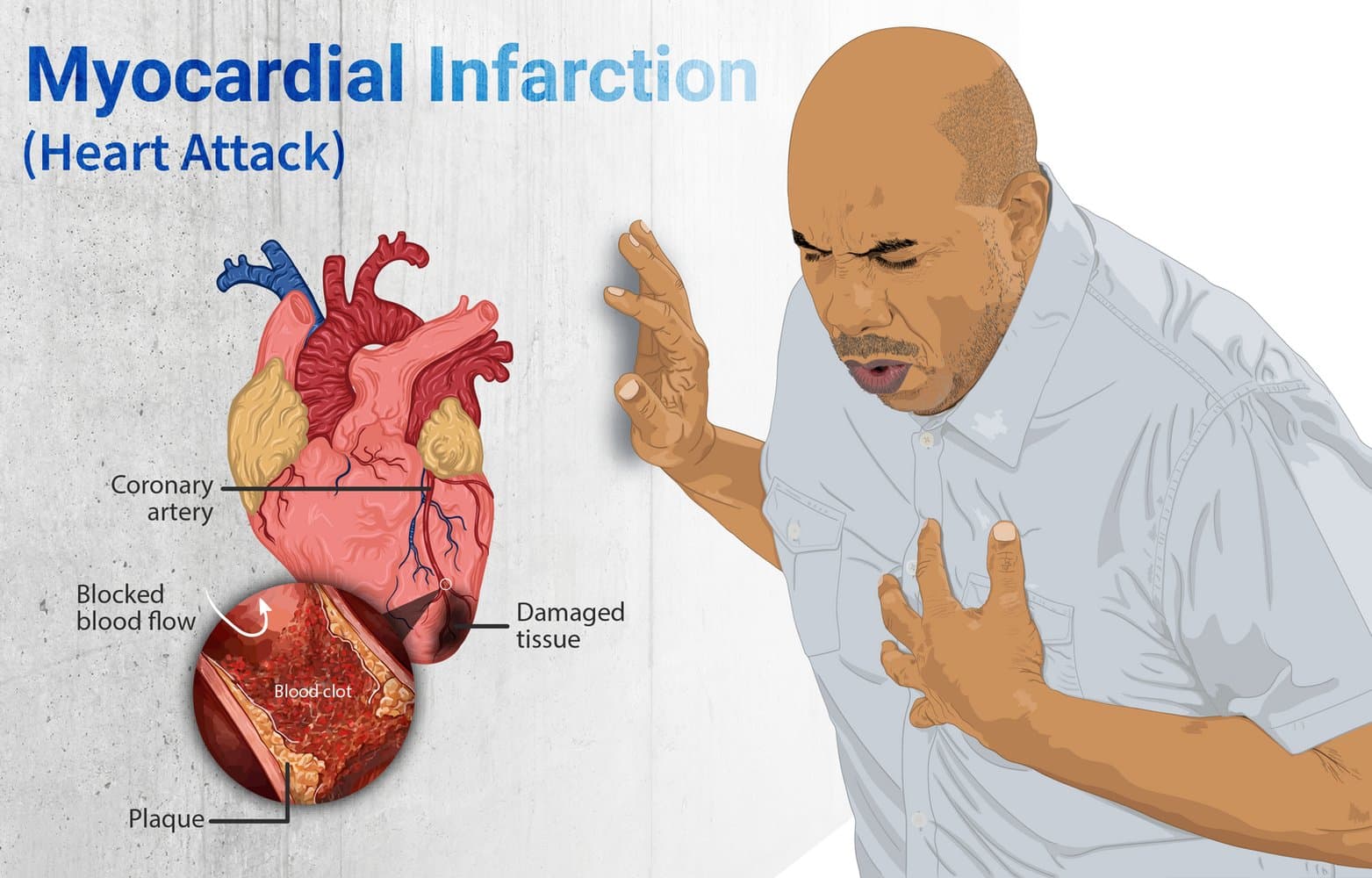
Classic heart attack : a coronary artery blocked by a clot, the very thing missing in Takotsubo
myupchar, Wikimedia Commons (CC BY-SA 4.0)
All that remained was to find the blow. Her son was facing back surgery, her son-in-law had just lost his job, and a property sale was dragging on endlessly. And Meha, her nine-year-old Yorkshire terrier — "our little girl" ever since the children had left home — was suffering from heart failure. Joanie had made an appointment to have her put to sleep, then canceled it because the dog seemed to be doing better. Meha died the next day.
The hospital days :a fake heart attack, a real death
Even when the catheter finds clean arteries, the patient is not out of the woods. In the international registry, severe in-hospital complications, including shock and death, are just as common as in patients of the same age and sex admitted for a classic heart attack. For some of those hearts deformed into an octopus pot, resuscitation fails.
Who is most at risk of a severe complication? Patients whose hearts gave way after a physical assault on the body rather than after grief, and those suffering from a neurological or psychiatric disorder. Such disorders are common among them: more than one in two patients has one, twice the rate seen in ordinary heart attack patients. And men: rare among cases, they are hit harder. In US hospitals between 2007 and 2012, when the syndrome was the primary reason for admission, men died of it more than three times as often as women (3.0% versus 0.9%).
Average age: 66.8 years. In the Johns Hopkins study, eighteen out of nineteen patients were women ⧉ [Templin et al., NEJM, 2015](https://doi.org/10.1056/NEJMoa1406761) · [Johns Hopkins, 2005](https://www.sciencedaily.com/releases/2005/02/050210235901.htm)
From 1942 to Hiroshima :an octopus pot in the chest
In Houston, the doctors knew what to call what they were seeing. Getting there took decades. In 1942, the American physiologist Walter Cannon published "'Voodoo' Death" in American Anthropologist: he gathered accounts from indigenous societies of men and women convinced they had been cursed or had broken a taboo, who sometimes died in less than a day, without wound or poison.
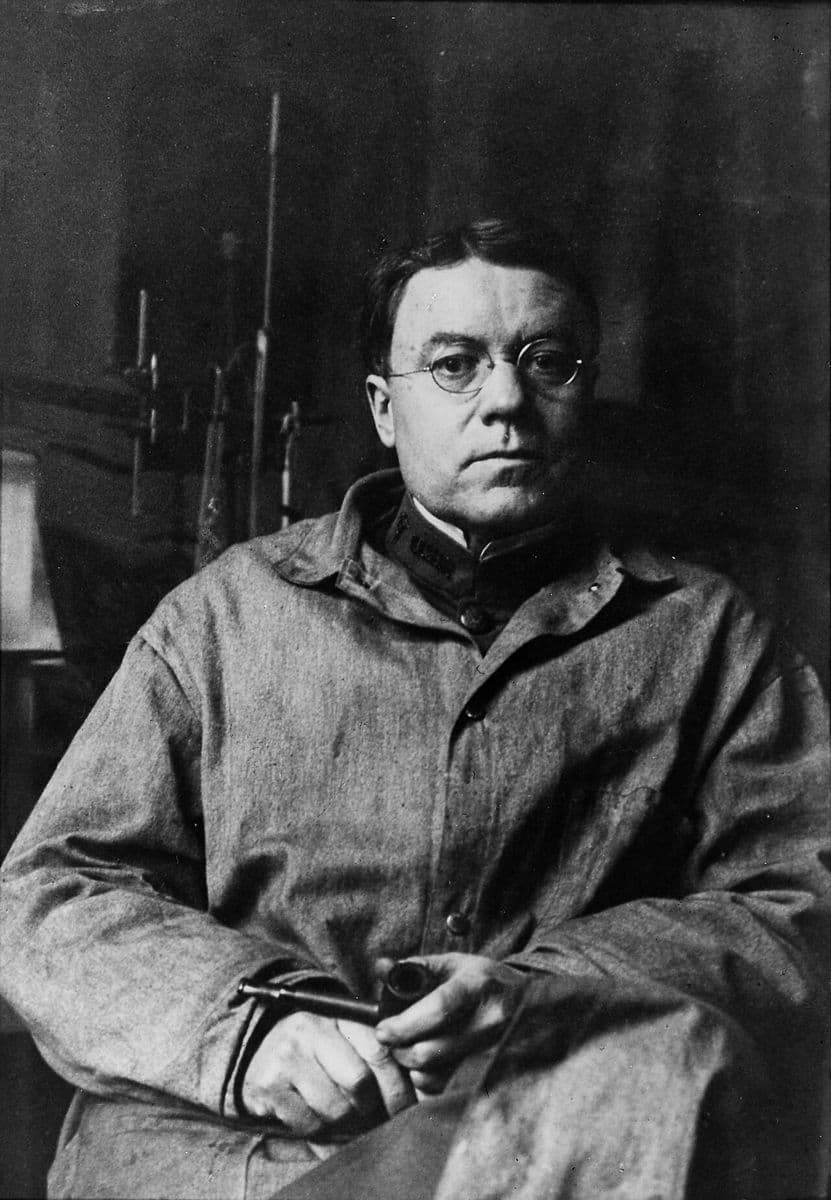
Physiologist Walter Bradford Cannon seated in a laboratory coat, pipe in hand, undated photograph
Wellcome Collection, CC BY 4.0
His explanation fits in a single sentence: fear acts through the sympathetic nervous system and the adrenal glands until blood pressure collapses. Pure fear kills. The medical community read the paper, nodded, and went back to unblocking arteries.
At Hiroshima City Hospital, one day in September 1983, a 63-year-old woman arrived with chest pain and an electrocardiogram pointing to a heart attack. Emergency catheterization was performed: no narrowed coronary artery, but a left ventricle with an unfamiliar silhouette. In 1990, Sato and his colleagues described the first Japanese cases and gave them that fisherman's name, tako-tsubo, after the shape of the ventricle.
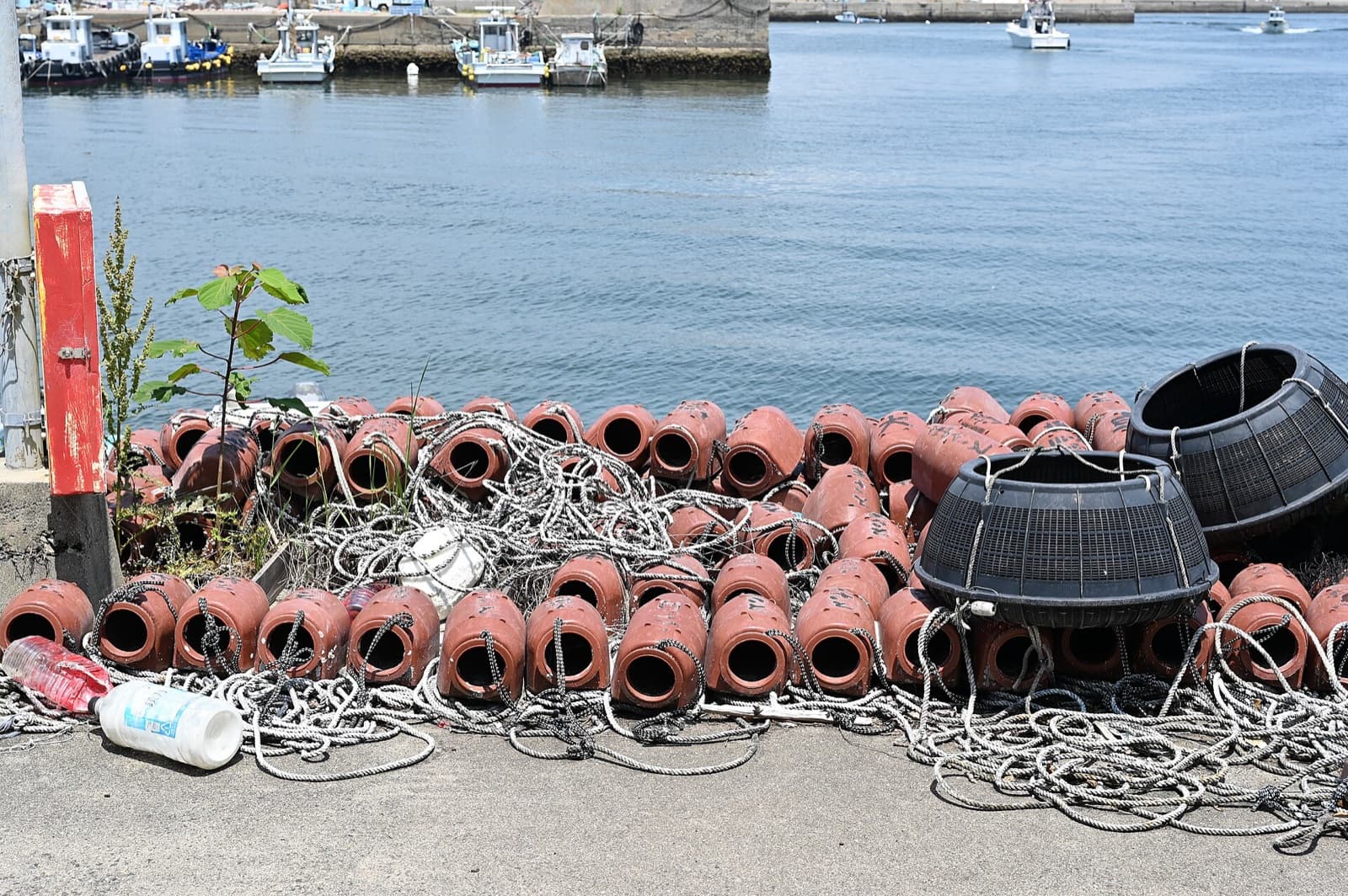
Tako-tsubo : clay pots used to trap octopuses, stacked on a quay on Himakajima Island, Japan, May 2023
Bariston, Wikimedia Commons (CC BY-SA 4.0)
In 2005, the Johns Hopkins team still hoped to help doctors tell it apart from a heart attack. In the United States, hospitalizations for the syndrome, relative to total hospital stays, went on to more than triple between 2007 and 2012 (whether because of more patients or more diagnoses, the figure cannot say), and the national study that counted them noted a growing care bill: dying of love, or close to it, comes at a price.
When the earth shakes, hearts follow
On October 23, 2004, a magnitude 6.8 earthquake shook Niigata Prefecture. In the month that followed, cardiologists in the region diagnosed sixteen cases of Takotsubo: fifteen women and one man, with an average age of 71 and a half. Near the epicenter, the incidence was roughly twenty-four times what it had been before the quake, and eleven patients felt the first symptoms on the very day of the tremor.
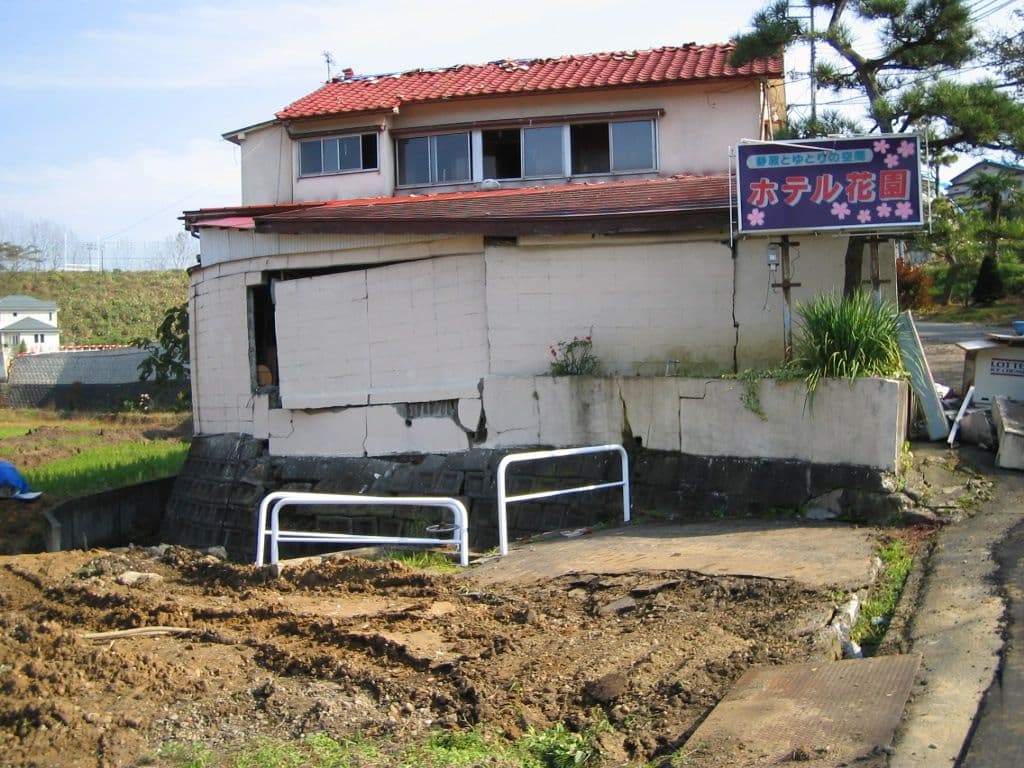
A hotel in Nagaoka with cracked walls and a buckled foundation, two weeks after the Chūetsu earthquake (November 6, 2004)
Naoki Sato, CC BY-SA 2.0
Sixteen years later, fear no longer needed to shake the ground. At the Cleveland Clinic, between March 1 and April 30, 2020, the share of Takotsubo cases among patients arriving with acute coronary syndrome more than quadrupled. All twenty patients tested negative for Covid: the virus had not touched their hearts. The authors pointed instead to the psychological, social, and economic distress of the pandemic, to loneliness and isolation. Everyone was protecting themselves from the virus; nobody had thought to protect their hearts.
Up from 1.5 to 1.8% before the pandemic across the two Cleveland hospitals studied
The years after :the heart remembers
In 2005, the Baltimore researchers wanted to reassure patients: ventricular function returned within two to four weeks, and their patients, they said, had no permanent heart damage. Benign, transient, reversible: a rough patch to get through.
The ventricle does start beating properly again; as for the rest, long-term follow-ups tell the opposite story. After discharge, the international registry measures 5.6% deaths per patient per year — each year, more than five deaths for every hundred former patients. In 2019, a Scottish team found an infiltrate of inflammatory cells in these hearts, along with abnormalities, many of which persisted for at least five months: a chronic, low-grade inflammation. The heart remembers.
Yet that 5.6% counts all deaths, not heart deaths alone. Patients in the registry were already more fragile than others: as noted earlier, more than one in two carried a neurological or psychiatric illness. Cardiologists who followed 318 Takotsubo patients wrote in Frontiers in Cardiovascular Medicine in 2022 that long-term mortality is weighed down by non-cardiovascular illnesses, and therefore by non-cardiovascular deaths.
Among their patients, those who had cancer died twice as often as the others during follow-up, 23.8% versus 11.6%; yet compared with cancer patients without Takotsubo, they did not die at a higher rate. The study is small, and its authors present it as a lead to be confirmed. The heart remembers, but it is not always what kills.
Joanie Simpson went home after two days. She still takes two heart medications, and she is doing well. She has not ruled out adopting another dog: "They give so much love and companionship that I'll do it again."
The heart does not break out of poetry, but under the violence of a tide of adrenaline: human emotion is a biochemical shockwave capable of stopping the body's most vital machinery cold