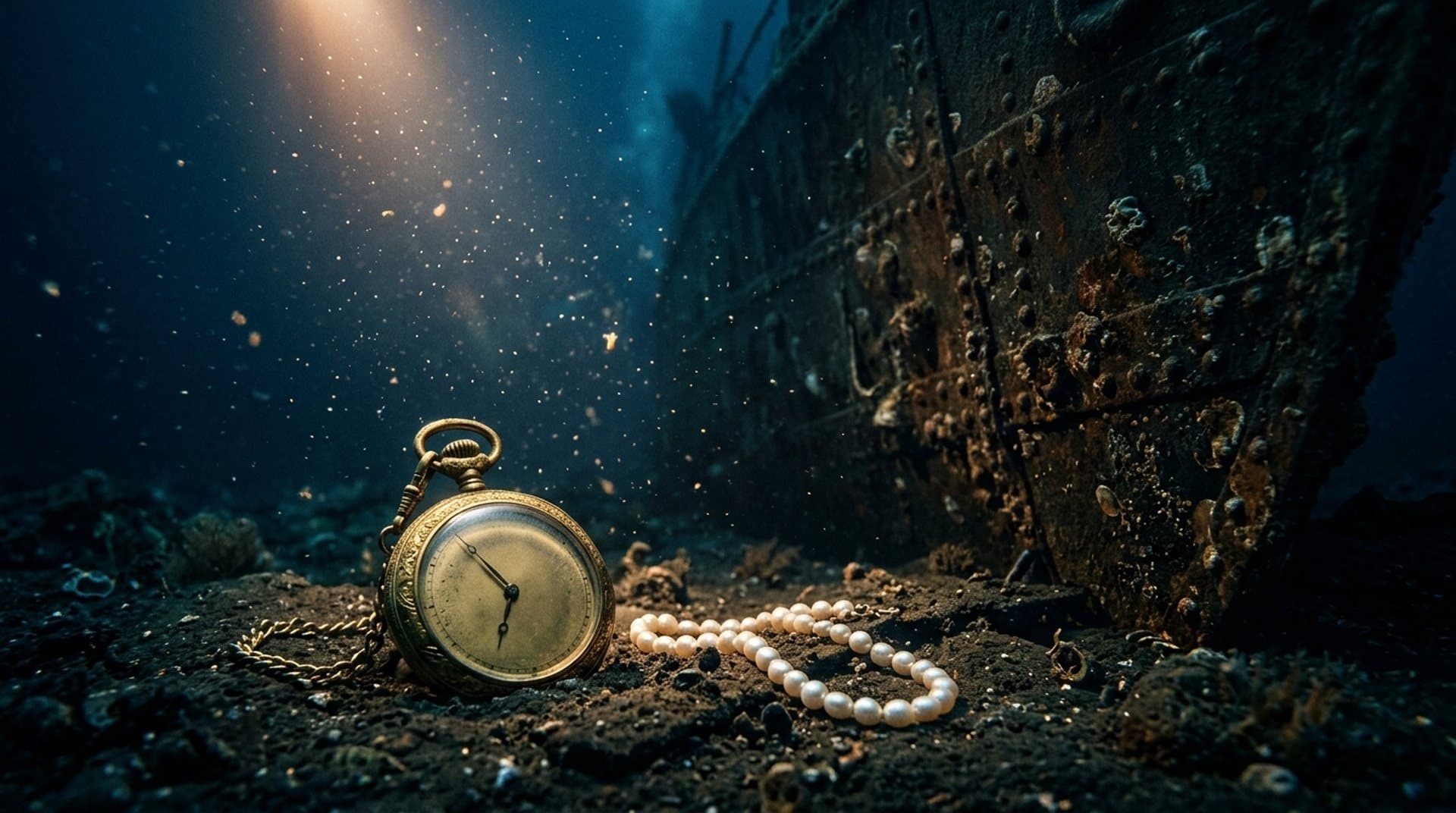
Two shipwrecks at the same spot in the North Atlantic, a century apart: the liner Titanic in 1912, then, in 2023, the submersible Titan, which set out to show the wreck to paying passengers. After each disaster, boards of inquiry established what money had paid for. In 1912, a cabin closer to the lifeboats. In 2023, a viewport facing the wreck.
What money had bought neither time was a safe system. That is built out of regulatory tables and inspection reports, in offices, years before the night people die.
The Californian's Wireless Room
On the evening of April 14, 1912, Cyril Evans was alone. The Leyland liner Californian carried a Marconi wireless operator—just one, him, and with no night-watch schedule. His captain stopped in the ice and had him send word to the nearest liner. At 21:05, New York time, Evans called up: "Say, old man, we are stopped and surrounded by ice."
The reply came from the Titanic, where Jack Phillips, her senior operator, was clearing passenger telegram traffic to the station at Cape Race: "Shut up, shut up, I am busy; I am working Cape Race." Evans acknowledged that he had jammed his colleague, and then turned in at 23:30. Phillips, for his part, had finished working with Cape Race about ten minutes before the iceberg.
Caronia, Baltic, Amerika, Californian, Mesaba; the last placed pack ice across the ship's track and "does not appear to have been delivered to the Master or to any of the officers"
The Californian was right there, five miles away—"probably greater, though not more than eight to ten." Had she come, the British Wreck Commissioner's report concluded, "she might have saved many if not all of the lives that were lost." Only one man on board knew how to listen to the sea, and he was asleep when the Titanic called for help.
Scotland Road
Along E deck ran a working alleyway that stretched nearly the whole length of the ship. The crew called it Scotland Road, and so did counsel at the British inquiry: "E deck; that is Scotland Road as you call it." That was the way steerage—third class—came up, when it came up at all, behind the ship's interpreter "forcing people along the watertight doors."
Olaus Abelseth, a Norwegian from South Dakota, was quartered "in compartment G." Before the U.S. senator, he described a closed gate, then refused to say what people would have liked to hear: "I do not know whether it was locked, but it was shut." And on those who remained below: "in the rooms, I do not think there was anybody that held anybody back."
The padlocked gates of the movies do not exist in either inquiry. The British report concluded that third-class passengers "were not unfairly treated": they were reluctant to leave without their baggage, and above all they were quartered at the two ends of the ship, far from the boats. That much, at least, was paid for at the ticket window. Among adult men, one in three was saved in first class, one in twelve in second.
| Group | On board | Saved | Share saved |
|---|---|---|---|
| 1st class | 325 | 203 | 62% |
| 2nd class | 285 | 118 | 41% |
| 3rd class | 706 | 178 | 25% |
| Crew | 885 | 212 | 24% |
| of which 3rd-class children | 79 | 27 | 34% |
| Total | 2,201 | 711 | 32% |
Out of the 2,201 persons on board, the British report counted 1,490 dead. For children in first and second class, it entered no number saved: it entered "All Saved." In steerage, fifty-two children out of seventy-nine died.
Alma Cornelia Paulson, aged thirty, third-class ticket No. 349909, was traveling from Sweden to join a husband who had gone ahead to America, with her four children. A cable ship recovered her body: No. 206, Fairview Cemetery, Halifax. None of the four children was ever found.
On the boat deck, wealth opened no seat for a man. John Jacob Astor IV, the wealthiest passenger on board, helped his wife climb into Boat No. 4, then asked the second officer whether he might join her to protect her. A first-class passenger, Archibald Gracie, reported the reply before the U.S. Senate: "No, sir; no man is allowed on this boat or any of the boats until the ladies are off." Astor asked for the number of the boat, so that he might find his wife afterward. His body was recovered by the cable ship Mackay-Bennett: No. 124.
Isidor Straus, co-owner of Macy's department store, refused the exception other passengers wanted to make for him on account of his age: he would share his fate, he said, with the rest of the men. His wife Ida refused to leave without him. Isidor's body bore No. 96; Ida's was never recovered. In first class, what money had bought stopped at the rule of women and children first.
Boiler Room No. 10
Frederick Barrett was leading stoker in section No. 6, stokeholds 10 and 11, right forward. Above the furnaces, a dial lit up red whenever the bridge ordered the engines stopped. It lit up. "I called out, 'Shut all dampers.'" Too late: "the crash came before we had them all shut," and then "water came pouring in two feet above the stokehold plate." Hesketh, the second engineer, gave the order that kills: "Every man to his station." He and the other engineer officers would stay there to the end.
According to the summary read out at the bar by counsel for the Crown, Barrett went back down into stokehold No. 5, saw engineer officer Shepherd fall into a manhole and break his leg, stayed behind in case he should be wanted, and escaped when the water rushed in. The machinery, for its part, held: the steamer Virginian heard a final signal, "C.Q.," very faint, and the court noted that "the Marconi apparatus was at work until within a few minutes of the foundering of the Titanic." The lights and the wireless held almost to the end because men stayed below the waterline to keep them running. Among the crew, the deck department had 43 saved out of 66, two in three; the engine room department had 72 out of 325.
On the memorial in East Park, Southampton, the engineer officers are honored "who showed their high conception of duty and their heroism by remaining at their posts." The first name carved is that of Joseph Bell, chief engineer, with Jonathan Shepherd beside him. Lower down: John Hesketh, Herbert Harvey—the men Barrett named in his testimony.
Boat No. 1
Charles Hendrickson, leading fireman, proposed turning back: "It is up to us to go back and pick up anyone in the boat." At the witness stand he was asked who had answered. Nobody: "No one at all." Then a voice in the dark: "He said it would be dangerous to go back; we should get swamped." According to fireman Hendrickson's testimony, it was Sir Cosmo Duff Gordon.
The boat was No. 1, and the British report put it in writing: "No. 1 certainly left with only 12; this was an emergency boat with a carrying capacity of 40." Yet the table in the report listed seven crewmen, eight male passengers, and two women or children—seventeen in all—and then entered a total of twelve: the court that faulted the lifeboats for their empty seats did not add up its own columns.
Later, a fireman explained to the man on the thwart beside him that he had lost his kit and that his pay stopped that very night. His neighbor, Sir Cosmo Duff Gordon, answered: "I will give you a fiver each to start a new kit." Accused of having paid the oarsmen to row away from the drowning, he was cleared: the charge was "unfounded." The very same page added that, had he encouraged them to return, they "could have saved some lives."
The Rule of March 9, 1894
A table of the Board of Trade, the British department that regulated merchant shipping. Dated March 9, 1894, it fixed the number of boats to be carried under davits according to tonnage—and it stopped short at "10,000 tons and upwards," where sixteen boats were enough. The Titanic measured 46,328 tons. The table killed nobody: it simply stopped counting at ten thousand tons, as if ships, past that threshold, ceased to sink.
At the end of his report, Lord Mersey, Wreck Commissioner of the United Kingdom, answered the formal questions put to the Court. Did the ship comply with the Merchant Shipping Acts, 1894–1906? "Yes." Was she properly constructed and equipped as a passenger steamer? "Yes." Everything was in compliance. That was the problem.
Alexander Carlisle, of Harland & Wolff, had drawn a plan placing sixty-four boats on that very deck. He confirmed it on the stand, and explained why the number was never settled: "they were entirely waiting to see what the Board of Trade would require." On the sixteen retained: "I certainly do not think it is enough."
Then there was the deck itself. Lightoller had the port side, Murdoch the starboard; asked about his colleague's rule, Lightoller answered: "That I could not say." The starboard boats left with 36 male passengers, the port boats with seven.
June 18, 2023
The submersible Titan descended toward the wreck of the Titanic with five people on board: Stockton Rush, chief executive of OceanGate, the company selling these dives, who was piloting; Frenchman Paul-Henri Nargeolet, a Titanic specialist; British businessman Hamish Harding; Shahzada Dawood, vice chairman of a Pakistani industrial group, and his son Suleman, aged nineteen. The hull gave way at 3,346 meters. Nobody came back up.
A seat cost up to $250,000, yet those who paid were not listed as passengers: OceanGate recorded them as "mission specialists." A Coast Guard officer stated the rule that this label sidestepped: "If you have paid, then you don't qualify as a member of the crew." *An inspector testified that OceanGate had never requested an inspection of the Titan.* You do not bypass a certification you never applied for: you replace it with a job title.
David Lochridge, director of marine operations, had submitted a report in January 2018 outlining defects in the hull. Fired a few days later, he summed up the ground held against him: he was "anti-project."
In July 2022, during Dive 80, the sensors recorded a "major acoustic emission event" and a loud bang was heard upon surfacing. Rush concluded that the craft had shifted in its cradle. "If you just want to be safe, don't get out of bed," he used to say.
Four days earlier, another shipwreck had left more than a hundred times as many dead and missing. On June 14, 2023, off Pylos, Greece, the trawler Adriana sank with an estimated 750 people on board, mainly from Syria, Pakistan, and Egypt. 104 survived; 82 bodies were recovered, and more than 500 people remain missing. On June 22, in Athens, while the search for the Titan was still underway, Barack Obama contrasted the "minute-to-minute" coverage of the submersible with the fate of "700 people who sank": "That's an untenable situation."
That shipwreck, too, has its inquiry, and it targets those whose duty was to rescue. In May 2025, a Greek naval court brought charges against seventeen coast guard officers, ranging from obstructing transport to causing a shipwreck; in November 2025, four senior officers were added, including the sitting chief of the coast guard. As of that date, the investigation was still open and nobody had stood trial.
The Verdict
On August 5, 2025, the U.S. Coast Guard Marine Board of Investigation released its report: more than three hundred pages, seventeen recommendations. Its chair, Jason Neubauer, wrote the sentence awaited for two years: "This marine casualty and the loss of five lives was preventable."
For the board, the primary causal factor was OceanGate's design, certification, maintenance, and inspection process; the loss of structural integrity of the hull was only how it happened. The contributing factors were office matters too—a toxic workplace culture and an ineffective whistleblower process. One man had reported the defect; a procedure existed to protect him; it did not work.
In 1912, an 1894 table had authorized everything; in 2023, there was no table at all. Money buys a cabin near the lifeboats, or a viewport facing the wreck. It does not buy the rest: updated tables, inspectors who get called in, and someone who can still say no.