In 1700, in Modena, physician Bernardino Ramazzini published De Morbis Artificum Diatriba, the treatise on the diseases of workers that founded occupational medicine. To the questions a physician is taught to ask a patient—where he hurts, what caused his pain—he added one: "what occupation does he follow?" He had found the answer in the poorest workshops, which he regarded as the only schools where such things could be learned.
The question has not aged. Occupation still tells who dies, and of what: men especially, migrants, newcomers on the job site, and many older workers whom work catches up with in retirement. It also tells what a society agrees to pay for its hardest labor, and to whom it entrusts it.
According to the International Labour Organization (ILO), which tallied for the year 2019, 2.93 million people die each year because of their work, one every eleven seconds, more than double the deaths from road traffic. Falls, crushing, explosions—the deaths people picture—account for only about 330,000. The rest die from disease, most often of the heart, cancer, or lungs, and often long after their last day on the job.
In 2019, more than double that of women, at 48. Nearly two out of three of these deaths occur in Asia and the Pacific, where the largest share of humanity works
Work that kills also has a price tag. In the United States, according to the AFL-CIO, the median penalty imposed by the federal agency OSHA on an employer following the death of a worker was 12,063 dollars in its 2023 report. The price of a used sedan.
Ranking by Risk :The Forest, the Sea, and the Roofs
Hollywood casts police officers as the dangerous job par excellence. The Bureau of Labor Statistics (BLS), which records fatal occupational injuries in the United States, describes a reality rooted far more in the woods.
In 2024, one every 104 minutes: 3.3 per 100,000 workers, all occupations combined
Logger. Among the occupations the BLS publishes, it is the deadliest in America: 110 killed per 100,000 workers in 2024, more than thirty times the average. The tree falls the wrong way, and broken limbs still hanging in the crowns—which the trade calls widowmakers—eventually give way. The nation's most exposed worker carries neither badge nor gun, but a chainsaw.
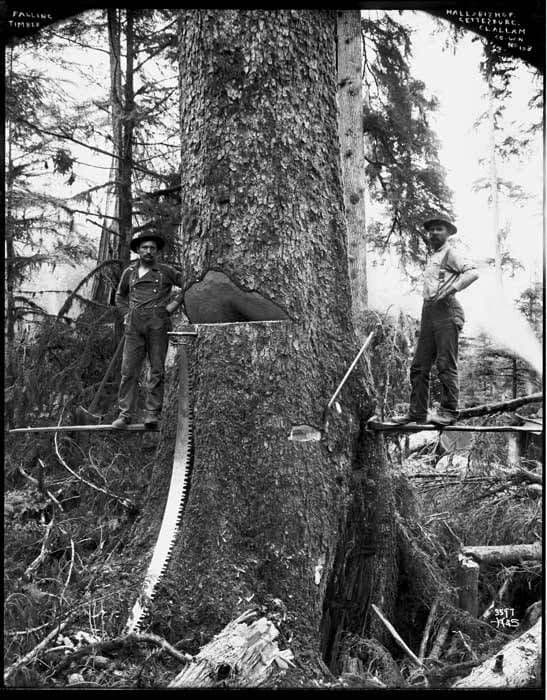
Two loggers standing on planks set into the trunk of a giant half-notched tree, crosscut saw resting against the undercut, circa 1905
Webster & Stevens, Museum of History and Industry (Seattle), public domain
Commercial fisher. Second, at 89 per 100,000. The fisher goes overboard, and in cold water drowning can come in minutes: 204 American fishers died this way between 2000 and 2016, and not one was wearing a life jacket. When no one witnesses the fall, nine times out of ten the body is never recovered.
Roofer. On a suburban roof, a slip is all it takes: 104 roofers died on the job in 2024. A little lower in the ranking come refuse collectors, working at the back of a truck in the middle of traffic, at the hour when motorists are in a rush.
Truck driver. By rate, it ranks far behind. But no occupation kills as many people: 950 truck drivers and delivery workers killed in 2024, nearly one in five work fatalities. Transportation incidents are the leading cause of death on the job in the United States, nearly two in five; law enforcement, by comparison, lost 132 of their own, seven times fewer than truckers.
Fatal work injury rates by occupation in the United States (BLS, 2024, per 100,000 workers)
rateWho dies? More than nine times out of ten, a man. Latino workers, accounting for nearly one in four victims, face a risk about 30% higher than the national average.
France :Dying in One's First Year
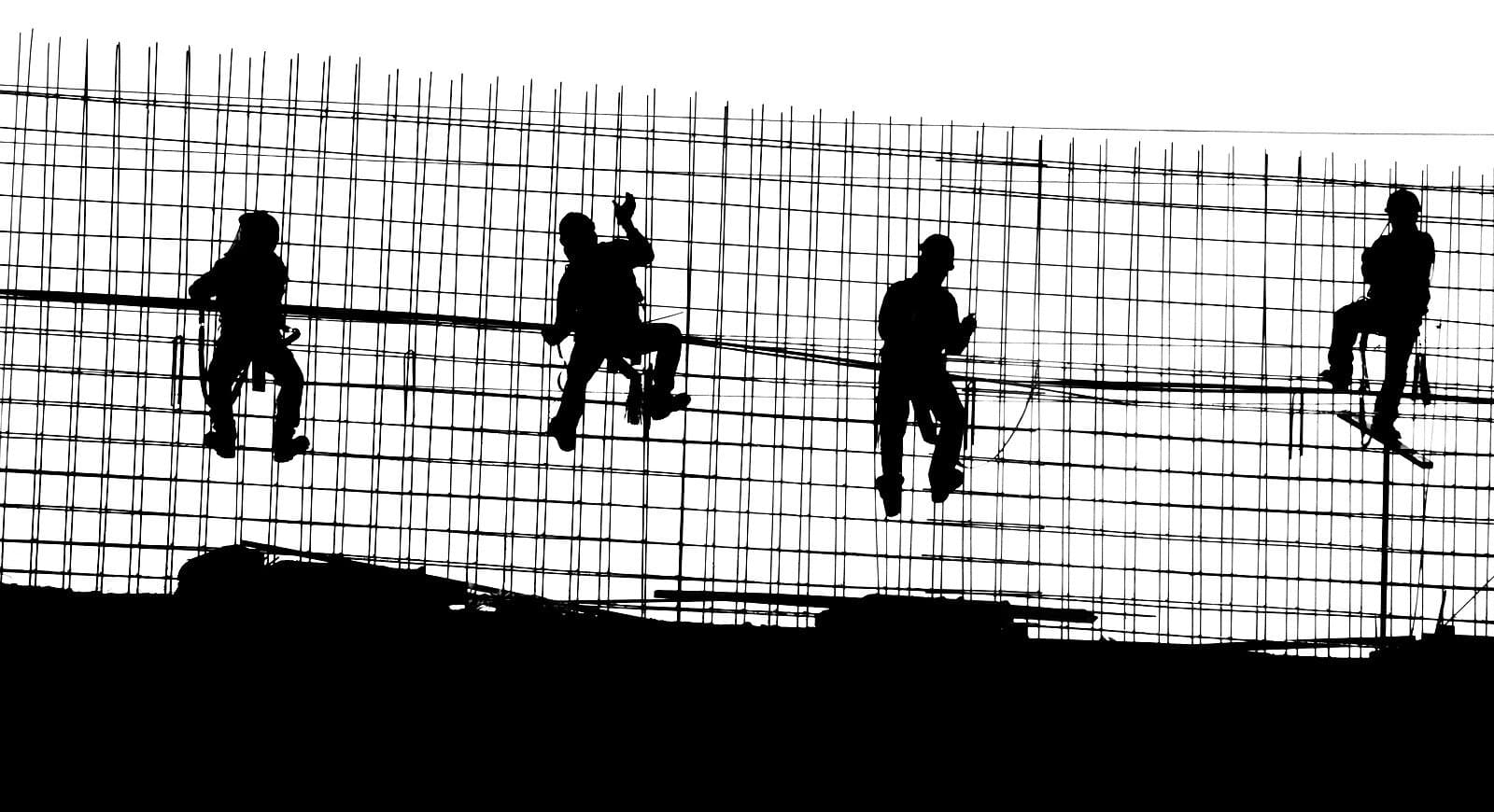
Construction workers on a job site in Mexico
Tomascastelazo, Wikimedia Commons, CC BY-SA 4.0
France likes to pride itself on having one of the most protective labor codes in the world. Yet alongside Bulgaria, it is the only European Union country with at least three fatal occupational accidents per 100,000 workers.
In 2024, more than double the EU average of 1.65. Eurostat cautions that France reports accidents occurring at work without always distinguishing those where work was the primary cause, which may inflate its figure
In 2025, French Health Insurance (Assurance Maladie) recognized 783 deaths under occupational accidents among general-scheme employees alone, excluding farmers and civil servants. The category's name is misleading: it counts deaths occurring at work regardless of cause: more than half are sudden illnesses, and according to the INRS, more than eight out of ten fatal illnesses are sudden cardiac deaths, led by heavy truck drivers; only a quarter have a direct occupational cause, a fall, a load. Transport and energy, followed by construction, are the deadliest sectors.
They are often newcomers. At least one in four victims had been in their position for less than a year, and more than thirty did not survive their first week.
On the construction sites of the Grand Paris Express, a senator noted in March 2023 the fifth death since work began, pointing to "cascading subcontracting." The lead contractor entrusts the site to a company, which subcontracts, which calls a temp agency, which sends a temporary worker. When the scaffolding gives way, responsibility is diluted across contractual tiers: the temp worker dies, and the lead contractor's CSR record remains spotless. At least 45 temporary workers died on the job in 2025, including 18 in construction.
Subcontracting already has its precedent. On September 21, 2001, shed 221 at the AZF plant in Toulouse, owned by Grande Paroisse, a subsidiary of Total, exploded: 31 dead, including 21 people working on the site—employees of the plant and subcontracting firms—and about 2,500 injured. For labor inspector Gérald Le Corre, it was by far the worst workplace accident in France in roughly thirty years. After eighteen years of legal proceedings, the Court of Cassation made the conviction final on December 17, 2019: a fifteen-month suspended prison sentence and a 10,000-euro fine for former plant manager Serge Biechlin, and a 225,000-euro fine for Grande Paroisse, for involuntary manslaughter.
Ranking by Total Toll :Those Who Die Slowly
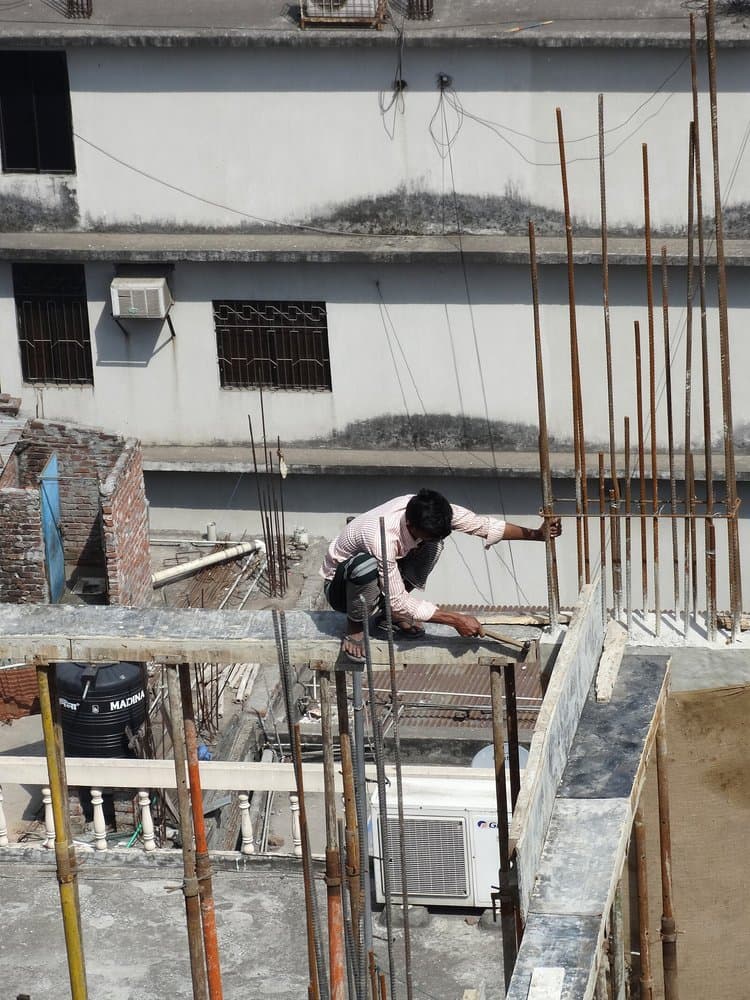
Worker on a construction site in Dhaka (Bangladesh)
Adam Jones, Wikimedia Commons, CC BY-SA 2.0
Ranked by the number of victims, the leaderboard changes completely. At the top comes the employee working excessive hours, then the laborer breathing dust, gases, and fumes; accidents arrive only in third place, just ahead of asbestos. These deaths make no noise: more than four in ten victims of occupational disease are seventy years old or older.
The worker with 55-hour weeks. According to the WHO and ILO, long working hours killed 745,000 people in 2016, from stroke or heart disease. Nearly three in four were men, and most died between 60 and 79 years of age, years after the workweeks that wore them down.
Japan has a word for this death: karoshi. Years of stress and short nights wear down the arteries, until the day a vessel gives way.
For the year 2024, the Japanese Ministry of Health and Labor recognized under overwork 67 deaths from heart or brain disease and 88 suicides, including attempts. In October 2015, Matsuri Takahashi, twenty-four years old, an employee of Dentsu, the major Japanese advertising agency, logged 105 hours of overtime. She took her own life in December, and the government recognized it as karoshi. In 2017, a Tokyo court fined Dentsu 500,000 yen for illegal overtime.
The asbestos worker. According to the WHO, asbestos kills more than 200,000 people a year, accounting for more than seven in ten deaths from occupational cancer. Mesothelioma, cancer of the pleura, typically appears twenty to fifty years after first exposure: a summer job on a poorly protected asbestos removal site in 1985 can still kill in 2025. American judges admitted as evidence the papers of Sumner Simpson, head of an asbestos giant, to show that Johns-Manville knew, or should have known, what the fiber did to shipyard workers.
Before them, in 1920s New Jersey, luminous dial painters sharpened the tip of their brushes between their lips, swallowing a little radium each time. Their bosses at the US Radium Corporation kept telling them radium was good for their health; when their jaws became necrotic, the company claimed they had syphilis. The first died in 1922.
In France, asbestos had its whistleblower. In late 1973, in his Jussieu chemistry lab, Henri Pézerat identified asbestos in the white dust falling from the ceiling that skewed his measurements; in 1978, he supported the female workers at the Amisol factory in Clermont-Ferrand. France did not ban asbestos until 1997.
How many people has asbestos killed in France? It depends on who is counting. In October 2005, a Senate fact-finding mission wrote that 35,000 people died from asbestos-related disease between 1965 and 1995, and projected 60,000 to 100,000 more within twenty to twenty-five years. In 2014, the High Council for Public Health recalculated for 1955-2009: between 61,300 and 118,400 deaths attributable to asbestos, counting for lung cancer only occupational exposures, and projected another 68,000 to 100,000 by 2050.
Against that stands the Health Insurance registry: for 2025, 204 deaths recognized under all occupational diseases combined, asbestos included. This registry only counts patients who died before their permanent disability rating was finalized: anyone dying of mesothelioma after that date does not enter the death column. That same year, Health Insurance recognized 1,833 occupational diseases linked to asbestos, living patients included.
The count of occupational cancers remains to be done. In 2023, more than 2,600 cancers were recognized as occupational in origin, whereas Health Insurance estimated, according to a senator inquiring, that 69,600 to 102,100 cases were attributable to work. "It is necessary to improve the recognition of occupational diseases," the government replied.
The Newcomers :Heat and the Algorithm
Tul Bahadur Gharti, thirty-four years old, a construction worker in Qatar, died in his sleep on May 28, 2020, after some ten hours of work in 39 °C heat. When a body struggles for hours in extreme heat to cool itself through sweating, the WHO notes, dehydration and thermal stress severely strain the heart and kidneys, to the point of acute kidney failure or cardiac arrest. Like the five other men tracked by Amnesty International, Gharti had nonetheless passed his medical examinations before leaving, and his family was offered no autopsy. Among Indian, Nepalese, and Bangladeshi workers who died in Qatar, seven out of ten deaths were classified as "natural," with no mention of trade or job site. Of thirty-seven deaths linked to World Cup stadiums, thirty-four were declared non-work-related.
A minimum, from the awarding of the World Cup in late 2010 to 2020, excluding the final months: twelve per week, all causes combined, among workers from India, Nepal, Bangladesh, Pakistan, and Sri Lanka alone
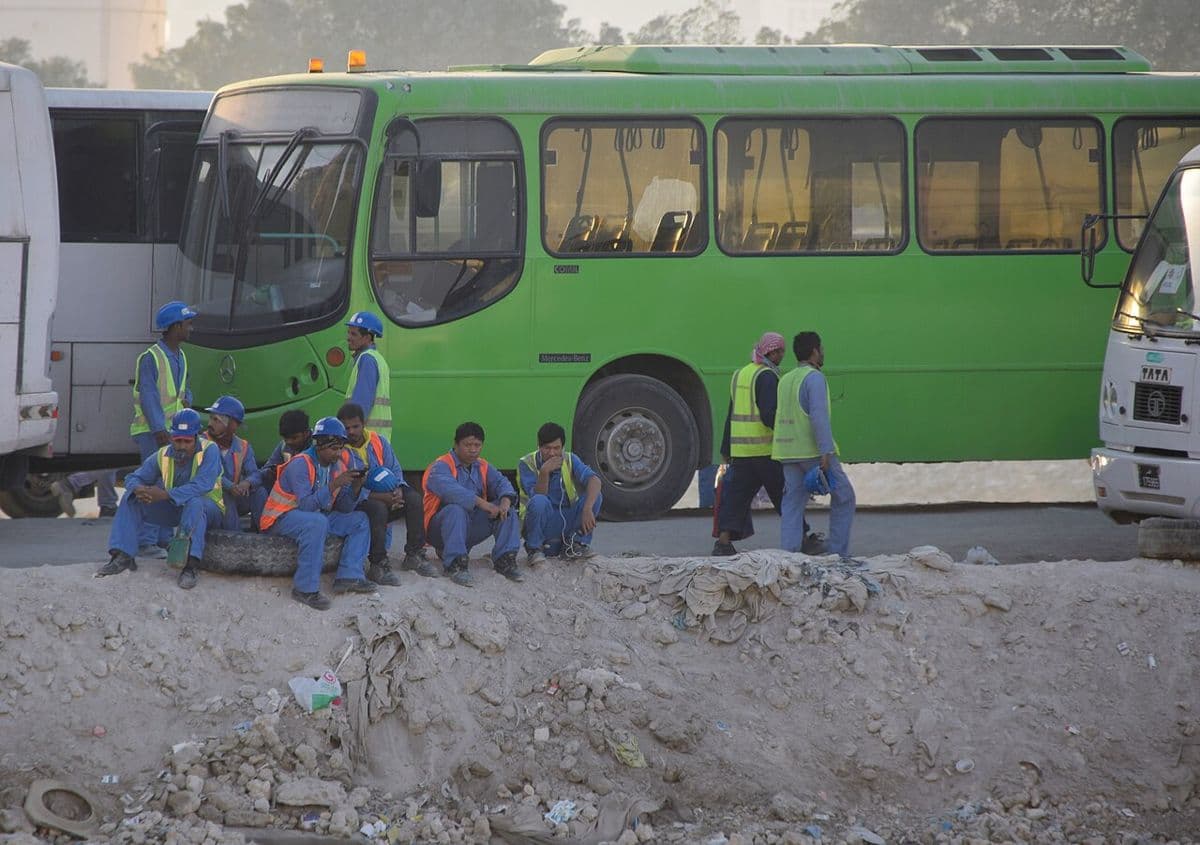
Foreign workers in hard hats and vests sitting before company buses after their shift, at a construction site at The Pearl in Doha, Qatar, in 2018
Mosbatho, Wikimedia Commons, CC BY 4.0
Until the 2020 reforms, these men lived under the kafala system: changing employers required the boss's permission, and leaving the country required an exit permit. In Texas, the law moved backward. In 2023, the state passed House Bill 2127, nicknamed the "Death Star law" by critics: it prohibits cities from enacting stricter regulations than state law, striking down the rest breaks that Dallas and Austin granted to construction workers, in Dallas ten minutes every four hours. "We are not robots," said Mario Ontiveros, a Dallas worker; between 2010 and 2020, at least 53 Texas workers had died from heat.
At the other end of the economy, the algorithm has replaced the foreman. According to Human Rights Watch, delivery workers and drivers across seven major US platforms are assigned orders, supervised, paid, and fired by algorithms, and live in fear of being "deactivated" without explanation or recourse. The software pushes no one under a bus. It simply makes the risk of an accident feel less terrifying than the risk of missing rent: in Brooklyn, in the year leading up to September 2021, five delivery workers died on the job, at least four of them in collisions.
The Price of a Death
What remains is the death everyone imagines, by fire and machinery,and what it costs those who allowed it to happen.
In New York City, in the spring of 1911, fire broke out in the shirtwaist workshop of the Triangle Waist Company. The workers were mostly young Italian and Jewish immigrant women, some fourteen years old, and the owners had taken to locking the doors, on the grounds that the workers stole fabric. The fire escape buckled under their weight, fire truck ladders fell several stories short, and many jumped from ninth-floor windows rather than burn alive.
On March 25, 1911, out of 500 factory employees: nearly three in ten did not make it out alive
The owners, Max Blanck and Isaac Harris, were acquitted. Overinsured, they collected more than their losses—a profit of 400 dollars per victim; in 1914, in civil settlements, they paid 75 dollars per life lost. Two years after the fire, Blanck again locked a door of his factory during working hours: a 20-dollar fine. New York State, however, enacted thirty-six laws drafted by the investigating commission that followed, which served as a blueprint for the rest of the nation.
One hundred and two years later, the workshop had moved to Bangladesh. In Savar, on the eve of April 24, 2013, cracks appeared in the walls of Rana Plaza, an eight-story commercial building where garment workers stitched clothing for Benetton, Mango, Primark, and Walmart; the next morning, factory managers gave them a "choice": work, or go home and never return. The building collapsed during the day: 1,134 dead according to the International Labour Organization, which chaired the compensation arrangement, 1,136 or 1,138 according to other counts. The ILO estimated the total compensation cost at nearly 30 million dollars for families of the dead and the injured combined. By May 2026, the murder trial of the jailed owner, Sohel Rana, and forty co-defendants had still not concluded: 150 of 594 witnesses had testified.
Bhopal, India, is not included in this count, and deliberately so. On December 3, 1984, the Union Carbide pesticide plant leaked a cloud of methyl isocyanate that swept across the city: about 500,000 people were exposed, whereas the night shift counted around one hundred workers. Its dead were primarily local residents, not workers, but its toll shows who sets the price of a death: Union Carbide proposed in 1985 to compensate 1,408 deaths, the Indian Supreme Court approved a 470-million-dollar settlement in 1989 based on 3,000, the government asserted 5,295 in 2010, and the Court refused in March 2023 to reopen the agreement.
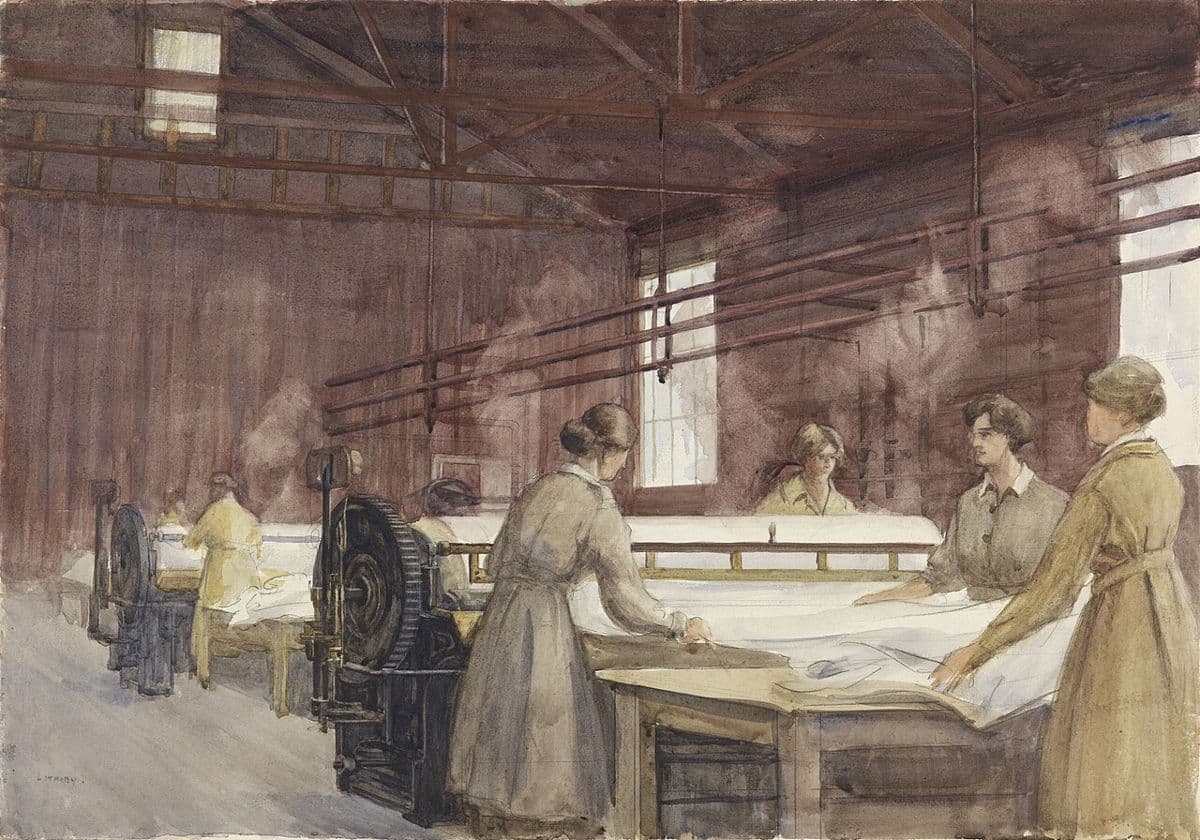
Steam laundry in Abbeville during World War I : women stretching sheets in front of large geared roller ironers
watercolor by Beatrice Lithiby, Imperial War Museums, public domain
In March 2007, in Tulsa, Oklahoma, Eleazar Torres-Gomez cleared a jam of wet linen on the conveyor feeding an industrial dryer at the Cintas laundry. He fell into the operating machine and remained trapped inside for twenty minutes at nearly 150 °C. According to OSHA, the plant neither shut down nor locked out equipment before clearing jams, nor trained those who did. "The thought of how my father must have suffered haunts me and my family every day," said his son, Emmanuel.
The largest ever issued against a service company. Cintas contested it, then settled in December 2008: 2.76 million for six cases, including the one involving this death
If a company installs safety harnesses, it is also because a dead worker costs more than yellow tape.
Workplace safety never advanced through benevolence: after Triangle as after asbestos, it was counted deaths, lawsuits, and fines that changed the laws—provided someone asked Ramazzini's question.
TELL ME YOUR TRADE, I WILL TELL YOU WHAT YOU DIE OF