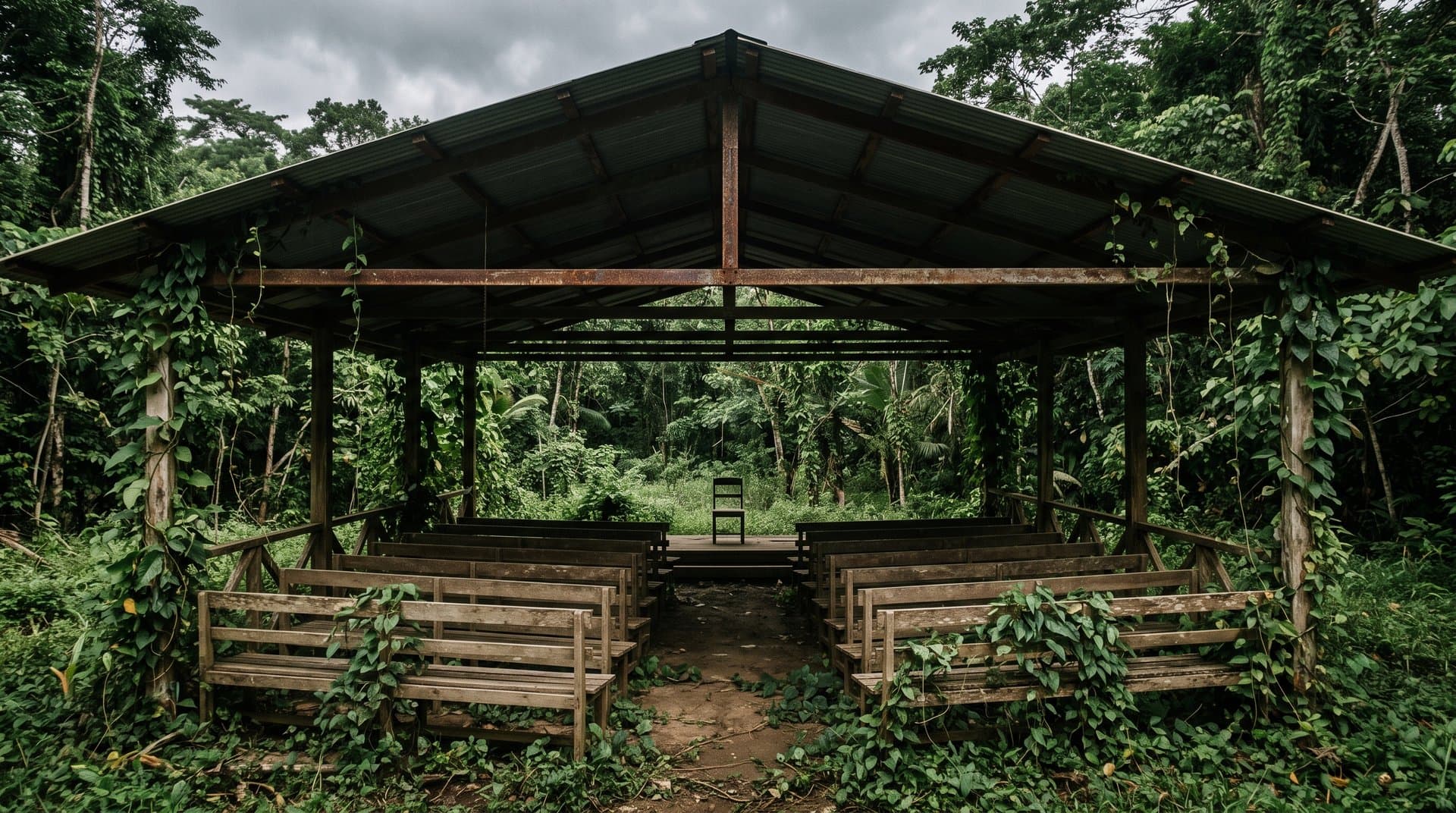
"We didn't commit suicide; we committed an act of revolutionary suicide protesting the conditions of an inhumane world." Jim Jones's words were recorded on November 18, 1978, in the jungle of Guyana, while around him his community, the Peoples Temple, was dying.
The world kept his term: Jonestown remains "the greatest mass suicide" of modern history, and English says drink the Kool-Aid to mock those who follow a leader to their own ruin. Yet the survivors, the tape of the final minutes and the archives tell something else: to a large extent, mass murder at gunpoint, of people who had first been stripped of their possessions, exhausted and isolated.
On that day, almost the entire community died: mostly Black Americans who had come from California in a church that promised equality. One in three of the dead was a minor. The word "suicide" made the victims bear the blame for their murderer.
909 at Jonestown, the others on the Port Kaituma airstrip and at the Temple's headquarters in Georgetown: the greatest single loss of American civilian life until September 11, 2001, according to the U.S. National Archives
Need help. If this subject hits too close, for you or someone close to you, call or text 988, the Suicide & Crisis Lifeline, free and available 24/7; in France, call 3114. In immediate danger, call 911 (15 or 112 in France). Numbers for other countries are at the end of the article.
The Pastor Who Healed
Jim Jones was born on May 13, 1931, in Crete, a rural village in Indiana. His father, a World War I veteran, was disabled, his lungs ruined; his mother, according to his biographers, often neglected him. The child wandered the village alone, sometimes naked, and held funerals for the roadkill he picked up off the road.
In 1955, in Indianapolis, he founded the church that would become the Peoples Temple, a fully integrated congregation that made him a civil rights figure. The method was already there: on several occasions, his miraculous healings were exposed as hoaxes, including a tumor that was nothing but a chicken gizzard.
In July 1965, he took his followers to Redwood Valley, California, then set up the Temple in San Francisco. There he became a prominent figure: Mayor George Moscone appointed him chairman of the city's Housing Authority Commission. In August 1977, New West magazine published Marshall Kilduff's investigation into abuses at the Temple, and Jones pushed his followers toward Guyana.
"The Punishment for Defection Was Death"
Deborah Layton kept the Temple's books. She fled on May 13, 1978, and in June, in San Francisco, she signed a sworn statement addressed to the U.S. government. In it she described a labor camp: the fields from morning to night, six days out of seven, rice at every meal, Jones's voice over the loudspeaker during work and during sleep. No one left without an assignment, and Jones repeated that the punishment for defection was death.
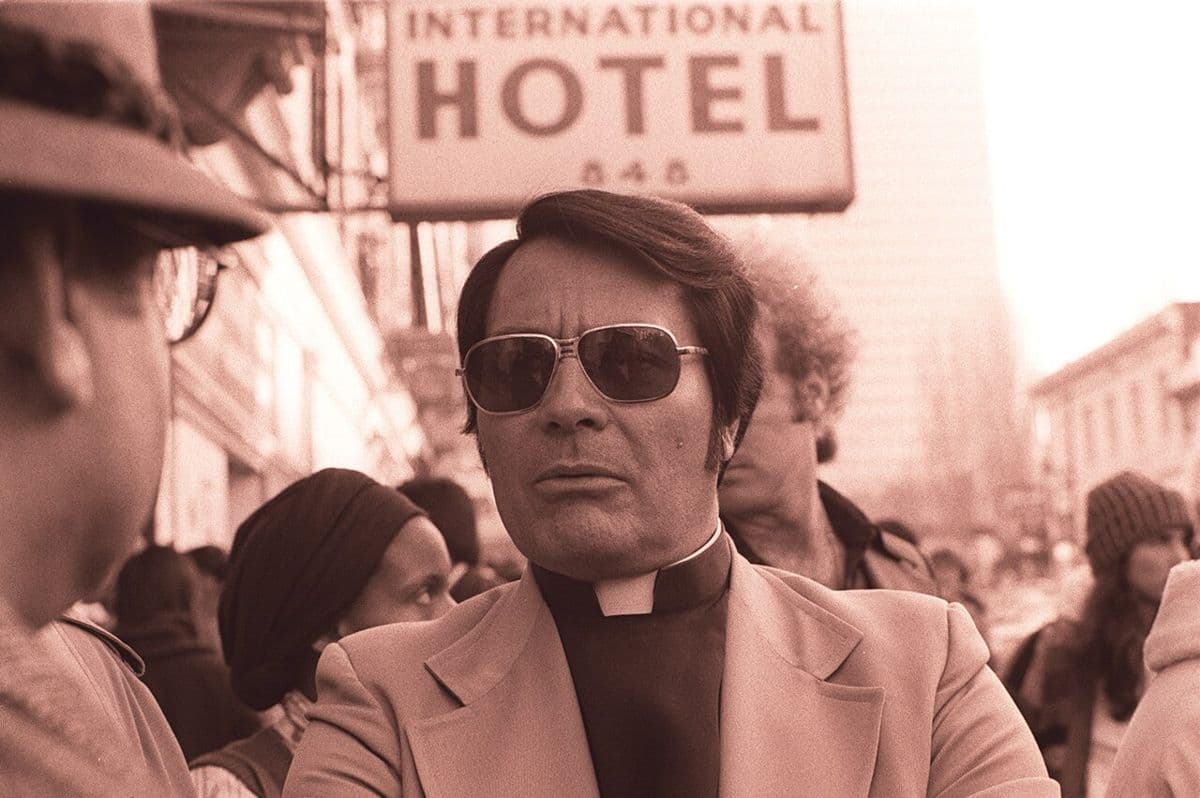
Jim Jones, in a clerical collar and dark glasses, at a protest against the eviction of the International Hotel's tenants in San Francisco, January 1977 : the pastor was then showing himself alongside the city's social struggles
Nancy Wong, Wikimedia Commons, CC BY-SA 3.0
In San Francisco, this white pastor had gathered a church that was two-thirds Black, with many retirees, where he preached racial equality and mutual aid. After the New West investigation, he took nearly a thousand followers to an isolated clearing in Guyana, leased from the state. There the Temple collected their pensions. At least once a week, Layton recounted, sirens woke the camp for a "white night," a state of emergency.
On one of those nights, everyone drank a liquid said to be poisoned, before Jones announced a loyalty test. Five months before the end, Layton warned Washington that Jones was preparing "a mass suicide for the glory of socialism."
| What Deborah Layton describes | What it produces |
|---|---|
| Over $65,000 in retirement pensions paid to the Temple every month | Followers with no income of their own |
| The fields from 7 a.m. to 6 p.m., six days out of seven | Exhaustion |
| Rice in the morning, rice water at noon, rice and beans in the evening | Hunger |
| The loudspeaker day and night, meetings six nights out of seven | Lack of sleep |
| No leaving without an assignment, defection punishable by death according to Jones | Fear, and no way out |
| "White nights" at least once a week | The gesture repeated until it becomes a reflex |
"Help Us Get Out of Jonestown"
The warning did not come from her alone. On March 14, 1978, Jones himself had written "to all U.S. Senators and Members of Congress": "I can say without hesitation that we are devoted to a decision that it is better even to die than to be constantly harassed from one continent to the next." The threat was on every lawmaker's desk eight months before the end.
Layton's statement armed the worried families and pushed a California lawmaker, Representative Leo Ryan, to go and see. The congressional report on his death would put it in writing: Ryan had been advised "on more than one occasion" of the risk of violence, and he "tended to discount such warnings." He arrived in Jonestown on November 17. That evening, during the reception held in the pavilion, Vernon Gosney slipped a note to a man he took for the congressman: "Vernon Gosney and Monica Bagby please help us get out of Jonestown."
The man was Don Harris, an NBC reporter. The next day, Gosney, Bagby and fourteen others asked to leave. On the Port Kaituma airstrip, Temple men opened fire. Ryan was killed along with Don Harris, his cameraman Bob Brown, photographer Greg Robinson and a departing member, Patricia Parks; Gosney was hit by three bullets.
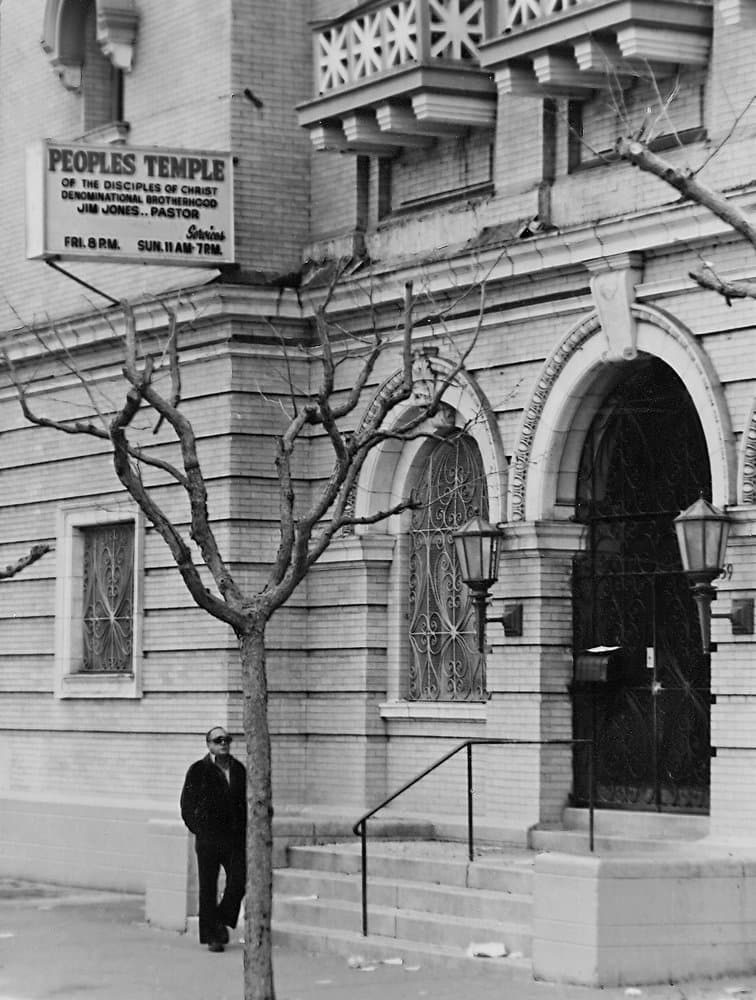
Entrance to the Peoples Temple headquarters, 1859 Geary Boulevard, San Francisco, December 6, 1978
Nicolas Martin, Wikimedia Commons (CC BY-SA 4.0)
At the camp, Jones gathered everyone under the pavilion. The congressional report would note that the death ritual began even before the gunmen came back from the airstrip to confirm their kills, which, in its view, lent credence to the idea of a plan settled in advance.
On the Tape, a Single Voice Says No
A tape recorder was running; it would record forty-four minutes. On it, Christine Miller, a member, can be heard asking whether it is too late to go to Russia. "As long as there's life, there's hope," she says. "I look at our babies and I think they deserve to live."
She was the only one to speak this way. Jones answered her, then asked the crowd to "die with a degree of dignity." On the stage, the camp doctor, Laurence Schacht, and nurses had prepared a tub of fruit drink (Flavor Aid) laced with cyanide and sedatives. "They started with the babies," a survivor, Odell Rhodes, would say three days later: with needleless syringes, nurses and mothers poured the poison into the infants' throats.
Cyanide blocks cellular respiration and prevents the tissues from using oxygen: within minutes, the children went into convulsions, gasped for breath and died. Their cries overpower the recording. A child does not choose to die for a revolution.
People under eighteen, counted one by one; half were ten or younger
Found on November 24, 1978, by U.S. Vice Consul Richard Martin, at the foot of Jones's chair, on the stage
Guns and Bows Around the Pavilion
Odell Rhodes escaped on the pretext of fetching a stethoscope from the infirmary. According to him, most drank willingly at first, but when the babies screamed and writhed on the ground, armed guards surrounded the pavilion, turned back those who fled and forced them to drink. Stanley Clayton, the other escapee, described to NBC rifles and bows around them: "most of them were too afraid to do anything because—because of the weapons."
Of the 909 dead in the camp, 907 died of cyanide poisoning; only two, Jim Jones among them, died of gunshot wounds. Seven in ten were Black, nearly half were Black women, and nearly two hundred were over sixty.
Guyana's chief pathologist, Leslie Mootoo, noted injection marks on bodies, but his figures varied from one interview to the next. Flown back to Dover, the bodies were embalmed on arrival; only seven were autopsied in the United States. The exact share of the dead who were killed by force has never been established. The Guyanese coroner's jury, for its part, ruled as early as December 22, 1978, five weeks after the events: "Jim Warren Jones and persons unknown [are] criminally responsible for the deaths of the 910 persons." That figure is the jury's; elsewhere the count is 909 dead at the camp and 918 in Guyana. It found suicide for only two women, Ann Elizabeth Moore and Maria Katsaris.
Six months later, 409 unidentified bodies, mostly children, were buried at Evergreen Cemetery in Oakland.
After Jonestown, the Same Disguise
On April 19, 1993, in Waco, Texas, the FBI siege of the Davidians' residence ended in fire: according to the 1996 congressional report, more than seventy Davidians died, including twenty-two children. Four federal agents had been killed during the failed raid of February 28. The same report found, without treating it as conclusive proof, that Davidians set the fires themselves, and that their nineteen dead by gunfire had shot themselves or were shot by their own.
The Order of the Solar Temple spoke of "transit to Sirius." Over two and a half years, starting in the fall of 1994, 74 of its members died in Switzerland, France and Quebec, along with its two founders, Luc Jouret and Joseph Di Mambro. At Cheiry, in the canton of Fribourg, twenty of the twenty-three victims had been shot.
The counterexample came from California. On March 26, 1997, in a villa in Rancho Santa Fe, the bodies of the thirty-nine members of Heaven's Gate were found, including their leader, Marshall Applewhite: twenty-one women and eighteen men aged 26 to 72, who died in three waves, the living of each wave cleaning up after the one before. Adults only: this is the case where "mass suicide" is perhaps the right term, and that is what sets it apart from Jonestown.
On March 17, 2000, in Kanungu, Uganda, the church of the Movement for the Restoration of the Ten Commandments of God burned, its doors locked and its windows nailed shut from the outside. About five hundred followers died there, and hundreds of other bodies were later exhumed from pits. There was talk of a failed end-of-the-world prophecy and of property the followers were asking to get back; the motive has never been established.
The toll given by the Ugandan police spokesman in July 2000, church and pits combined
In the Shakahola forest in Kenya, more than four hundred bodies have been exhumed since 2023 on the land of pastor Paul Nthenge Mackenzie. At the trial, a witness described the order of the fast meant to lead to Jesus: the children first, then the young people, the women, and the men last; Mackenzie kept the last place for himself.
On October 19, 2026, Mackenzie and twenty-eight co-defendants were found guilty of murder; almost all the victims counted were children. "A parent has no legal entitlement to determine that a child should die in pursuit of a religious belief," ruled Kenya's High Court, presided over by Justice Diana Kavedza.
190 children and one adult: for the court, children could not legally consent to being starved to death
A Guyanese jury wrote it as early as December 1978, and a Kenyan court said it again in 2026: what we call mass suicide is, first of all, murder
Need help. If you are having thoughts of suicide or are worried about someone close to you, call or text 988, the Suicide & Crisis Lifeline, available 24/7 anywhere in the United States. In an emergency, call 911. In France, call 3114, the free national suicide prevention line, open 24/7 throughout France, overseas territories included, where trained nurses and psychologists answer; in an emergency, 15 or 112. Elsewhere: 0800 32 123 in Belgium, 143 in Switzerland, 988 in Canada. To report a group's coercive hold in France, Miviludes collects reports.