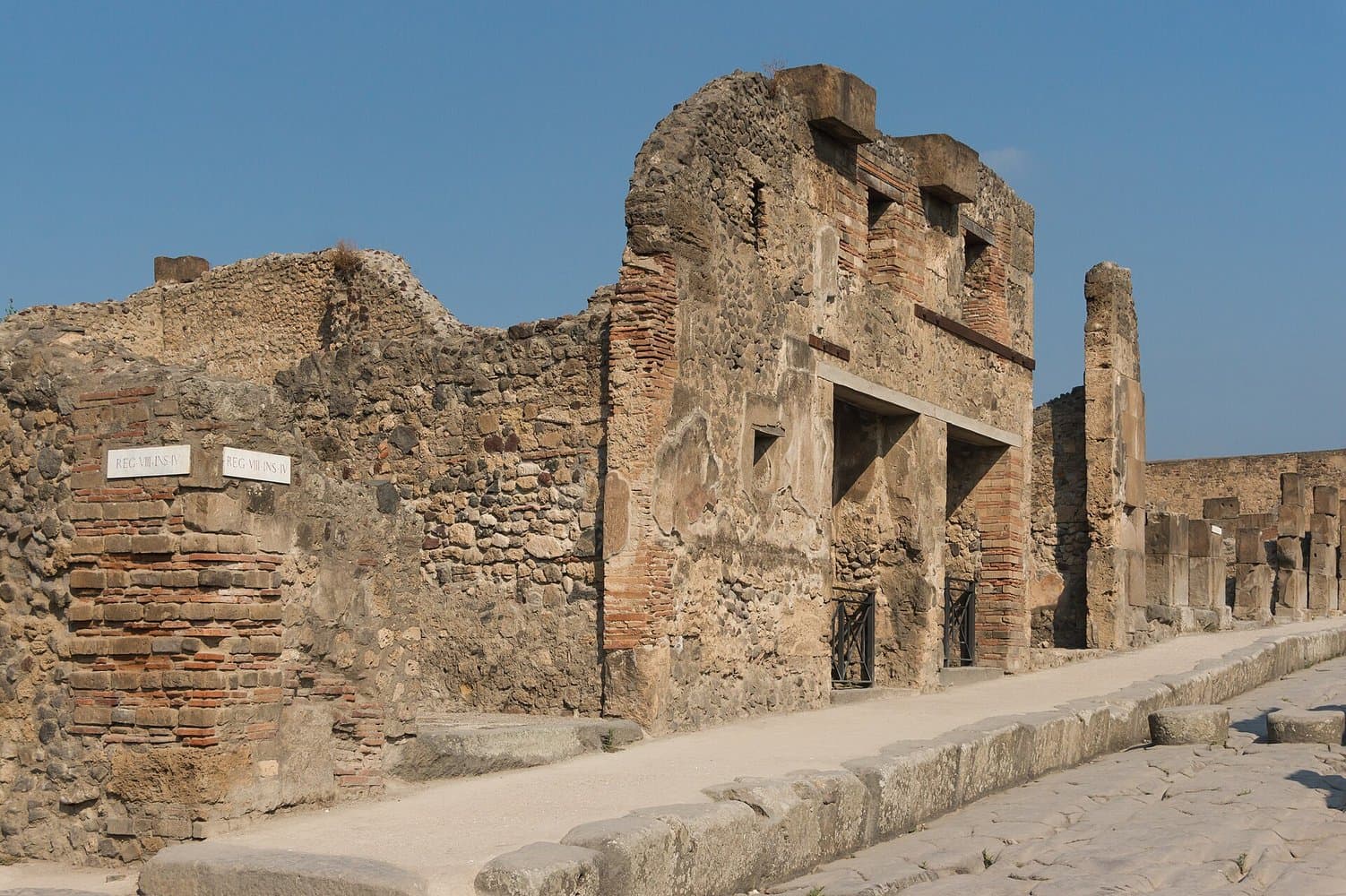
People think a volcano kills with its lava. The three most famous ones killed differently: a burning cloud at Pompeii, the sea at Krakatoa, starvation at Tambora. The more roundabout the path a volcano takes to kill, the more dead it leaves, and the less we look at them.
Pompeii, the smallest of the three in recovered victims, gave the world its image of volcanic death: excavations there have yielded the remains of more than a thousand victims. Krakatoa killed more than 36,000 people in 1883, and Tambora roughly 60,000 in 1815, according to the Smithsonian.
| Eruption | What the toll counts | Toll | What to keep in mind |
|---|---|---|---|
| Vesuvius, 79 | recovered victims and archaeological contexts | more than 1,000 victims recovered at Pompeii | this is not the total for the eruption |
| Krakatoa, 1883 | deaths, mostly caused by tsunamis | more than 36,000 | the Royal Society counted 36,417 in 1888 |
| Tambora, 1815 | flows, fallout, and famine after crop destruction | roughly 60,000 according to the GVP | deaths from fire and deaths from hunger cannot be separated; other authors go much higher |
Pompeii :Those Who Stayed Behind
At the foot of Vesuvius, roughly ten kilometers from the crater, Pompeii in 79 AD was a prosperous Roman city in Campania. The eruption killed in two phases, as the Archaeological Park distinguishes: first a shower of pumice stones and lapilli piling up to three meters high and collapsing roofs onto those sheltering beneath them—of those victims, only bones remain. Then came glowing avalanches—pyroclastic surges of burning gas and fine ash. They struck down the survivors in the streets: by instant thermal shock at a minimum of 250 °C according to Giuseppe Mastrolorenzo's team (2010), or by asphyxiation in the ash according to Llorenç Alapont's team (2023), with the scientific debate still open.
The most precise count dates from 2003. G. Luongo's team, writing in the Journal of Volcanology and Geothermal Research, tallied 1,150 victims recovered in the excavations of Pompeii: 1,044 well-recognizable bodies, including 394 in the pumice-fall deposit and 650 in the surge deposits, plus around a hundred individuals identified from scattered bones. The team estimated that 464 corpses may still lie buried in the unexcavated part of the city.
No total death toll for the eruption exists: archaeologists count recovered bodies, and most of the inhabitants had left the city. That count stops at the walls of Pompeii.
The plaster figures shown to visitors are not bodies turned to stone. Since 1863, following Giuseppe Fiorelli's method, plaster has been poured into the hollows left by decomposed flesh beneath the hardened ash: a cast is a filled absence. In the House of the Golden Bracelet, an adult wears the jewel on an arm, with a child on their lap. For decades visitors saw a mother; in 2024, DNA revealed a man biologically unrelated to the child. The plaster had promised nothing: the visitor needed a mother.
The contemporary eyewitness account, for its part, comes from a letter. At Misenum, Pliny the Elder commanded the fleet. Rectina, wife of Tascus, sent him a distress message; he had the galleys launched in the hope of rescuing, his nephew wrote, "not only Rectina, but many others." He joined his friend Pomponianus at Stabiae and died there—because, according to Pliny the Younger, his breathing was obstructed by the thickness of the fumes. When daylight returned, his body was found intact, dressed just as he had been, "more like a person asleep than a dead man."
Pliny the Younger wrote all of this to the historian Tacitus, who had asked him for an account of his uncle's death.
Only those killed by the surge left a hollow to cast. 26 casts were X-rayed or CT-scanned in 2015: before pouring the plaster, excavators had often removed bones and introduced other elements
Krakatoa :The Noise Made History, the Sea Made the Death Toll
Aboard the Norham Castle, some sixty kilometers away, the captain wrote that over half his crew had shattered eardrums and that he was convinced the Day of Judgment had come. He had the scale wrong: it was only the end of an island. On Rodrigues, nearly five thousand kilometers away, people thought they heard "the distant roar of heavy guns."
As it collapsed, the island heaved up the sea; the waves drowned, according to the Royal Society, all the coastal towns on the morning of August 27. At Telok Betong, in Sumatra, they swept a government steamer, the Berouw, inland. By the time it reached the villages, the disaster no longer had the shape of a volcano, but that of a wave. Those who died were coastal villagers of Java and Sumatra, and even the fire crossed the sea to come for them.
glowing ash flows crossed 40 km of open sea
Tambora :War Against a Mountain, Then Starvation
In April 1815, Java heard cannon fire. A detachment of troops marched out from Yogyakarta to relieve a post believed to be under attack, and boats were dispatched in search of ships in distress, according to an account compiled by Lieutenant-Governor Raffles. The colonial administration had just marched off to war against a mountain on another island.
On the Sanggar Peninsula, in northern Sumbawa, the volcano took everything. Lieutenant Owen Phillips wrote that in Pekat "no vestige of a house is left." He counted no fewer than twelve thousand inhabitants in the kingdoms of Tambora and Pekat; only five or six people survived.
Then the ash sterilized the fields. Phillips saw corpses along the roadsides and villages emptied by hunger, which killed even a daughter of the Rajah of Sanggar; the records of 1815 do not separate those killed by fire from those killed by famine.
In the summer of 2004, excavations beneath three meters of ash uncovered a house built on stilts, two adults, and carbonized timber. Volcanologist Haraldur Sigurdsson saw in it a "Pompeii of the East." Nobody has ever called Pompeii the Tambora of the West.
The Summer That Never Came
The following year, the volcanic veil cooled part of the globe: in Europe, famines, typhus, and riots followed the lost harvests, though not every death can be traced back to the volcano. On the shores of Lake Geneva, incessant rain confined Byron and his guests indoors, and each of them wrote a ghost story: out of it, Mary Shelley drew Frankenstein.
Europe gained a novel's monster from it. Sumbawa had its corpses along the roadsides.
Three Eruptions and Their Ways of Killing
79—Vesuvius
Vesuvius buries Pompeii. Excavations have recovered the remains of more than 1,000 victims
What the Three Volcanoes Say About Us
Vesuvius kills in the streets of a city. Krakatoa kills in a single morning, on the far side of a strait. Tambora kills for months in the fields, and ruins the summer of another continent. The crater gives the signal; the surge, the sea, and hunger do the counting.
Naples still lives at the foot of Vesuvius. The Earth turns inside out; afterward, it is human beings who decide who lives at the foot of the crater, by the edge of the sea, or one harvest away from hunger.