In April 1959, an eighteen-year-old high school student learned that his father was starving to death. He returned to the village with rice; in front of the house, the elm tree had been stripped of its bark, which had been eaten. Yang Xiushen, the uncle who had raised him and whom he called his father, could already no longer swallow. He died three days later.
The boy's name was Yang Jisheng. Much later, he would say: "I didn't think my father's death was the country's fault. I thought it was my fault." All the power of Mao Zedong lies in that sentence: a regime capable of starving its people and making them believe the misfortune came from elsewhere.
The man whose portrait still dominates Tiananmen Square wanted to bend China, and nature with it, to his will alone. Between 1958 and 1962, his Great Leap Forward produced the deadliest famine in history, under normal weather, without invasion: through quotas, lies, and the fear of contradicting him. Those who died were peasants, in their villages, while the cities kept their rations.
Between 30 and 45 million people died of it, in a country of about 660 million inhabitants. The Party that still governs China speaks instead of "serious difficulties."
Deaths above normal mortality: about 30 million according to Ashton and his colleagues, at least 45 million according to Frank Dikötter, with Yang Jisheng standing between the two
An Assistant Librarian with a Southern Accent
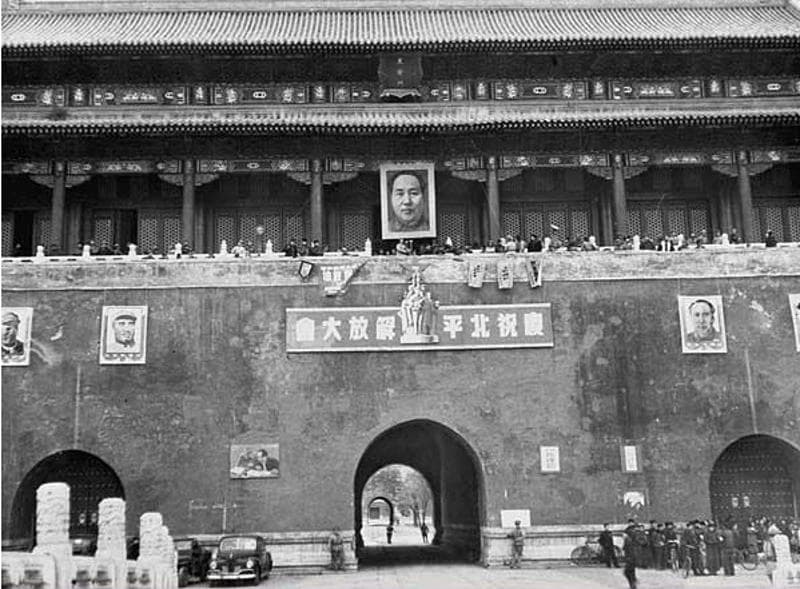
Tiananmen Gate decked with banners for the "liberation" of Beijing, early 1949 (banner : "Celebrate the liberation of Beiping")
Photographic archives
Shaoshan, 1893, amid the rice paddies of Hunan. Mao was born to a peasant turned grain merchant and moneylender, who beat his sons and despised any schooling that brought in no money. From this, the child developed an aversion to any authority that was not his own, and a passion for the outlaw heroes of the novel Water Margin, who slit the throats of corrupt mandarins.
In 1918, in Beijing, his mentor Li Dazhao, one of the fathers of Chinese Marxism, found him a job as an assistant librarian at the university. He would later tell the journalist Edgar Snow: the great minds who came to read the newspapers had no time to listen to an assistant librarian who spoke a southern dialect. All his life, Mao would hold scholars, professors, and experts as suspects, and the faith of the masses as superior to their science.
He showed early on what he did with his own people. In 1930, in his Jiangxi red base, he launched a purge against an alleged "Anti-Bolshevik League" infiltrating the Red Army. At Futian, officers mutinied; in the repression that followed, more than seven hundred communist officers were executed, by their own side.
The Party did not hold it against him. In 1935, during the Long March, the Red Army's retreat toward Shaanxi, Mao took its leadership. Allied with the Kuomintang against Japan starting in 1937, he resumed the civil war after the Japanese surrender and won it: in 1949, the nationalist government retreated to Taiwan, and Mao founded the People's Republic of China.
The Futian method was scaled up to the entire country. To be done with the "counter-revolutionaries," Mao estimated that roughly one inhabitant in a thousand would have to be executed. In 1954, the vice minister of Public Security drew up the tally of the campaign launched in 1950: rouge:712,000 executed, and 2.62 million arrests.
In 1958, the year of the Great Leap, he compared himself before Party leaders to the first emperor, Qin Shi Huang, who burned books and buried scholars alive: "He only buried 460 scholars. We have buried forty-six thousand scholars." Then: "We have outdone him a hundredfold." The image was figurative: he was speaking of the intellectuals hit by the "Anti-Rightist" campaign that had just ended, which had persecuted half a million people. The leader was boasting of a repression before those who carried it out.
The Great Leap :Melting the Pots, Hunting the Sparrows
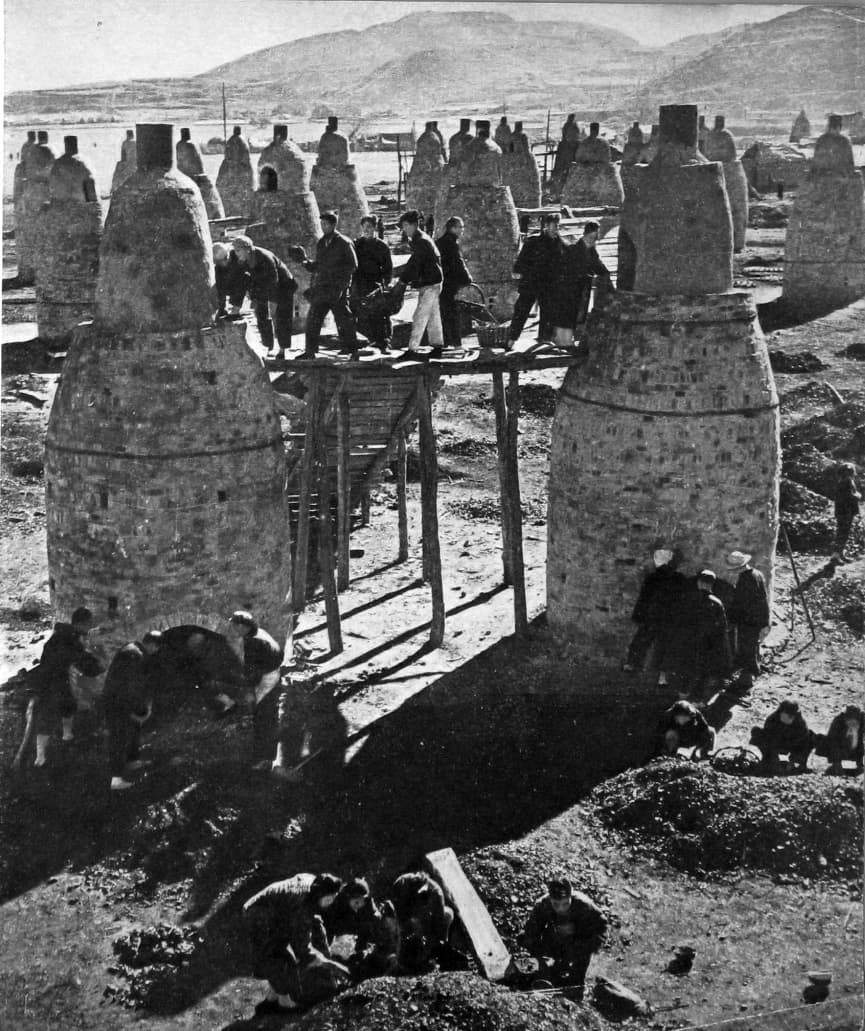
Backyard earthen furnaces (tu gaolu) lined up in Henan, October 1958, during the Great Leap Forward's steel campaign
Peasants melted their tools and cooking utensils in them
Zhang Qingyun, Selection of Chinese Art Photography (1959), public domain
At the end of 1957, Mao promised to overtake Great Britain's industrial production in fifteen years. He wanted to skip Marx's stages and propel China into communism in a single leap. The countryside was regrouped into people's communes: in a few months, 600 million peasants found themselves in 26,000 giant communes. Plots and livestock became collective; houses were sometimes demolished to salvage their wood.
Then came steel, which Mao held as the measure of power. Every commune, every village, every school built a small earthen blast furnace in its courtyard, and peasants by the millions left the fields to feed it day and night. Fruit trees were cut down for fuel, and plowshares, locks, and family woks were thrown into it. What came out was a brittle, useless pig iron.
Meanwhile, the harvests of autumn 1958 rotted in the fields, for lack of hands to reap them.
That same year, the "Four Pests" campaign targeted rats, flies, mosquitoes, and sparrows, accused of eating grain. Entire villages banged on pots, gongs, and cymbals to keep the birds from landing, until they dropped from exhaustion.
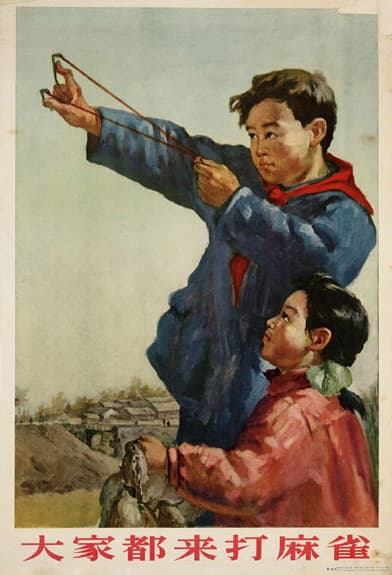
Poster for the "Four Pests" campaign : "Everyone come hunt sparrows!" (Dajia dou lai da maque), two children including a Young Pioneer armed with a slingshot
Bi Cheng, Chaohua Publishing House (Beijing), September 1956
chineseposters.net, IISH collection (CC BY-SA 4.0)
Official figures from 1958-1959, unverifiable
Rid of their predator, locusts and insects proliferated, devouring part of what remained in the fields.
From Sputnik Fields to Canteen Doors
The lies rose from below, out of fear as much as ambition. To please Beijing and secure the title of production heroes, cadres reported harvests two, three, up to ten times higher than previous yields. The press called them "Sputnik fields." It showed children standing on ears of grain so tightly packed that they seemed to float on the wheat.
The "record" wheat of Xiping, Henan: 7,320 jin per mu according to the People's Daily of July 12, 1958
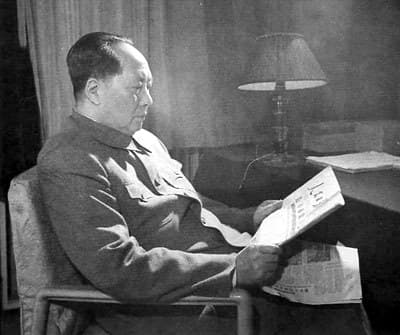
Mao Zedong reading the press
date and location undocumented
Mao read these dispatches and worried publicly about what would be done with so much grain. Less than a year later, in Yang Jisheng's village, people were eating elm bark. On the faith of imaginary figures, the state raised requisitions: in many districts, it demanded more grain than the actual harvest. Militiamen searched homes, probed walls, dug under beds, and carried off even the seed grain for the following year.
Family kitchens were banned in favor of communal canteens. Families could no longer cook anything at home: the state now controlled all food, and those who served in the canteen decided who ate. When supplies ran out, the canteen closed. There was nothing left at home.
Lushan, the Summer When Hunger Could Still Have Been Stopped
Peng Dehuai was by no means an opponent. A hero of the war against Japan, commander of the Chinese volunteers in Korea, and minister of Defense, he was a blunt and loyal soldier. From his native village in Hunan, he brought back what he had seen: the hunger, the exhaustion of the peasants, the lies of the cadres. On July 14, 1959, during the Party conference at Lushan, he handed Mao a personal and respectful letter, welcoming the Great Leap while criticizing its excesses.
Mao had it distributed to all delegates. On July 23, he responded with a threatening speech: if the Party must perish, "I will go to the countryside to lead the peasants to overthrow the government," and if the Liberation Army did not follow him, he would go "and find a Red Army." In the same speech, he admitted having launched mass steel smelting: "The chaos caused was on a grand scale and I take responsibility." He took the blame, and punished the man who named it.
No one stood up. Zhou Enlai made one self-criticism after another; Liu Shaoqi, president of the Republic, fell in behind Mao; Deng Xiaoping, absent due to injury, approved. Peng and the few who supported him, Zhang Wentian, Huang Kecheng, and Zhou Xiaozhou, were brought down for "Right opportunism." The marshal lost his ministry.
The surrender at Lushan was paid for in lives, in the villages. So as not to be seen as supporters of Peng, provincial chiefs tightened requisitions, and anyone who reported hunger became a "Rightist." The following year, 1960, was the deadliest. Yet the country continued to sell its grain: between 1957 and 1959, the state doubled its exports, to repay the Soviet Union and buy machinery. The 9.6 million tons sold abroad from 1958 to 1960 would have covered the needs of 16.7 to 38.9 million people for three years, economists Hiroyuki Kasahara and Bingjing Li calculate.
Those Who Had No Right to Leave
The famine did not strike everyone. The cities kept their rations: Beijing, Shanghai, and Tianjin were supplied directly by the central government, and holders of an urban residence permit came before the peasants. Those who died were peasants, and they had no right to flee: refugees caught in the cities were immediately sent back home.
At Xinyang, in southern Henan, the Party secretary had roadblocks manned by militia so that no one could escape. Granaries were full of seized grain, and the rare cadres who dared to open them were punished. Starting in the autumn of 1959, about one million people died there, between one eighth and one seventh of the inhabitants.
Mortality rate by province at the peak of the famine (1960)
Deaths per 1,000 inhabitantsThe map of deaths followed that of zeal. Sichuan, the country's breadbasket, was governed by Li Jingquan, a loyalist of Mao who requisitioned without restraint: 8 to 10 million inhabitants starved to death, nearly 13% of the province. In Anhui, the death rate multiplied by more than five between 1958 and 1960, while that of neighboring Jiangsu, under the same skies, merely doubled.
In the internal Party and police reports that Yang Jisheng read, one word recurred: cannibalism. People ate grass, bark, roots, boiled leather; in some villages, families turned to the dead. The administration filed everything, right down to the heading of a case file: "Manner of crime: Exhumed the victims' corpses and consumed the flesh."
Hunger did not kill alone. According to historian Frank Dikötter, who combed through provincial archives, at least 2.5 million victims were beaten or tortured to death by cadres, for hiding or gleaning a little grain, or saying that the Party was starving the country. Other historians, such as Felix Wemheuer, dispute this figure.
The Cultural Revolution :The Great Helmsman's Revenge
At the start of 1962, before seven thousand cadres gathered in Beijing, Liu Shaoqi took up a phrase that was circulating: the disaster was three parts natural, seven parts man-made. Mao offered his self-criticism and stepped aside. Liu and Deng Xiaoping restored private plots, put an end to the Great Leap, and the death rate fell back. Hunger receded as soon as policy changed.
Mao did not forget. He feared being denounced after his death, as Stalin had been by Khrushchev. In May 1966, he launched the youth against the Party apparatus itself: this was the Great Proletarian Cultural Revolution.
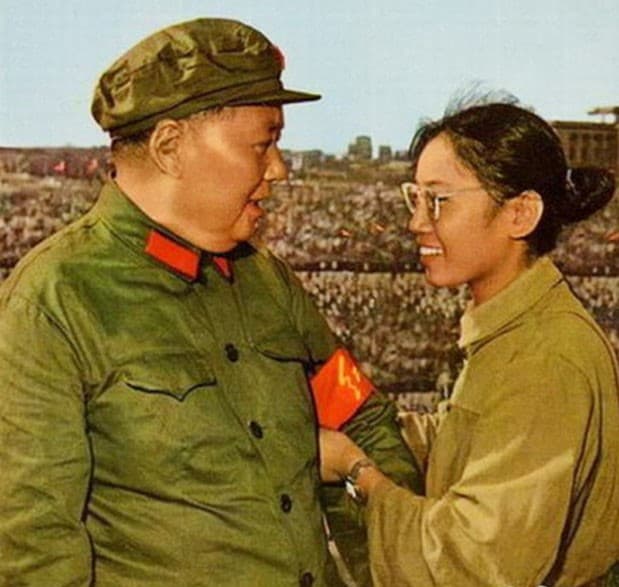
Mao Zedong and Song Binbin, Red Guard delegate from a Beijing girls' high school, tying a red armband on him atop Tiananmen Gate
Mao reportedly answered "Yào wǔ ma" ("be combative")
Beijing, August 18, 1966
photographer unknown, public domain (PD-China, Wikimedia Commons)
On August 18, 1966, in Tiananmen Square, he reviewed one million young Red Guards. A schoolgirl, Song Binbin, tied a red armband on his arm. Thirteen days earlier, in her girls' school, students had beaten to death their deputy principal, Bian Zhongyun. Song was one of the school's Red Guard leaders; it remains unknown whether she took part in the beating. In 2014, she apologized: "I failed to protect leaders of the school." Bian's widower, Wang Jingyao, said of the armband that it was soaked with his wife's blood.
The Red Guards ransacked homes, libraries, and temples, in the name of the struggle against the "Four Olds." Professors, writers, doctors, and artists endured "struggle sessions": kneeling for hours, arms pulled backward, wearing dunce caps. Many killed themselves.
Liu Shaoqi, the man of the "seven parts," was humiliated in struggle sessions, then detained in Kaifeng, denied medical care. He died there on November 12, 1969, and his body was cremated under an assumed name. In Guangxi, writer Zheng Yi documented victims, labeled class enemies, whose flesh was eaten. The decade caused more than one million deaths, and millions of urban youth were forcibly sent to the countryside.
Estimate by sociologist Andrew Walder based on county and city annals: lynchings, struggle sessions, factional fighting, repression
The Mausoleum and the Score of 70 Out of 100
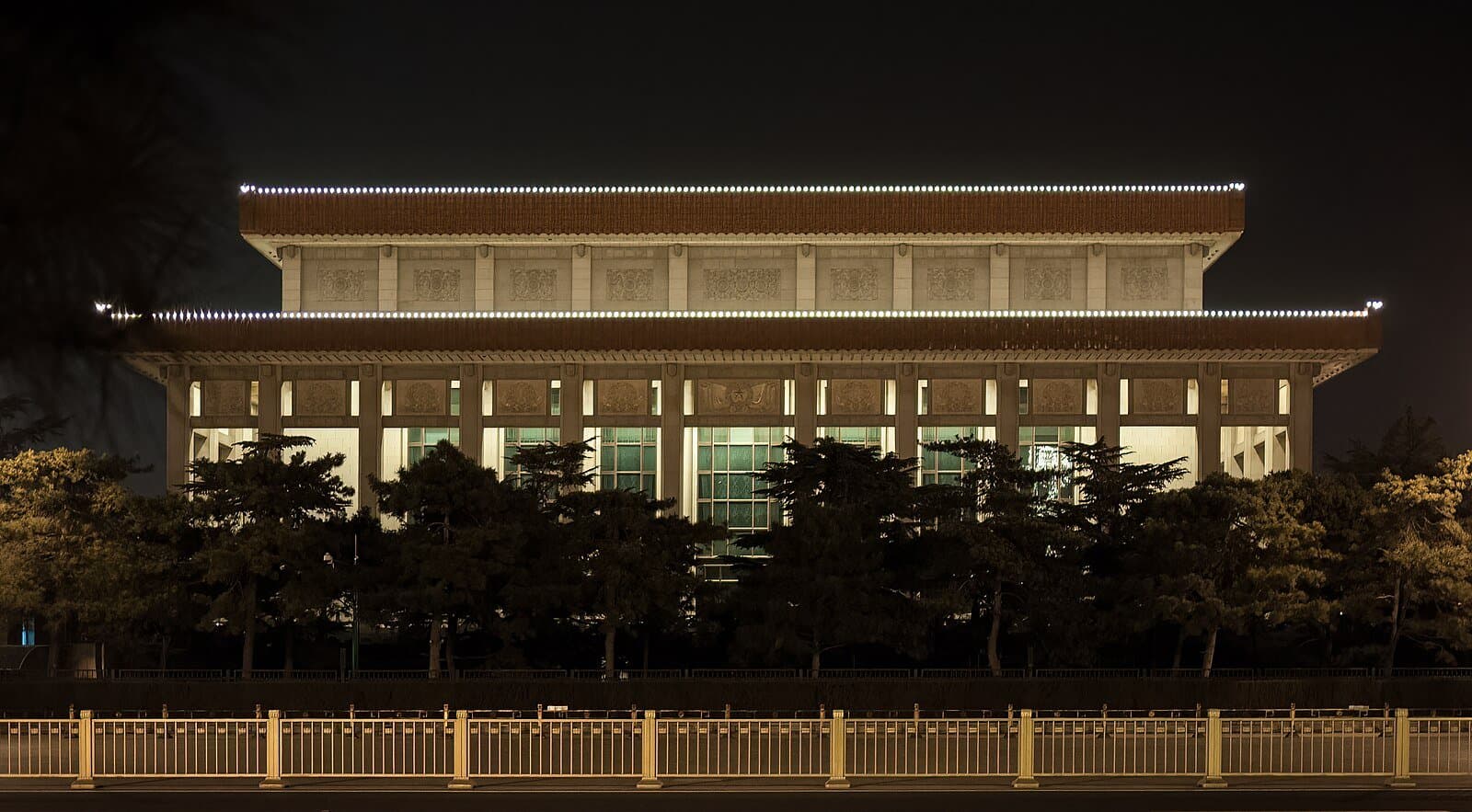
Mao Zedong's mausoleum in Tiananmen Square in Beijing illuminated at night
The dictator's embalmed remains still rest there in a crystal coffin
Ermell, Wikimedia Commons (CC BY-SA 4.0)
Mao died in September 1976 without having to answer for the famine. The Soviet Union had Khrushchev's secret speech; China never carried out its de-Maoization. On June 27, 1981, the Party settled the matter in a resolution: Mao's merits were "primary," his errors "secondary." The "serious difficulties" of 1959 to 1961 were attributed mainly to the errors of the Great Leap Forward, then to natural calamities and the tearing up of contracts by Moscow; they inflicted "serious losses to our country and people."
To his credit, his defenders cite a semicolonial country turned into a major power, literacy, women's rights, basic healthcare, schooling, and increased life expectancy. The phrase circulating ever since, "70% good, 30% bad," came from Mao himself. Deng Xiaoping would recall it in 1988: Mao would have been satisfied to have his work judged as seventy percent achievements and thirty percent mistakes. The man had set his own grade, and the Party copied it.
There remains the label that follows him everywhere, "the greatest mass murderer in history." Everything depends on what is counted. Historian Timothy Snyder arrives at about 11 million civilians deliberately killed by Nazi Germany, and about 6 million under Stalin, including some 3.3 million deaths from the Ukrainian famine of 1932-1933, which he considers a policy of killing. Counted the same way, the deaths of the Great Leap Forward place Mao far ahead of both. If one counts only deaths at human hands, 712,000 executed after 1950, at least 2.5 million beaten or tortured to death during the famine and more than one million during the Cultural Revolution, his total exceeds 4 million and remains below theirs. The entire ranking hinges on one question: is a famine that those in power caused, and then refused to stop, murder?
His embalmed body rests in a crystal coffin at the center of Tiananmen Square, and his face adorns every banknote. The book in which Yang Jisheng erected a monument to his father and the other victims of the famine, Tombstone, is banned in China.
Thirty to forty-five million dead; in the official text, two words: "serious losses