Modern France was born in war. In September 1792, at Valmy, the soldiers of the Revolution stopped the Prussians with the cry of "Vive la nation!", and the monarchy was abolished the following day. Since then, its wars have made and unmade its regimes: Waterloo swept away Napoleon's Empire in 1815, Sedan the Second Empire in 1870, the defeat of 1940 the Third Republic, and the Algerian War the Fourth, in 1958. The Great War, though won, cost it a generation.
What did it fight for? To defend the Revolution, then to dominate Europe under Napoleon; to build a colonial empire in the nineteenth century, then to keep it, all the way to Indochina and Algeria; for its territory in 1870, in 1914, and in 1939; and, since then, in distant interventions, in the name of its alliances or the fight against terrorism.
Up to the Sahel operations, concluded in 2022, France waged a dozen major wars and as many colonial campaigns. The wars examined here cost the lives of about three million French soldiers, nearly half of them during World War I.
Those France killed, in Europe as in its colonies, were almost never counted: demographers and historians reconstruct their numbers, which can vary, from one author to another, by a ratio of one to forty, and sometimes more.
The Wars of the Revolution and Empire (1792-1815) :Death in the Hospital
Twenty-three years of almost relentless war: Revolutionary France, then Napoleon's, faced the coalitions of Europe, from the declaration of war on Austria in April 1792 to Waterloo in June 1815.
The vast majority of dead soldiers did not fall on the battlefield: they died in hospitals, from wounds or disease. The Fondation Napoléon sees this as "the deficiency of the medical service more than the harshness of combat."
For hundreds of thousands of others—prisoners, deserters, or men struck from the registers—their fate was never recorded. The Foundation accepts a toll of 900,000 to 1,000,000 dead soldiers from 1800 to 1815, nearly half of them between 1812 and 1814, from the retreat from Russia to the Campaign of France.
On the other side, the opposing armies lost between 1 and more than 2.5 million men. And war killed far from the armies: in Spain, from 1808 to 1814, it caused 215,000 to 375,000 deaths among civilians.
The War in the Vendée (1793-1796) :A War Between Frenchmen
On February 24, 1793, the Convention decided on a levy of 300,000 men. In March, in the West, around the Vendée, it triggered a peasant uprising. In early 1794, the "infernal columns" of General Turreau ravaged the insurgent country; in Nantes, thousands of prisoners were drowned in the Loire. These columns alone killed about 50,000 Vendéans, according to the World History Encyclopedia.
Exaggerated estimates, up to 500,000 dead, circulated for a long time. Historian Peter McPhee accepts the most widely agreed-upon recent estimates: up to 170,000 insurgent dead and about 30,000 republican soldiers.
The Conquest of Algeria (1830-1871) :Razzias and Hunger
It was meant to be a punitive expedition; it became a conquest lasting over forty years. Landing at Sidi-Ferruch in June 1830, the French army took Algiers three weeks later. The best-known practice was the enfumade: in June 1845, in the Dahra caves, hundreds of Algerians, mostly civilians, died of asphyxiation. But according to historian Alain Ruscio, it was the razzias, the raiding of villages and tribes, that killed the most: deprived of the means to live, peasants died of famine and epidemics. In 1843, an officer, Montagnac, wrote: "All populations that do not accept our conditions must be leveled, everything must be taken, ransacked, without distinction of age or sex."
From 1830 to 1852, Ruscio counts between 400,000 and 500,000 Algerian deaths out of about 4 million inhabitants, the vast majority civilians.
The conquest also killed nearly 100,000 French soldiers, most carried off by fevers and exhaustion rather than in combat: Ruscio sees in this the command's contempt for the troops.
The Crimean War (1854-1856) :Cholera Before the Enemy
In March 1854, France and the United Kingdom aligned with the Ottoman Empire against Russia; the siege of Sevastopol lasted eleven months.
French deaths were counted by a military physician, Jean-Charles Chenu, under an eloquent title: De la mortalité dans l'armée, et des moyens d'économiser la vie humaine. He counted more than 95,000. About 75,000 of them died of diseases, including cholera, and not in combat.
The War of 1870 (1870-1871) :The Dead Without a List
A single dispatch, that of Ems, was enough for France to go to war against Prussia in July 1870. Six weeks later, Napoleon III was a prisoner at Sedan, and besieged Paris spent the winter in cold and starvation.
The conflict cost the lives of 138,000 Frenchmen, according to the Ministry of the Armed Forces: many from wounds or disease, many also in captivity, among the prisoners taken to Germany.
No general list of these dead was ever compiled: each death was transcribed into the civil registry of the municipality where the soldier lived. In 2020, the Revue française de généalogie estimated their number, at the very least, at 139,000; the Fédération française de généalogie and Le Souvenir français invited mayors to engrave the recovered names on their monuments.
The Paris Commune (1871) :The Bloody Week
Paris refused to surrender its cannons. In March 1871, the city rose up against the government of Adolphe Thiers, installed at Versailles, which wanted to disarm the national guard. The Commune was, more than any other nineteenth-century movement, a workers' movement, according to historian Quentin Deluermoz.
From May 21 to 28, during the "Bloody Week," the Versailles army retook the city neighborhood by neighborhood. Courts-martial tried cases quickly, people were shot in groups, and the blood was washed away with chlorine and lime; nearly 40,000 people were arrested. The Communards, for their part, executed hostages, including the archbishop of Paris.
The death toll remains debated. Older estimates ranged from 15,000 to 40,000; in 2011, historian Robert Tombs, using cemetery, hospital, and town hall records, proposed about 6,500 dead, a figure that others dispute.
World War I (1914-1918) :A Generation in Stone
The system of alliances dragged France into the war: Germany declared war on it on August 3, 1914, invaded Belgium and the North, and the front froze for four years.
Nearly 1.4 million French military personnel were killed, according to the Ministry of the Armed Forces, leaving nearly 600,000 widows. Historian Antoine Prost considers that the losses of this war were underestimated.
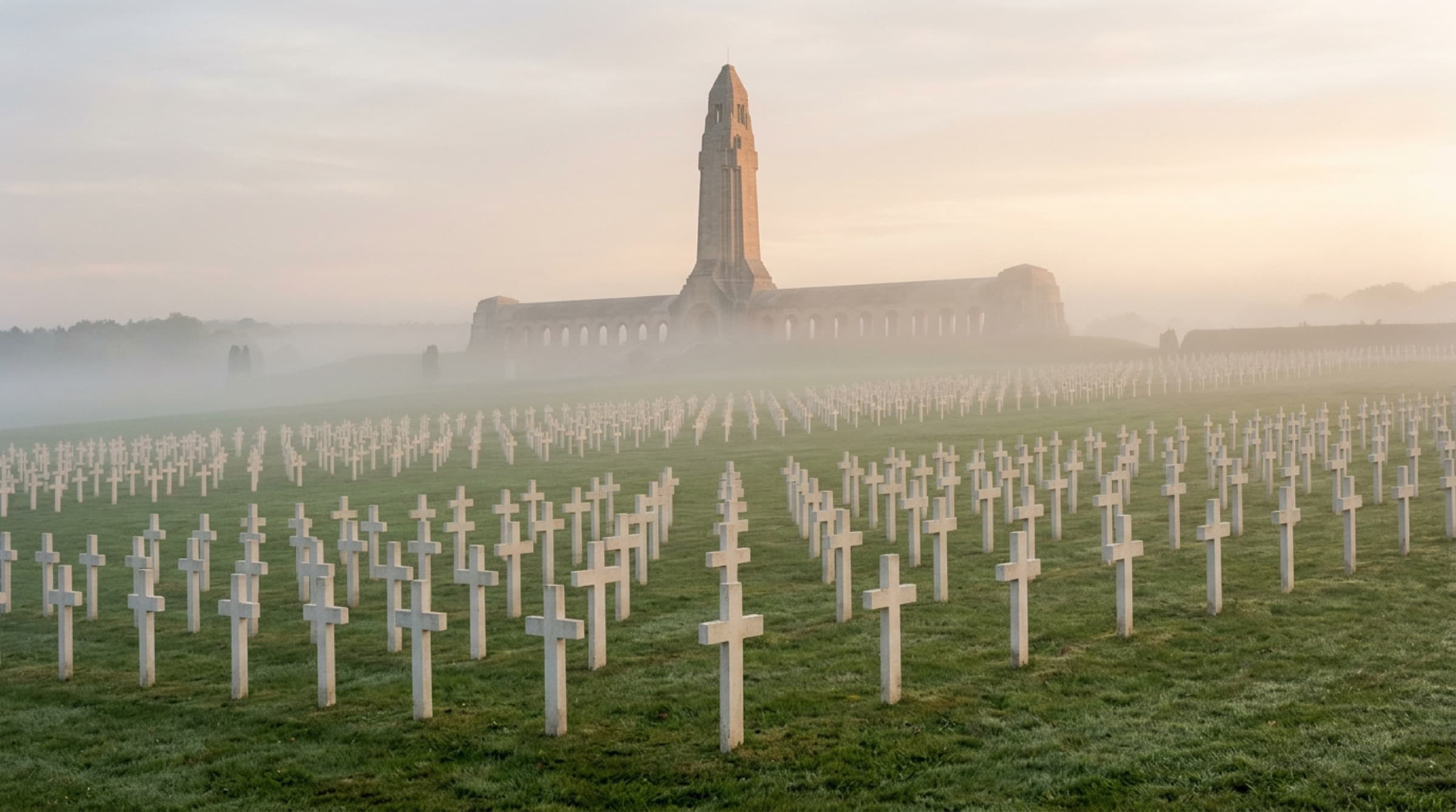
Verdun. On February 21, 1916, General von Falkenhayn, at the head of the German army, launched the attack on Verdun; the battle lasted until December 18. It cost France 163,000 dead and missing, and 216,000 wounded: the 379,000 "losses" often cited add the two together. Germany lost 143,000 dead and missing there. In 1919, Falkenhayn wrote in his memoirs that he had wanted to "bleed white" the French army; the Verdun Memorial today reads this as a justification written after the fact, once the toll was known.
At Douaumont, the ossuary inaugurated in 1932 holds the remains of 130,000 soldiers gathered from the battlefield. No one could give them back a name, or even a side: they are "German or French."
The Somme. From July 1 to November 18, 1916, the armies of General Joseph Joffre, the French commander in chief, and of British General Douglas Haig attacked on the Somme; they gained twelve kilometers at most. On the first day, the British army counted 19,240 killed; the next day, an official communiqué expressed satisfaction at having recorded only light losses. France lost 66,688 dead and missing there: its 202,559 "losses" add the wounded, and the three armies together exceeded a million men put out of action.
It was this war that covered the country with monuments: as soon as peace came, they "invaded the communal landscape," driven by the desire to carve into stone the names of those who fell.
World War II (1939-1945) :More Civilians Than Soldiers
Defeated in six weeks in the spring of 1940, France was occupied, and the Vichy regime collaborated. It had entered the war in September 1939, alongside the United Kingdom, against Germany, which had just invaded Poland.
There were 567,600 French dead, according to the National WWII Museum, including 217,600 military personnel: the others, more numerous, were civilians, killed in bombings, in the fighting of the Liberation, in massacres, and in deportation. For either world war, no source isolates the share of deaths caused by the French army.
Vichy France also handed over its Jews. The Jewish Statute of 1940 was personally hardened by Pétain, according to a document revealed in 2010 by Serge Klarsfeld. On July 16 and 17, 1942, police officers from the Paris police prefecture, together with French police and gendarmerie, arrested 13,000 Jews in Paris: this was the Vel' d'Hiv roundup. From March 1942 to August 1944, 75,721 Jews were deported from France, including nearly 11,000 children; when the camps were liberated, only 2,566 survivors were counted.
The occupier massacred as well. On June 10, 1944, in Oradour-sur-Glane, in Haute-Vienne, a detachment of the SS division Das Reich, on the orders of its commander Heinz Lammerding, killed 643 residents; 350 women and children had been locked in the church, which was machine-gunned and then set on fire.
Sétif, Guelma, and Kherrata (1945) :The Other May 8
On May 8, 1945, Victory in Europe Day, Algerian nationalists marched in Sétif. A 26-year-old scout, Saâl Bouzid, brandished the flag of the Algerian People's Party; he was shot dead. The ensuing riot killed 102 Europeans.
According to a proposed resolution submitted to the National Assembly in 2025, the French military then conducted a repression that lasted until the end of June. In the first eleven days, through May 19, the air force dropped 41 tons of bombs on the region. In Guelma, sub-prefect André Achiary armed a militia of Europeans, and an improvised tribunal, without magistrates, ordered the execution of 50 to 60 Algerians per day, according to the same text. Some of the bodies were burned in lime kilns, making any precise count impossible.
The initial French official toll reported 1,165 victims. Historians go up to 15,000 or 20,000 dead, and Algerian authorities put the figure at 45,000.
| Who counts | Death toll |
|---|---|
| Initial French official toll | 1,165 victims |
| Charles-Robert Ageron and Gilbert Meynier | 5,000 to 6,000 dead |
| Roger Vétillard | 5,000 to 10,000 dead |
| Jean-Pierre Peyroulou and Gilles Manceron | 15,000 to 20,000 dead |
| A US consulate representative at the time | 30,000 to 35,000 victims |
| Algerian authorities | 45,000 dead |
In Sétif, a stele commemorates Saâl Bouzid, the "first dead" of these massacres; in 2021, the French ambassador laid a wreath there. In France, the 2025 proposal calls for a national memorial site.
The Indochina War (1946-1954) :Legionnaires, Africans, Indochinese
Ho Chi Minh's Viet Minh proclaimed Vietnam's independence in September 1945; France chose to reconquer Indochina by arms. On November 23, 1946, its navy bombarded the port of Haiphong: according to historian Thomas Vaisset, estimates range from 300 to 20,000 dead, mostly civilians. At the end of 1953, the French general staff established an entrenched camp at the bottom of the Dien Bien Phu basin in northwestern Vietnam, resupplied by air; but General Giáp's troops hauled their artillery onto the wooded hills overlooking the valley, neutralized the airstrip, and pounded the garrison for fifty-six days, from March 13 to May 7, 1954. The fall of the camp sealed the end of the war.
Those who died for France came from everywhere: according to the Ministry of the Armed Forces, 83,300 combatants fell from 1945 to 1954, including 12,000 legionnaires, more than 15,000 soldiers from Africa, and 27,000 from Indochina. Every June 8 pays tribute to them, the day an unknown soldier from Indochina was buried at Notre-Dame-de-Lorette. Of the 40,000 soldiers taken prisoner by the Viet Minh, nearly 30,000 never returned.
Yet the same ministry provides, further down on the same page, another breakdown that includes the armies of the Associated States and does not add up to the same total: 92,000 dead instead of 83,300. The page does not explain the discrepancy.
| Other breakdown from the Ministry of the Armed Forces (same page) | Death toll |
|---|---|
| Metropolitan soldiers, legionnaires, and Africans | more than 47,000 killed |
| Indochinese combatants of the expeditionary corps | 28,000 killed |
| Soldiers of the armies of the Associated States | 17,000 killed |
On the other side, nearly 500,000 Viet Minh combatants died. No reliable toll of Vietnamese civilians killed has been established.
Madagascar (1947-1948) :Hunger and "Pacification"
On the night of March 29, 1947, Malagasy insurgents attacked military outposts and plantations in the eastern part of the island. They targeted Europeans, and Malagasy people who worked with them. France accused the deputies of the Mouvement démocratique de la rénovation malgache and conducted nearly two years of "pacification," mainly using Senegalese riflemen: torture, summary executions, burned villages.
This time, the official death toll exceeded that of historians. French state accounts reported 89,000 Malagasy victims, a figure historians consider exaggerated, perhaps to weigh down the prosecution's case. Historian Jean Fremigacci accepts 30,000 to 40,000 dead. About 10,000 died violent deaths; the others died of hunger or disease, a large portion in areas held by the insurrection.
On the French side, about 550 Europeans were killed, along with about 1,900 Malagasy auxiliaries.
The Algerian War (1954-1962) :The War Without a Name
For Paris, Algeria formed three French departments: war was not waged there. Yet attacks by the National Liberation Front (FLN) on November 1, 1954, the "Red All Saints' Day," opened eight years of fighting, and it was not until a 1999 law that official texts wrote "Algerian War."
More than one and a half million young conscripts served there, and the army practiced torture.
The Algerian toll divides opinion. Based on demography, French historians accept 250,000 to 300,000 Algerian dead; the French Ministry of National Education, about 400,000, civilians and combatants; the Algerian state claims 1.5 million martyrs. After the ceasefire, 15,000 to 30,000 harkis, Algerian auxiliaries of the French army, were killed.
It was General de Gaulle, recalled to power in 1958 by President René Coty, who decided to get France out: in September 1959, he offered Algerians self-determination, which the French approved by referendum on January 8, 1961, with 75% of the vote. The departure took place without the harkis: in May 1962, his ministers Pierre Messmer, of the Armed Forces, and Louis Joxe, in charge of Algeria, telegraphed the order not to repatriate them. In 2016, President François Hollande recognized "la responsabilité des gouvernements français dans l'abandon des harkis, des massacres de ceux restés en Algérie" ("the responsibility of French governments for the abandonment of the harkis, for the massacres of those who remained in Algeria").
According to the Ministry of National Education, the French army lost about 30,000 soldiers, and about 4,000 French civilians were killed.
Afghanistan (2001-2014) :The Uzbin Valley Ambush
After the attacks of September 11, 2001, France joined the US-led coalition against the Taliban, then the NATO force. On August 18, 2008, in the Uzbin Valley, ten French soldiers were killed in an ambush.
Eighty-nine or ninety French soldiers died there: the Ministry of the Armed Forces publishes both figures, and the count cited in the National Assembly uses the first.
In the absence of a figure specific to French forces, the death toll of the entire war from 2001 to 2021 remains: about 176,000 direct deaths, including more than 46,000 civilians, according to Brown University's Costs of War project.
The Sahel (2013-2022) :The Bounti Strike
In January 2013, at the request of the Malian government, France launched Operation Serval against jihadist groups advancing from northern Mali, followed by Barkhane, extended to the Sahel. After two coups in Mali, the last French soldiers left the country on August 15, 2022. That day, the Chief of the Defense Staff paid tribute to "the ultimate sacrifice of the 59 French military personnel fallen in the Sahel."
No public death toll of combatants killed by French forces has been published. On January 3, 2021, an airstrike by Barkhane near the village of Bounti killed at least 22 people, including 19 civilians, gathered for a wedding, according to an investigation by the UN mission in Mali. France disputes these findings and maintains that it targeted a jihadist gathering.
The Wall of Names
On November 11, 2019, in Paris, the President of the Republic inaugurated a monument to soldiers who died in foreign operations since 1963. Bronze soldiers carry a coffin that is not there: "The absence of the coffin is all the more moving," he said. On the wall, 549 names are engraved, from Chad to Mali, from Lebanon to Iraq.
On this wall, as on village war memorials, each of the dead has a name. Those whom these wars killed on the other side, from Dahra to Guelma, from Haiphong to Bounti, almost never do: what remains are ranges that historians debate.
See also: the calendar of the dead, where these dates have their day.