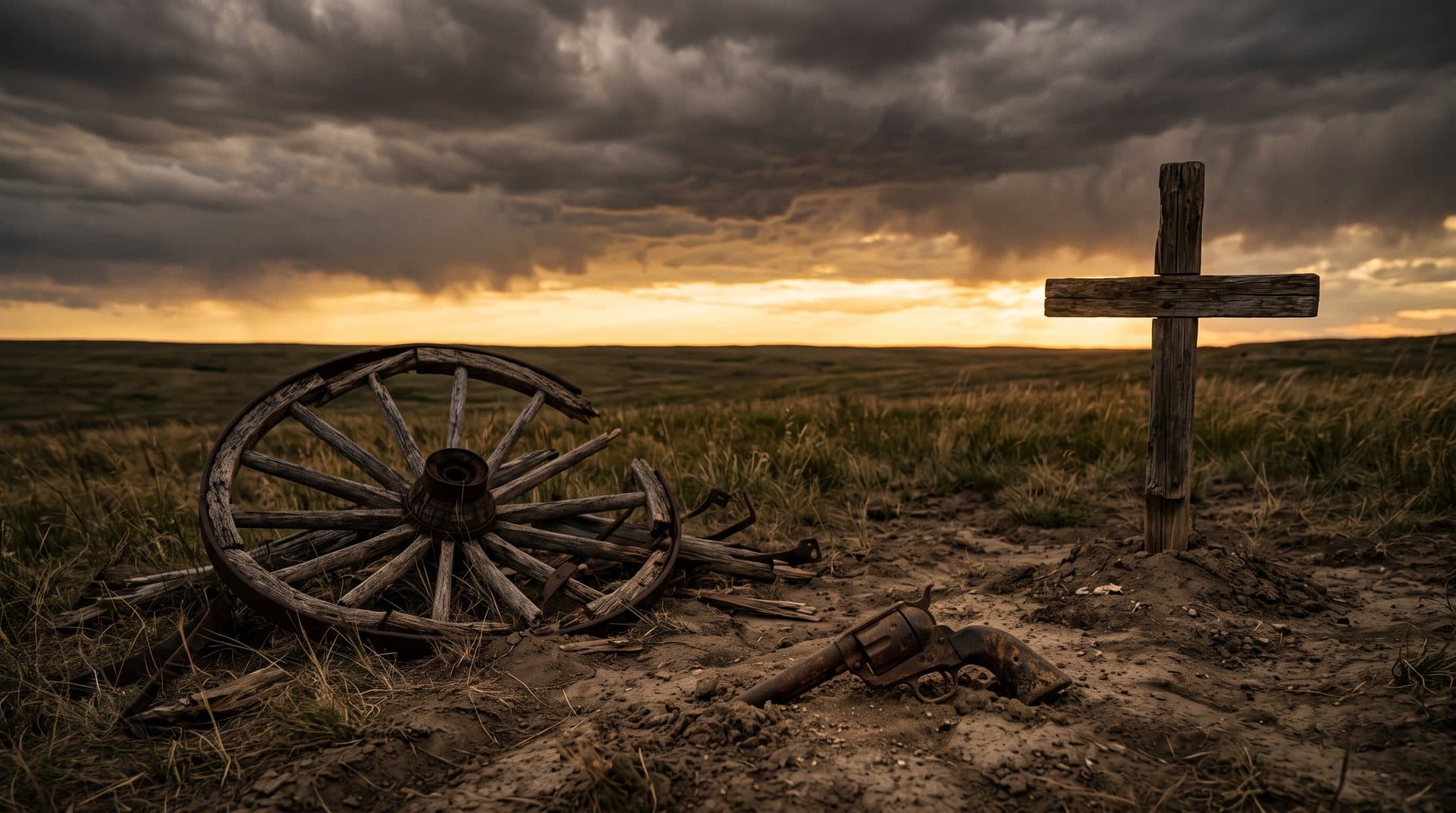
On July 8, 1849, in what would become Wyoming, a twenty-five-year-old forty-niner, seized by delirium, begged his friends for a bullet to end it all. Charles Bishop, a Washington plasterer, had survived the Mexican War; at two in the morning, he was still standing guard. He died at one in the afternoon, of cholera, after drinking, according to his captain, stagnant water from a slough. Nobody fired a shot.
They buried him with music, sewed up in his blue blanket, with the Stars and Stripes over the body. The Western kept the flag and the brass band; it threw out the diarrhea. Sergio Leone and John Wayne never filmed that death. Along the route to Oregon and California, "the nation's longest graveyard" according to the National Park Service, nearly one emigrant in ten did not survive, all causes combined. The movies preferred the only kind of death that can be filmed standing up.
High estimate, out of roughly 350,000 emigrants who set off: disease was, "by a wide margin," the number one killer
The Nation's Longest Graveyard
From 1841 to 1869, heading West meant walking for five months on foot beside an ox-drawn wagon across the 3,200 kilometers separating the jumping-off towns along the Missouri from Oregon or California. Every wagon train followed the same rivers, camped at the same crossings, and drank downstream from those ahead of it. In that moving crowd without sewers or doctors, cholera was nothing like a Western movie villain: the bacterium thrives in polluted water, attacks the intestine, and drains the body within hours—victims often died within twelve hours of the first symptoms. In 1849, it made its way up the Missouri on steamboats along with the gold seekers. "The gold rush was to cholera like wind to fire," writes historian George Groh, and for that single year, some estimates run as high as five thousand dead.
Graves were often dug right in the trail itself, where the wheels of the following wagons packed down the dirt, and most graves were deliberately left unmarked to discourage grave robbers.
National Park Service calculation: up to 30,000 deaths from disease across roughly 3,200 kilometers (one mile equals 1.6 km); only a few grave sites are marked
The Enemy Was Not Behind the Hill
The Western has its favorite scene: wagons circled under a hail of arrows. For 1840–1860, historian John Unruh counts just over 360 emigrants killed by Indians, and more Indians killed by emigrants. The major threat posed by Indians, he notes, was thievery, not murderous attack. The tribes that came in contact with the wagon trains, meanwhile, paid a heavy price in cholera.
Unruh's count stops at the wagon trains. Off the trail, the largest mass killings in the West were neither duels nor attacks on wagons: it was the army doing the shooting. On November 29, 1864, along Big Sandy Creek in the Colorado Territory, Colonel Chivington and regiments of Colorado volunteers attacked a Cheyenne and Arapaho camp: over the course of eight hours, around 230 dead, mostly women, children, and the elderly, according to the National Park Service.
On December 29, 1890, at Wounded Knee, South Dakota, some 500 troops of the 7th Cavalry surrounded a Lakota band to disarm them. The first shot went off during a struggle over a rifle; more than 250 Lakota were killed, over half of them women, children, and elderly tribal members. Twenty soldiers received the Medal of Honor for that day.
The real danger traveled inside the wagon train: above all the wagon accident, when a child or an adult fell off the seat under the wheels. Accidental shootings were common, murders rare: many emigrants shot themselves for lack of knowing how to handle their rifles. The armed pioneer had a formidable enemy—himself.
The mountain, for its part, sorted its dead. In the winter of 1846–1847, trapped by snow in the Sierra Nevada, the Donner Party resorted to eating its own dead: out of 87 people, 46 survived according to PBS, and counts vary. Anthropologist Donald Grayson looked at who died among the 85 people in his own count, 52 men and 33 women: more than half of the men died, and fewer than a third of the women, who were better insulated against the cold by their body fat. Among the dead were eleven single men aged twenty to thirty-nine: the lone young man, the very hero of the Western, fitted the profile of the dead.
At least, over the same period, according to John Unruh's estimate
The High Noon Duel Never Happened
After the trail, the Western has its other stage set: the cattle town. Across five of them in Kansas, Dodge City included, historian Robert Dykstra counts forty-five adults who died violently from 1870 to 1885. "Nobody died in a Hollywood-style duel," he writes; fewer than a third of the victims returned fire.
Out of fear for their business, merchants first funded police forces and tough gun-control laws. The cowboy rode into town, and they took his revolver before they took his money.
Even the most famous shootout in the West grew out of an ordinance prohibiting guns within city limits: on October 26, 1881, in Tombstone, the Earps set out to enforce it; thirty seconds later, three men—Billy Clanton and the brothers Tom and Frank McLaury—lay dying in a vacant lot behind the O.K. Corral. The movies kept the name of the corral, which had nothing to do with it.
Few duels did not mean few murders. In Dodge City, according to Randolph Roth's calculations, an adult living there from 1876 to 1885 faced at least a one-in-sixty-one chance of being murdered. People did not fight duels there, yet they did not retire there either.
Mass violent death in the West also happened in town, and without a duel. On October 24, 1871, in Los Angeles, a mob that quickly grew to 500 people—one resident in ten—attacked Chinatown. The next morning, seventeen bodies were laid out in the jail yard; an eighteenth had been buried the night before. One in ten Chinese residents of the city was dead. The grand jury returned forty-nine indictments, eight rioters were convicted of manslaughter, and then the convictions were overturned on a legal technicality, and no one was ever retried.
Including justifiable killings by the police; four of these deaths were accidental shootings
The Wild West did kill, then, though not the way movies shoot it: within twelve hours from slough water, under a wagon wheel, at the muzzle of one's own rifle, or from starvation in the snow. Those deaths had no heroes, and Hollywood left them by the side of the trail. Charles Bishop begged for a bullet. On the road West, the deadliest weapon was a mouthful of stagnant water.