
In August 2002, by the family's account, Robert Ajemian set up a Yahoo email account for his brother John. Both brothers knew the password, the family later told the court, but Robert used the account so rarely that he forgot it.
On August 10, 2006, John Ajemian died in a bike accident at 43. He left no will and no instructions about the account he had used as his main email address. His brother and sister, appointed to settle his estate, asked Yahoo to let them in. Yahoo refused. Eleven years after he died, the highest court in Massachusetts ruled that Yahoo was allowed to hand over the emails. It did not rule that Yahoo had to.
The house, the car, the life insurance: that inheritance has probate courts and centuries of practice behind it. The other inheritance, the one stored on someone else's servers, sits behind a federal law from 1986, and it opens mainly if you wrote down that it should.
John Ajemian died in August 2006; Massachusetts' highest court ruled in October 2017, then sent the case back down to probate court
What Yahoo gave a Marine's father under court order in 2005: the emails his son had received, not the ones he wrote
The Uniform Law Commission's tracker on October 30, 2026; Massachusetts, where the Ajemian case was fought, still has bills pending
Massachusetts :the password nobody remembered
Yahoo offered subscriber information, and only with a court order. The siblings obtained the order and got the records, but not the messages. In September 2009 they sued in probate court for "unfettered access to the messages in the decedent's e-mail account."
The case was dismissed, revived on appeal in 2013, then lost again on the ground that federal law forbade disclosure. It reached the Supreme Judicial Court, which ruled on October 16, 2017. The federal statute "permits Yahoo to divulge the contents of the e-mail account where, as here, the personal representatives lawfully consent to disclosure on the decedent's behalf." The dead man's estate could give the consent the dead man no longer could.
Eleven years for one inbox
2002—Account
A Yahoo email account is set up for John Ajemian (his brother Robert says he did it)
Then came the catch. If Yahoo's terms of service were an enforceable contract, they gave the company, in the court's words, "the apparently unfettered right to deny access to the contents of the account and, if it so chooses, to destroy them." Chief Justice Gants would have ruled for the family outright; the majority sent that question back to probate court. On March 26, 2018, the U.S. Supreme Court declined to hear Yahoo's appeal, and we found no public report of what happened next. The highest court in the state had decided that the family could be let in; it could not decide that anyone would open the door.
Michigan, 2005 :ten thousand pages, none of them his
The Ajemians were not the first. On November 13, 2004, Lance Cpl. Justin M. Ellsworth, 20, was killed by a bomb on patrol in Al Anbar Province, Iraq. His parents wanted the messages he had written before he died. Yahoo said no: its terms stated that "rights to the Yahoo! I.D. and contents within the account terminate upon death," and its policy was to erase an account after 120 days without activity. The family was racing the clock.
In April 2005, a probate judge in Oakland County, Michigan, ordered Yahoo to provide the contents of the account. Yahoo did not fight the order. It handed over a CD of more than ten thousand pages, and John Ellsworth, the father, went looking for his son's voice. He found the emails Justin had received: the family's own messages, spam, a few notes from strangers. Nothing Justin wrote. "Maybe that's all he had," he said. Yahoo then said the outgoing messages should have been on the disc and promised a paper copy. The Ellsworths pried open a dead man's inbox by court order, not by law, and found the envelope before the letter.
The 1986 law standing at the door
The obstacle in both cases has a name: the Stored Communications Act, enacted on October 21, 1986, long before anyone kept a life in an inbox. It says a provider "shall not knowingly divulge to any person or entity the contents of a communication," except with the "lawful consent" of the sender or the recipient. Records about the messages are another matter: those can go "to any person other than a governmental entity."
The law splits your mail in two: the envelope and the letter. In 2015 the Uniform Law Commission, which drafts model laws for the states, built on that split with the Revised Uniform Fiduciary Access to Digital Assets Act, or RUFADAA. By default, your executor gets the "catalogue of electronic communications": who you wrote to, when, and at what address, plus your other digital assets. The content of your messages comes out only if you consented or a court orders it.
Your consent can come from three places, ranked in what the drafters call a "three-tier priority system." First, a platform's own tool, such as a legacy contact setting, which overrides a contrary instruction in your will. Second, your will, trust, or power of attorney. Last, if you said nothing, the terms of service you clicked through years ago. And the act serves the executor, not the family as such: relatives who are not fiduciaries "are not covered by this act."
On October 30, 2026, the commission's tracker listed the act as adopted in 49 of the 53 jurisdictions it follows. Massachusetts, where the Ajemians spent eight years in court, is not among them: two bills there were reported out of committee on January 29, 2026, the last action the tracker shows.
New York adopted its version in 2016. In June 2017, a Manhattan court heard Kenneth Haywood, who wanted his late spouse's Google email, contacts, and calendar to "be able to inform friends of his passing." He got the contacts and the calendar but not the emails, unless he could show they were needed to settle the estate. In December 2025, according to a summary by the law firm Farrell Fritz, a Suffolk County judge did open a son's email for his parents, because access was "reasonably necessary to their administration of the decedent's estate." The law will open a dead person's mail to settle the estate, not to answer the family's questions.
THE LAW HANDS YOUR FAMILY THE ENVELOPESONLY YOU CAN HAND THEM THE LETTERS
Now reverse the roles
You are the one who dies, and your children are standing at the closed door. They are not facing one account but a whole life stored in machines: family photos that exist only in a cloud, an inbox holding the correspondence with the bank and the insurance company, a subscription that will keep billing after the funeral. They will not even know what to look for.
The platforms now offer their own settings, free, to fill in while you are alive. In states that adopted the uniform act, such a setting generally outranks your will, as long as you can still change it yourself. At Apple, a Legacy Contact receives an access key and, with your death certificate, can request your data: "photos, messages, notes, files, device backups, and more." Not the passwords in your iCloud Keychain, and not the movies, music, books, or subscriptions you bought. You paid for them; your Legacy Contact won't get them.
At Google, the Inactive Account Manager, launched in 2013, waits through a period of silence you choose, then notifies up to 10 people and shares the data you set aside for each. At Meta, which added the legacy contact in February 2015, you choose between a caretaker for your memorialized profile, who can pin a farewell post but cannot read your messages, and deletion at your death. Some password managers have an equivalent: Bitwarden's paid emergency access lets a trusted contact request your vault after a waiting period you set, during which you can still refuse. Silence counts as yes.
Four settings, four conversations spared for people who have just lost you. The simplest protection is a written list of your accounts and the legacy contacts you named for each, kept with your papers, so that whoever settles your estate knows which doors were already unlocked.
If you are the one left behind
Start with paper, not passwords. The rights under the uniform act belong to the estate's personal representative (the executor, or an administrator named by a court), and every request asks for a certified death certificate and proof of that appointment.
Then look for what the dead person set up. An Apple Legacy Contact needs both the access key and the death certificate; if there are several, any one of them, acting alone, can permanently delete the data, so talk among yourselves first. At Google, contacts named in advance are notified automatically; otherwise the family can ask Google to close the account, may get content "in certain circumstances," and will not get a password: "We cannot provide passwords or other login details."
Ask for the envelope before the letter: contacts, calendars, and sender lists are owed to the executor by default in states that adopted the act (unless the deceased barred it), though the provider may first ask a court to confirm the account; content needs the deceased's written consent or a judge. Do not post from the account, either: the act says an executor's authority "may not be used to impersonate the user."
And watch the clock. Google reserves the right to delete an account inactive for at least two years, and a deleted Gmail address can never be reused. The most useful first step takes an afternoon: in the first weeks, list every account you know of, before they start shutting down on their own.
What never comes back
For almost everything else, there is a form and a procedure, slow but real. A self-custody cryptocurrency wallet answers only to its private key or recovery phrase. If that phrase dies with you, no bank, executor, or court can restore access: this is not red tape; it is cryptography. The coins stay visible on the blockchain, and nobody touches them again.
The most famous example is misleading, and it is Canadian. When Gerald Cotten, the head of the crypto exchange QuadrigaCX, died in India on December 9, 2018, on his honeymoon, the platform owed clients about C$215 million and held almost nothing. The story was that the keys had died with him. In June 2020 the Ontario Securities Commission found an essentially Ponzi-like operation whose assets Cotten had lost or misappropriated before his death, and an exchange that "most likely would have collapsed even if Cotten had lived." Death had not locked the vault. It had shut the door on an empty one.
Where things stand
Writing down your wishes means thinking about your own death, and most people put that off. In a 2025 survey for Caring.com, 24% of American adults said they had a will, down from 33% in 2022, and procrastination was the most common reason for not having one. Under the uniform act, a will that does not exist cannot consent to anything: your digital life falls through to the bottom tier, the terms of service.
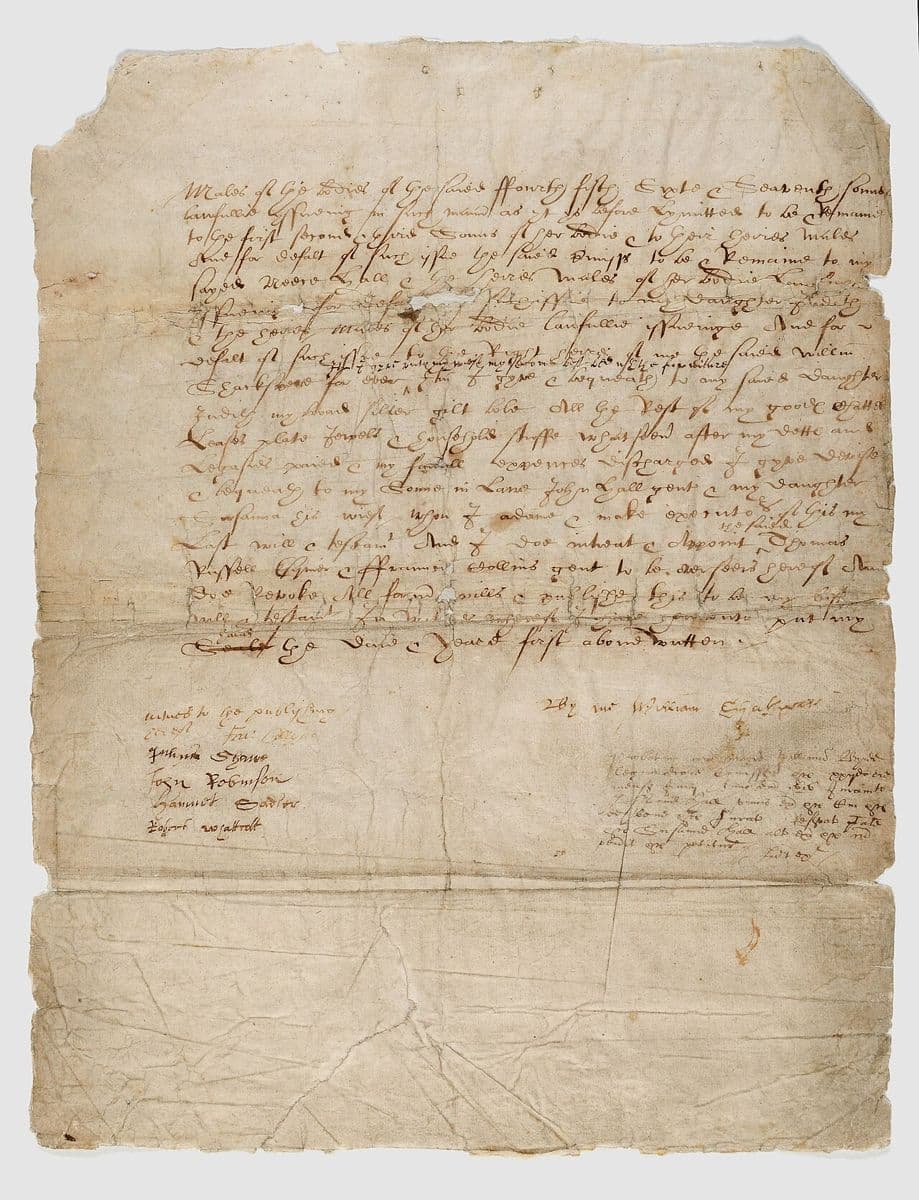
The last page of William Shakespeare's will (1616), written out by a clerk : only the words "By me William Shakespeare," below the text and beside the witnesses, are in his own hand
The National Archives (UK), public domain
The practical step fits on a few pages: the list of your services, what you want done with each, which legacy contacts you named, and one sentence in your will or trust consenting to your executor seeing the content of your electronic communications, or refusing it. Not your passwords written in a kitchen notebook: the inventory, and the way in. Kept with your papers, or with your lawyer.
Robert Ajemian once knew the password. He forgot it. His brother's inbox then took eleven years, eight of them in court, and we found no sign that it was ever opened. One line, written in time, might have helped settle the question.
Read next: Death binder: what your family will need after you die