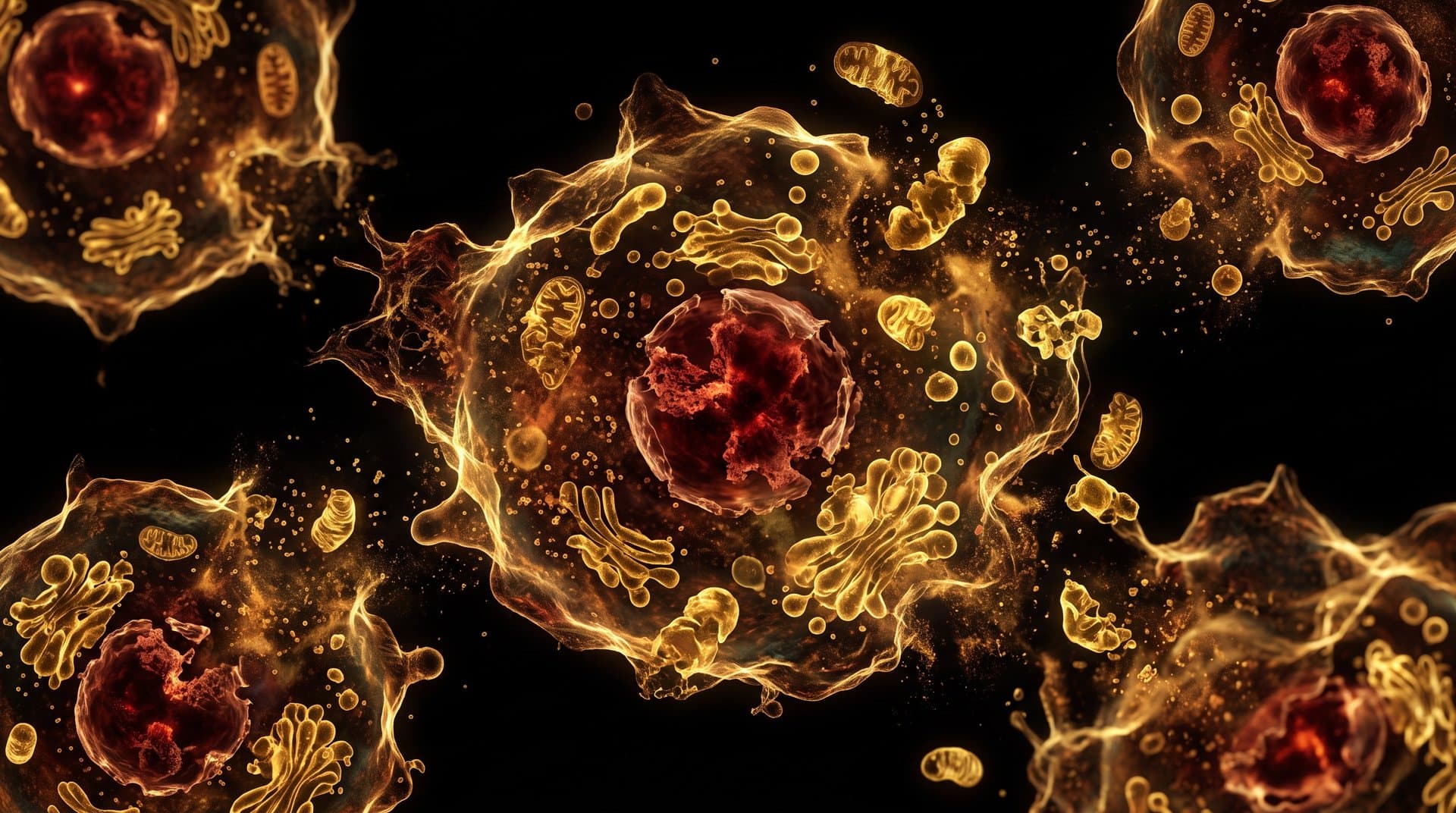
In December 1977, in Franklin, Tennessee, the new owners of an old estate found an open grave in the family cemetery. On top of the coffin of Lieutenant Colonel William Shy, killed at the Battle of Nashville in 1864, police discovered a headless body dressed in evening attire and suspected a recent murder. They called in William Bass, the state's first forensic anthropologist. From the still-pink flesh and the nearly intact remains, he judged the man dead for less than a year.
It was the colonel himself, embalmed, taken out of his cast-iron coffin. The man summoned to read the dead had erred by more than a century. That day, he realized how little anyone knew about what becomes of a body.
For death is not an instantaneous event. It bears no resemblance to a falling theater curtain, nor to the flick of a switch plunging a room into nothingness. When the doctor records the time of death, life has not departed your body: it has simply ceased to be centralized. Your consciousness goes out, but billions of cells continue burning their reserves, and the bacteria in your gut, suddenly freed from the surveillance of the immune system, realize the rules have changed.
Here lies our fragility: the body we believe we hold together was only a truce. It returns to matter, surrendered to enzymes, microbes, and chemistry, along a timeline forensic pathologists took a long time to decipher.
Nearly all in the colon, against about 30 trillion human cells: slightly more passengers than crew
With no oxygen reserve, the brain gives out first: without chest compressions, its most vulnerable neurons are at risk within 4 to 5 minutes; the rest of the body is still alive
A Hill to Learn Death
To learn what no textbook said, Bass asked his university for land. In the autumn of 1980, with his students, he cleared a patch of hillside near the university hospital in Knoxville, ran water and electricity to it, and built a shed. The first body arrived in the spring of 1981: a seventy-three-year-old man, donated by his daughter, whom Bass entered under number 1-81. He needed, he would write, to "track death deep into its own territory."
Police nicknamed the place the Body Farm. Donors lie in the open air on a wooded slope, left to decompose naturally. Their bones are then gathered, cleaned, and added to a collection open to researchers. Donation is free of charge; the center returns nothing to families.
Men and women of every adult age, most of them from Tennessee and the American Southeast, in the collection Bass opened in 1981
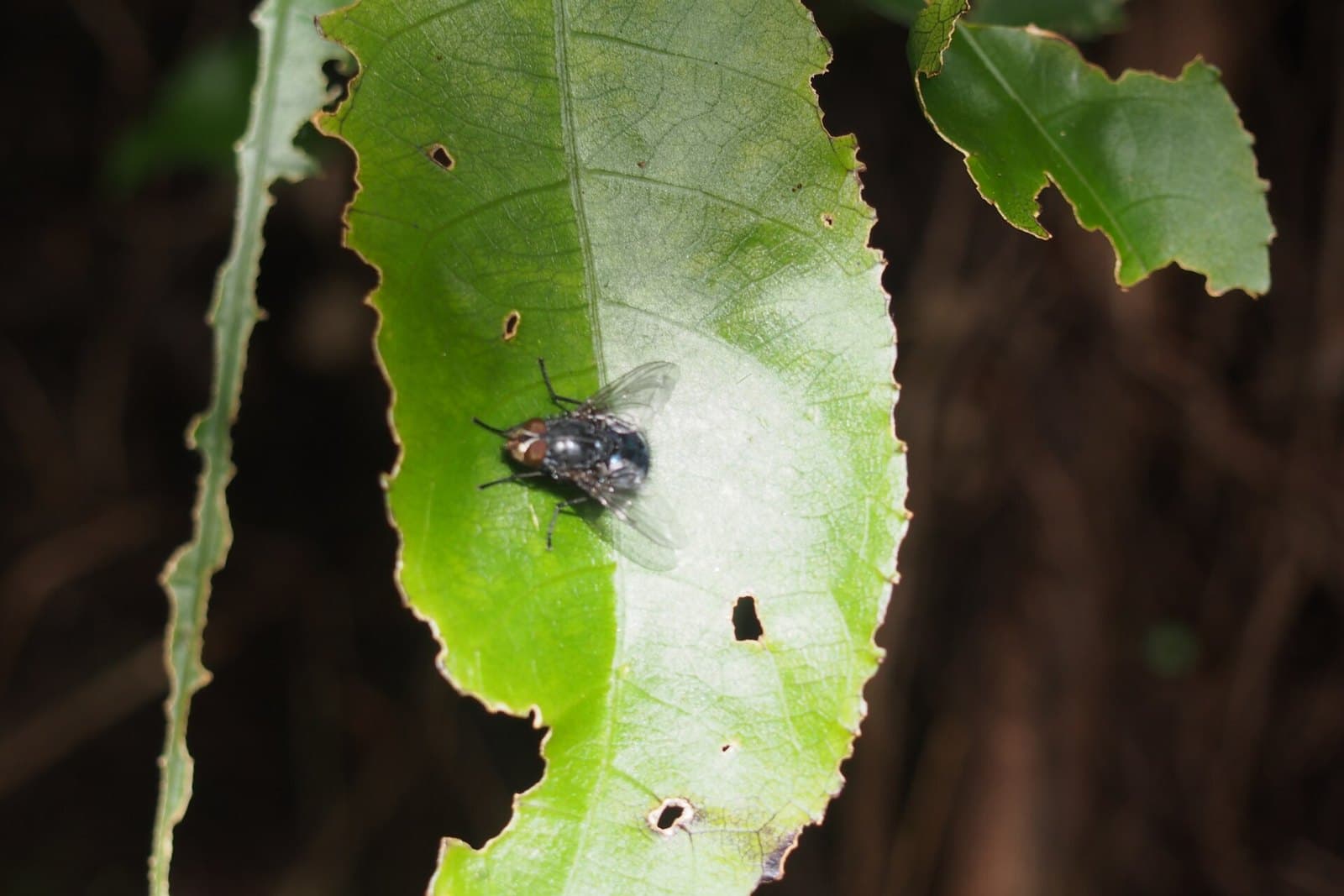
Calliphora vicina, a blowfly, among the first insects drawn to a body
elishr, Wikimedia Commons
What the hillside teaches serves investigators. Blowflies of the Calliphoridae family arrive among the first, beetles later, and their larvae grow at the pace of accumulated heat, measured in degree-days: the age of a larva tells how long a corpse has lain exposed. But before the insects, the forensic pathologist already has four clocks, known to medicine since the nineteenth century.
Four Clocks in the Early Hours
The first strikes within fifteen minutes to half an hour. The heart no longer pumps blood into the capillaries, which empty, and the skin trades its pink for a waxy pallor. This is pallor mortis, the swiftest of the clocks, and the least informative.
Then comes the cold. In life, you continuously generate seventy to one hundred watts of heat to maintain thirty-seven degrees Celsius; when the mitochondria stop, the furnace goes out. Heat does not leave right away: the corpse retains it for an hour or two, then loses it at a steady rate until it reaches room temperature. German forensic pathologist Claus Henßge derived from this a nomogram that cross-references rectal temperature, air temperature, body weight, and clothing. It yields a range of a few hours, never an exact time, and only if nothing has changed around the body.
The average rate of the first hours, a convenient simplification: body build, clothing, and the air in the room make it vary
Next comes stiffness, and with it the strangest paradox of thanatology: in life, muscle spends energy to relax. For actin and myosin filaments to separate after a contraction, an ATP molecule must detach them; without ATP, the muscle stays locked. At the moment of death, everything relaxes; the jaw drops. Then, as the reserves run out, rigor mortis seizes the eyelids, jaw, and neck within a few hours, descends to the arms, trunk, and legs, and peaks within the first day.
It breaks down after a day to a day and a half, in the same order. This is not the suppleness of life returning: it is enzymes beginning to dissolve the fibers.
Meanwhile, blood obeys gravity alone. It sinks toward the lowest parts of the body and, within an hour or two, forms pinkish patches that spread into purplish sheets; where the body presses against the ground—shoulder blades, buttocks—the skin stays white. For about fifteen hours, sometimes longer, this lividity shifts if the remains are turned over. Then the vessels give way, pigment soaks into the tissues, and it becomes fixed. Fixed lividity on the back of a corpse found face down tells the forensic pathologist the body was moved, and long after death.
Timeline of signs after death (orders of magnitude, forensic medicine)
Hours after deathThe Cell Digests Itself
Before the first fly, and even before bacteria join in, the body begins destroying itself from within. Every cell contains lysosomes, tiny sacs packed with enzymes capable of cutting up proteins, fats, sugars, and DNA. In life, the cell keeps them locked behind a membrane maintained by energy-hungry pumps.
When ATP runs out, the cell acidifies, membranes give way, and enzymes spill out. The cell digests itself: this is autolysis. It strikes enzyme-rich organs first. The pancreas, which makes digestive juices, is among the first to break down: under the microscope, in autopsies where the time of death was known, forensic pathologists in Bangkok saw its first lesions after about two hours. The stomach, deprived of the mucus that protected it, is attacked by its own juice; the liver and kidneys soften.
The Mutiny of the Thanatomicrobiome
In life, you host your bacteria like a good neighbor. They ferment fiber, make vitamin K, and stay in their place, held there by the intestinal wall, antibodies, and the movement of the digestive tract. When that wall dies in turn, for lack of oxygen, and autolysis breaches it, nothing holds them back anymore. The microbiota becomes an army of starving marauders, which researchers call the thanatomicrobiome, from the Greek thanatos, death.
The first to help themselves, such as Escherichia coli or Klebsiella, consume the oxygen left in the tissues. When there is none left, the ground belongs to strict anaerobes, first among them the clostridia, including Clostridium perfringens: in the organs of cadavers that have been analyzed, they are the ones found in the lead. They take the road the blood has deserted: the blood vessels.
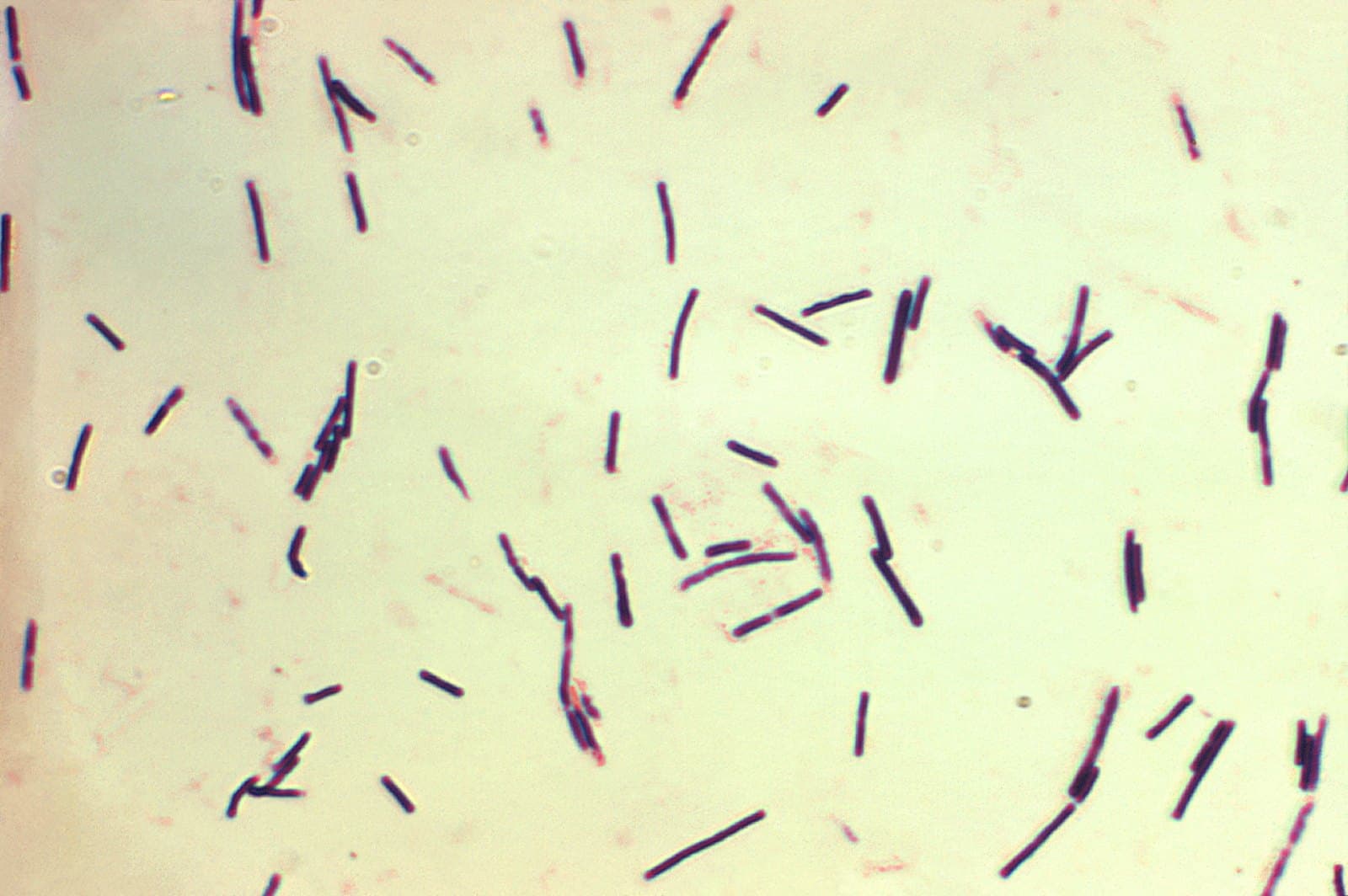
Clostridium perfringens under the microscope, Gram stain
CDC / Don Stalons, public domain
The first visible sign appears on the belly, lower right, where the cecum, the most densely populated part of the bowel, almost touches the skin. After a day to a day and a half, a green patch appears there: sulfur released by the bacteria binds to the iron in hemoglobin and forms a green pigment, sulfhemoglobin. The patch spreads across the abdomen, then the chest and face. The bacteria then travel up the veins of the skin and stain them brown and green: this is marbling, a branching network across the shoulders, neck, and thighs, like a road map etched into wax.
The Body Bloats, and the Casket Can't Stop It
As they devour the tissues, bacteria release gases: carbon dioxide, methane, hydrogen sulfide, ammonia. Added to these are two molecules whose smell has become legendary, described in 1885 by Berlin physician Ludwig Brieger and named after rot and the corpse: putrescine and cadaverine.
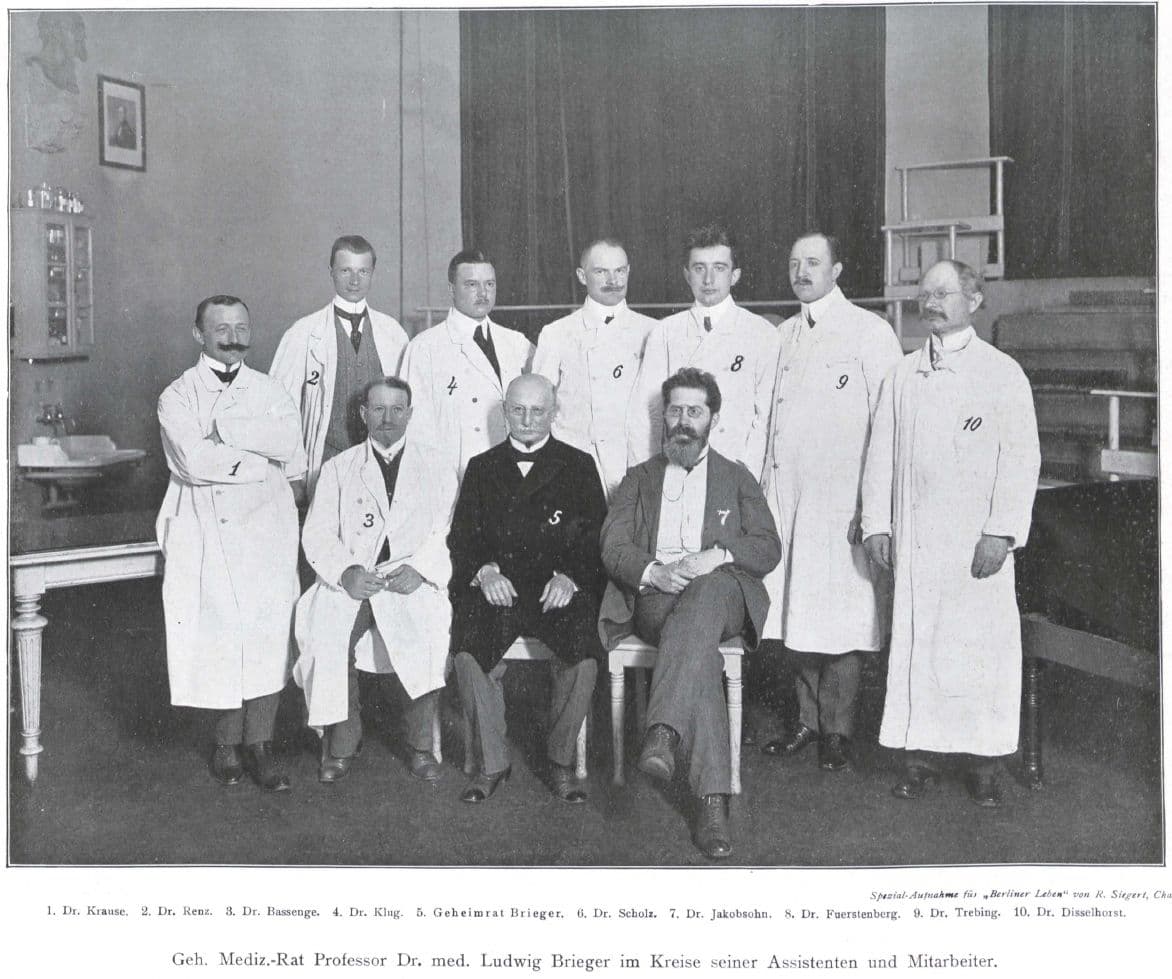
Ludwig Brieger (seated at center, in dark clothes) surrounded by his assistants in white coats in Berlin, in 1909
R. Siegert, Berliner Leben magazine, public domain
Around the third day, the corpse inflates like a balloon. The face becomes unrecognizable, the lips and eyelids swell, the tongue protrudes from the mouth. Pressure in the abdomen pushes the diaphragm up and drives a brownish froth out of the lungs, which a layperson takes for a sign of strangulation. The skin blisters and slips over the flesh.
Bloating sets in between the 60th and the 72nd hour; hair and nails, for their part, only come loose after three to four weeks
The living believed they could stop this. In the United States, so-called "protective" caskets are sold, closed with a rubber strip to keep putrefaction out, and families pay dearly for them. Yet federal regulations treat it as deceptive to claim that a funeral product will delay natural decomposition for a long time. Shutting a fermenting corpse inside an airtight box is building a pressure cooker: "the body can kind of turn into sort of a bog," as American mortician Caitlin Doughty puts it. Colonel Shy did not disprove this rule: he confirmed it. If he came out of his cast-iron coffin nearly intact, it was not the iron that had saved him, it was the embalming. A treated body does not ferment, and only then does a sealed box protect anything.
When the pressure builds high enough, something gives, and mausoleum panels sometimes crack. The trade has a name for it: exploding casket syndrome. To prevent it, some leave the lid unlocked in the mausoleum, and some manufacturers have added valves to let the casket burp.
Soap, Leather, or Bone
Decomposition does not follow a single corridor. Depending on water, heat, air, and soil, it branches off, and flesh can be preserved where it was least expected.
| Thanatological phenomenon | Environmental conditions | Biochemical mechanism | Anatomical result |
|---|---|---|---|
| Classic putrefaction | Open air, moderate temperature and humidity | Proliferation of the thanatomicrobiome, autolysis, colonization by flies (Diptera) | Skeletonization within a few weeks to a few months depending on the heat |
| Saponification (adipocere) | Waterlogged environment, anoxic clay soils | Hydrolysis of fat triglycerides by Clostridium, hydrogenation into free fatty acids | Fat turned into a hard, chalky or waxy mass (human soap), intact for centuries |
| Natural mummification | Extreme heat, dry and ventilated air (deserts, attics) | Water evaporates faster than bacteria proliferate | Skin tanned like leather, organs dehydrated and fixed, without odor |
| Bog tanning | Cold acidic bogs saturated with sphagnum moss | Sphagnic acid sequestering calcium and plant tannin fixing collagen | Demineralized skeleton, skin and internal organs preserved for millennia |
The strangest of these branchings was described in Paris. Beginning in 1786, the Holy Innocents' Cemetery was emptied, and corpses changed into a fatty, whitish substance were exhumed there. Chemist Antoine-François Fourcroy studied it and named it adipocere, corpse wax: in a moist, airless environment, the fat under the skin turns into an insoluble calcium and magnesium soap, which then resists bacteria and keeps the outline of the dead for centuries, at the bottom of cold ponds or in flooded tombs.
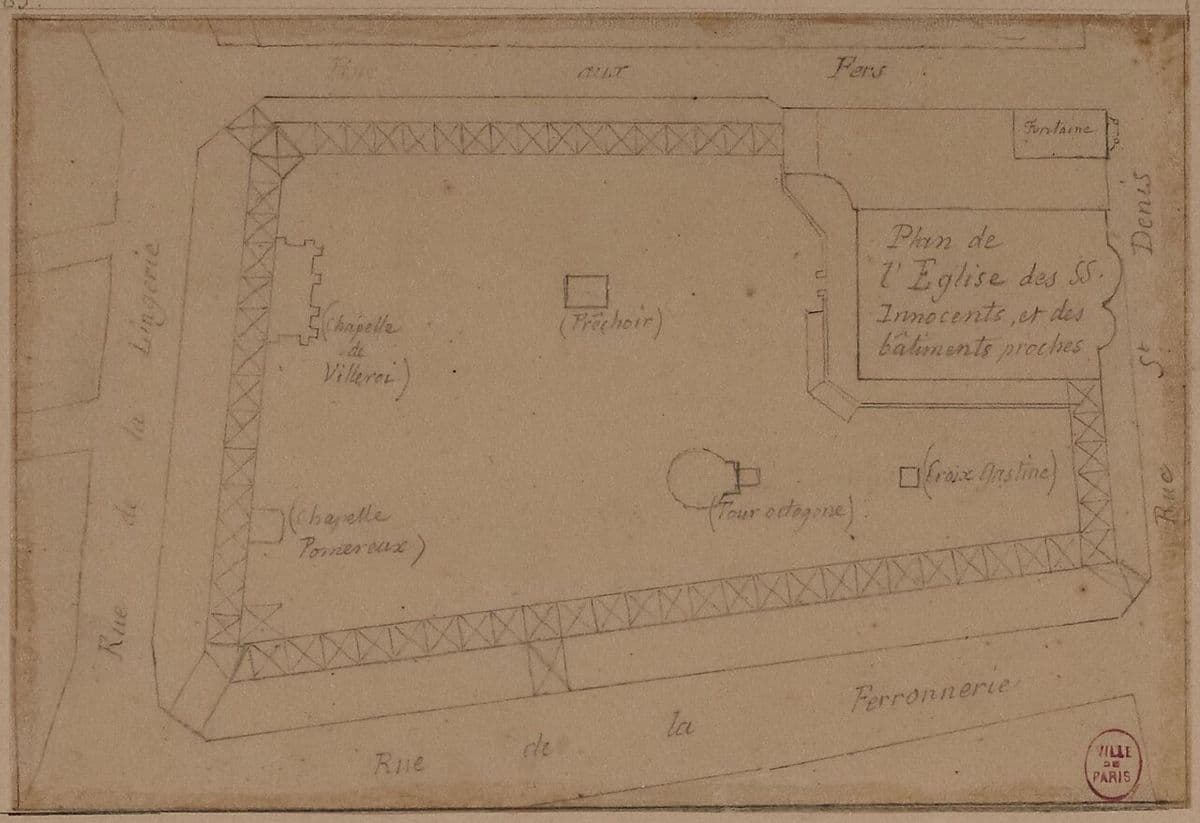
Plan of the Holy Innocents' Cemetery after an engraving of 1785 : the enclosure lined with galleries between rue de la Lingerie, rue aux Fers, rue Saint-Denis, and rue de la Ferronnerie, with the church, the outdoor pulpit, and the octagonal tower
Musée Carnavalet, Paris Musées, CC0
Returning What Was Borrowed
On the Knoxville hillside, when the insects have finished, only the bones remain; the earth, however, keeps the trace of all the rest. A decomposing body releases into the soil the elements it was made of, and changes the earth and the plants around it. Researchers at the University of Tennessee even propose watching by drone for the color of leaves fed by a corpse, to find missing people faster.
Underground, bones last much longer, depending on the acidity of the soil. Seeping water slowly dissolves their mineral, the collagen breaks down, DNA shatters into unreadable fragments, and the last atoms of what was once a thinking being rejoin the great cycle of the Earth's crust. The bones of the Knoxville donors, for their part, wait on shelves: it had taken an error of a century to understand that they were needed.
Studying thanatology is no morbid indulgence: it is biology's ultimate lesson in humility. Every molecule in our body is merely a temporary loan from the earth and the living world. Death is nothing more than the repayment of that loan, executed without error by enzymes, bacteria, and the elements.
Death does not annihilate living matter, it simply abolishes its centralization: from the last breath to the mineralization of bone, the corpse is not a void but an ecosystem at a full biochemical boil