A will is the only text a person writes to be read when they can no longer explain a thing. Often drafted at the edge of the end, it states what a dying person wants to see outlive them: a dog, a grudge, an alphabet, their own skeleton. Then the living pick up the pen.
Here are six last wills, all documented in the archives, ranked from the one the living most thoroughly overturned to the one they most faithfully carried out. Legends stay at the door—like Gunther, the German shepherd supposedly left $65 million by a countess who, Guinness admits, "never was."
6. Shaw, the Alphabet That Died in Court
George Bernard Shaw wanted part of his fortune to fund a forty-letter phonetic alphabet. In 1957, the courts ruled against the will: an out-of-court settlement left £8,300 to the alphabet, which broader society never adopted.
One-third of his posthumous royalties went to the National Gallery of Ireland, which reaped the windfall of My Fair Lady, adapted from Pygmalion. *Yet Pygmalion stages a phonetics specialist, "author of a universal alphabet," who teaches a flower girl how to speak: the stage alphabet enriched a museum, while the real one was never used.*
5. Trouble, the Trimmed Maltese
Leona Helmsley, a New York hotelier, died in 2007 and left $12 million for the care of Trouble, her Maltese dog, and nothing to two of her grandchildren, "for reasons which are known to them." Two others could inherit only by visiting their father's grave once a year.
In 2008, a settlement approved by a Manhattan judge cut the dog's trust fund down to $2 million. The two disinherited grandchildren walked away with $6 million: three times the dog.
In France, Trouble would have received nothing at all. The law forbids bequeathing property to an animal, which has no legal personality: only natural or legal persons can inherit. Notaries use a bequest subject to a duty (legs avec charge)—a sum left to a relative or friend on condition that they care for the animal. Without a will, the animal enters the estate like any other piece of property; if the heirs cannot agree, a court decides its fate.
4. Napoleon, a Will Paid at Sixty Cents on the Dollar
On Saint Helena, in April 1821, Napoleon parcelled out millions, including ten thousand francs to Cantillon, a non-commissioned officer tried for attempting to assassinate Wellington and later acquitted: the vanquished emperor of Waterloo was settling scores from his deathbed.
Louis XVIII's government refused to have the document validated by a French notary; it was registered in London, and only certain legatees were ever paid, receiving roughly 60% of their share on average. He had asked that his ashes rest "on the banks of the Seine": his body did not reach Les Invalides until December 1840, nineteen years later.
3. Millar and the Great Stork Derby
Upon his death in 1926, Charles Vance Millar, a bachelor lawyer in Toronto, bequeathed brewery stock to teetotal Protestant ministers, a vacation home in Jamaica to three men who detested each other, and the residue of his estate to the mother who gave birth to the most children in Toronto over ten years.
Helped along by the Great Depression, the "Great Stork Derby" turned into a race, and the Supreme Court of Canada upheld the clause in 1937. Four mothers of nine children shared the prize, receiving $110,000 each. Whether he meant to be obeyed or merely to amuse his lawyer friends remains unknown.
2. Shakespeare and the Second-Best Bed
William Shakespeare's will, dated March 1616, contains a single line that has kept tongues wagging for four centuries: "I give unto my wife my second best bed with the furniture." Many read it as a posthumous slap at Anne Hathaway.
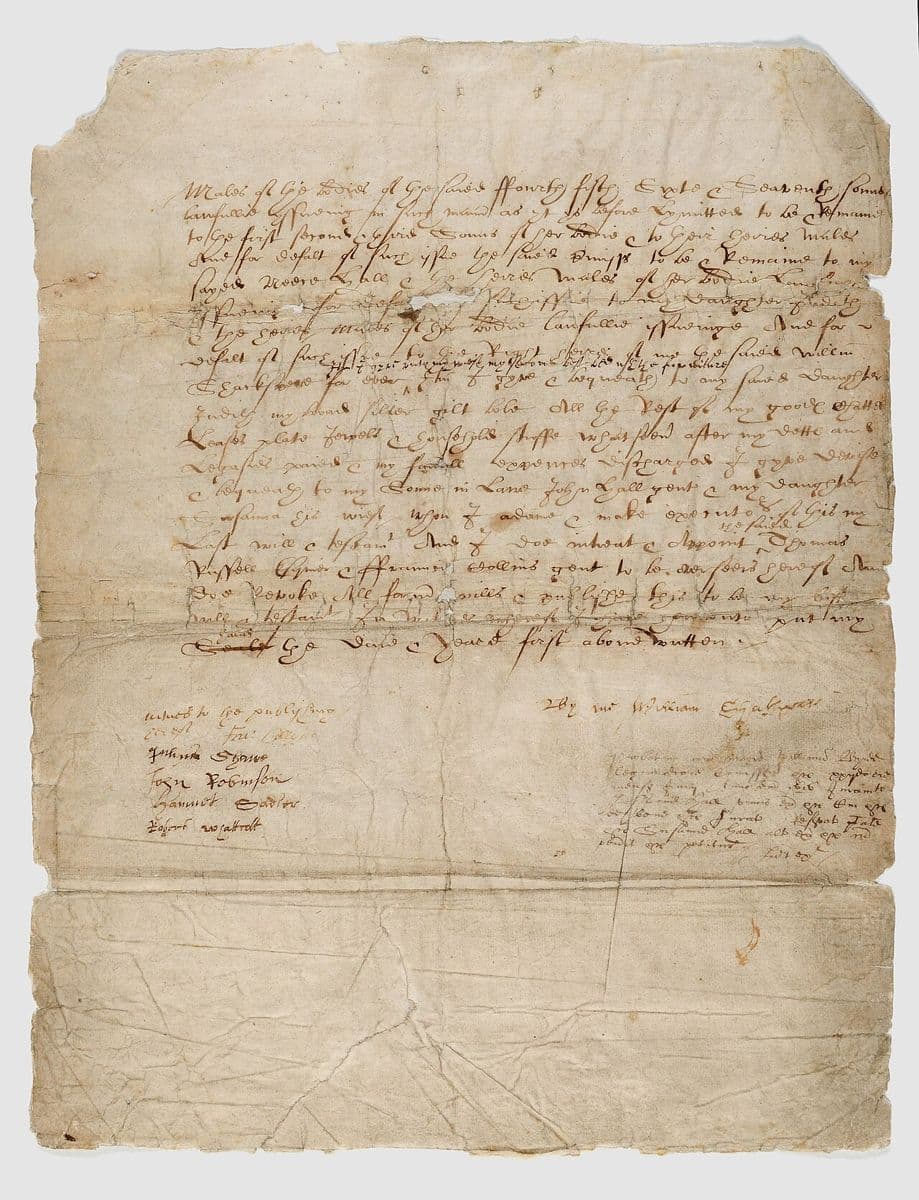
The final page of Shakespeare's will (1616), signed in his own hand
The National Archives (United Kingdom), public domain
The British National Archives point out that at the time the best bed was always an heirloom left to the heir, and that the widow may well have been better provided for than the text suggests. The law carried out the bequest without blinking; it was posterity that wrote a biography out of a piece of furniture.
1. Bentham, Still Seated
Jeremy Bentham, who died in 1832, bequeathed his body to his friend Dr. Southwood Smith to be turned into an "Auto-Icon": his skeleton, dressed in his own clothes, seated inside a wooden cabinet. Everything was done as instructed, except the head: once mummified, it looked so macabre that it was replaced with a wax head fitted with his own hair.
He has been at University College London since 1850, and the legend that has him attending every council meeting, recorded as "present but not voting," is a myth. Yet his is the most spectacularly executed wish in this ranking—and the only one whose gaze, in wax, you can still meet.
What the Living Keep
| Rank | Will | What the deceased wanted | What they got |
|---|---|---|---|
| 6 | George Bernard Shaw (1950) | a 40-letter phonetic alphabet | will overturned in court (1957), £8,300 for the alphabet |
| 5 | Leona Helmsley (2007) | $12M for her Maltese, Trouble | $2M after a court-approved settlement (2008); $6M to the two disinherited grandchildren |
| 4 | Napoleon I (1821) | millions in bequests, his ashes on the banks of the Seine | roughly 60% of bequests paid; return to Les Invalides in 1840 |
| 3 | Charles Vance Millar (1926) | his fortune to Toronto's most prolific mother | clause upheld (1937); four mothers of nine children |
| 2 | William Shakespeare (1616) | the second-best bed to his wife | executed; the intention remains unknown |
| 1 | Jeremy Bentham (1832) | his body preserved and displayed | executed, except for the head, made of wax |
A dead person may ask for the absurd, provided they follow the required legal form—and that form changes at the border. In France, a holographic will must be written entirely by hand, dated, and signed, and one cannot disinherit a protected heir (héritier réservataire), whom the law forbids excluding from the estate regardless of the reason given. In England and Wales, two witnesses must be present at the same time.
Even absurdity, however, has a limit. In any will, states Article 900 of the French Civil Code, "impossible conditions, and those contrary to laws or good morals, shall be deemed not written": the judge erases the condition and leaves the bequest standing. French law even anticipates that the dead may be wrong about the future. Anyone who has received a bequest may ask a judge to revise conditions and burdens that have become, "as a result of a change in circumstances," "either extremely difficult or seriously harmful" to carry out—though not until ten years after the testator's death; the judge then modifies what is needed "taking inspiration from the intention of the disponor."
The deceased believes they have the last word; it is the living who have it, and only the archives preserve what was actually written.