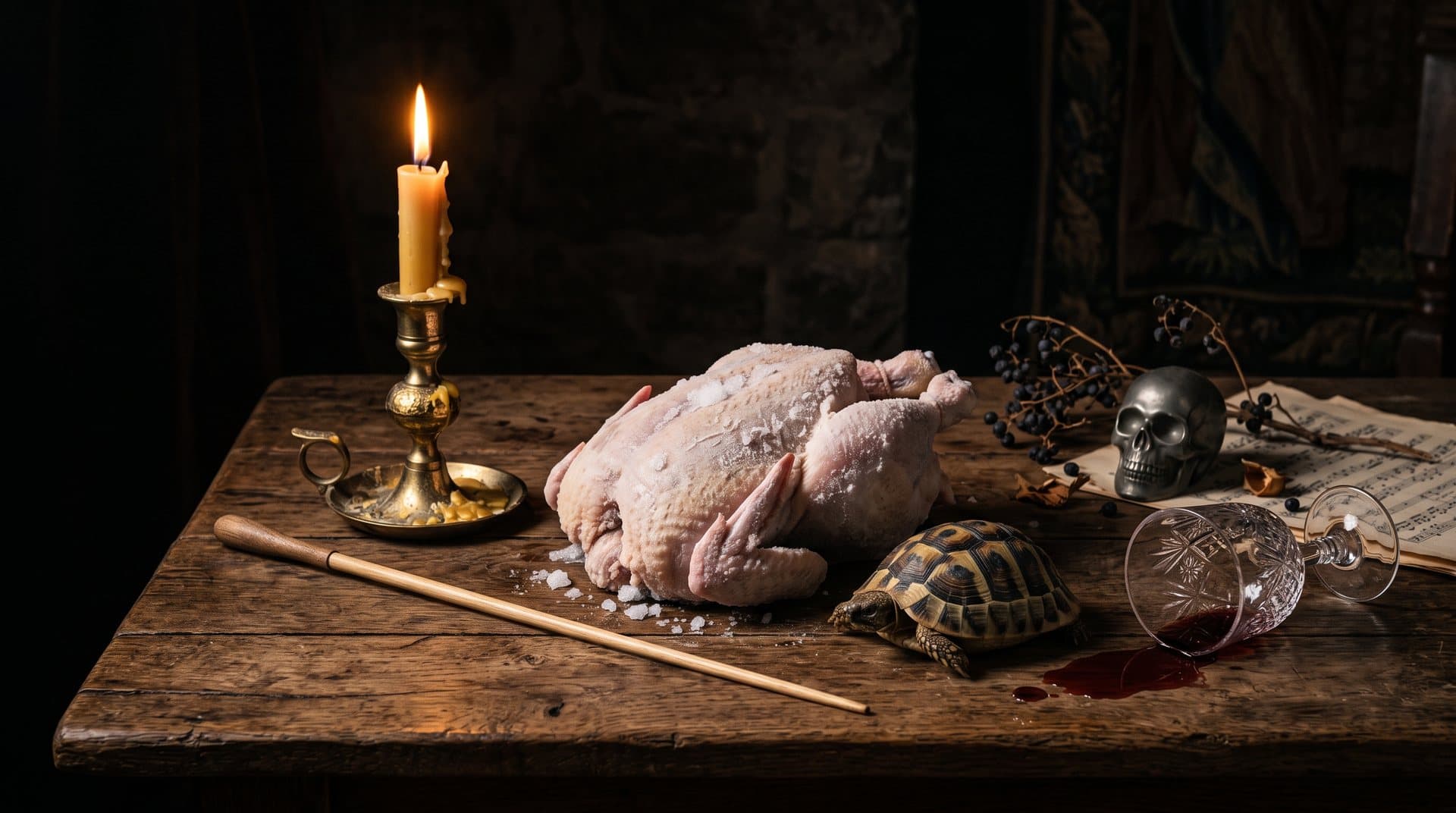
A great man ought to die on a scale to match his life: in battle, on the scaffold, or in his bed surrounded by disciples. Some bungled their exit, and history remembers it with relish.
ABSURD DEATHS OF THE PANTHEON: FROM ATTILA'S NOSEBLEED TO CHARLES VIII'S DOOR LINTEL
These deaths bring the mighty back down to everyone else's size. Chroniclers knew it, and never missed a chance to draw the moral. Here are six absurd ends, ordered not by date but from the most legendary to the best attested. The last one is the truest—and the filthiest.
Aeschylus, or Misplaced Caution
The fates, Pliny the Elder relates, had foretold to the father of Greek tragedy a death falling from above: he therefore trusted only the open sky. One day in Sicily, an eagle looking to crack open a tortoise dropped it on him. Valerius Maximus adds a detail: having walked outside the city walls, he had sat down in the sun, and the bird mistook his bald skull for a stone.
He had avoided roofs. He had not anticipated tortoises. And his epitaph says not a word about his tragedies—only that he fought at Marathon.
Between his death and the accounts of Valerius Maximus and Pliny
Attila, the Empire, and the Nose
The Scourge of God had ravaged the Balkans, Gaul, and Italy, and forced Constantinople to pay tribute. In 453, he married a very beautiful girl named Ildico, drank heavily, and fell asleep on his back: the blood that would ordinarily have flowed from his nose ran down into his throat and choked him. In the morning, his attendants broke down the door and found the bride weeping beneath her veil.
What the legions had failed to achieve, a nosebleed accomplished. Jordanes tells the story a century later, following a diplomat who had dined at Attila's table.
The Roman armies had certainly tried. Around June 20, 451, on the Catalaunian Plains in Gaul, General Aetius and Theodoric, king of the Visigoths, had met him in open battle. Theodoric died there, and the outcome remains debated: the following year, Attila invaded Italy. The chronicler Hydatius speaks of almost 300,000 dead, Jordanes of 165,000; both write "are said," and nobody counted.
Asymmetry of the tolls: the Catalaunian Plains and the wedding night
deathsDied of an effusion of blood, without any wound, according to Jordanes
Bacon and the Highgate Hen
Francis Bacon wanted to rebuild science on experiment. On a snowy day in 1626, riding in a coach toward Highgate, he wondered whether snow would preserve flesh as well as salt. According to Aubrey, they bought a hen, had it gutted, and the philosopher stuffed the body with snow with his own hands. Chilled to the bone, he was put to bed at the Earl of Arundel's house, in a damp bed that had not been slept in for about a year, and there he died "of suffocation."
The hen got the glory; the bed may have done the work. What remains is his last letter: in it, he says he was likely to have had the fortune of Pliny the Elder, who died at the foot of Vesuvius—the very same Pliny who told the story of Aeschylus's tortoise. As for the experiment itself, he notes, it succeeded excellently well.
From the damp bed to his death, according to John Aubrey, who had the story from Hobbes
Lully, the King, and the Toe
In France's Grand Siècle, conductors beat time by striking the floor with a heavy staff. In the autumn of 1686, Louis XIV survived three hours under the scalpel, without anesthesia, for an anal fistula, and the kingdom sang Te Deums. On January 8, 1687, Jean-Baptiste Lully, master of the royal court's music, was conducting his own setting when he smashed his toe with his staff. Gangrene set in; a former dancer, he refused amputation.
The king had survived his backside. His composer did not survive his toe.
From the Te Deum of January 8 to his death on March 22
Tycho Brahe, or Politeness
The emperor's astronomer had spent his life measuring the heavens. In October 1601, at a banquet in Prague, he considered it a breach of etiquette to leave the table, and held it in. Afterward, he could barely urinate at all, and only in excruciating pain; he grew delirious, and kept repeating that he hoped he would not seem to have lived in vain, relates Kepler, his assistant.
For a long time he was said to have been poisoned with mercury. Exhumed in 2010, his body delivered its verdict: no mercury; what remains is the banquet bladder that Kepler described. The tests also settled one detail: his prosthetic nose was made of brass. Politeness has never been a survival strategy.
Charles VIII and the Haquelebac Gallery
The king of France was twenty-seven years old when he took the queen to watch a game of real tennis in the castle ditch at Amboise, in the spring of 1498. The way led through the Haquelebac Gallery, "the nastiest place about the castle" according to the chronicler Commynes, where everyone went to relieve themselves. The king was not a tall man, yet he knocked his head against the lintel. He watched the match, talked freely with people, and then collapsed.
They laid him upon a coarse mattress, which he would never leave. Commynes drew the moral: this king with so many magnificent palaces died in a sordid and filthy place.
From his collapse to his death on April 7, according to Commynes
Tycho Brahe is said to have died because he did not dare go to the toilet, according to Kepler. A century earlier, a king of France died in the toilets of his own castle.
Absurd Death, a Privilege
Six men, all illustrious: unknown people who slip or bump their heads have no chronicler. An absurd death is only funny if the life was grand. A Sicilian shepherd killed by a tortoise would never have had Pliny.