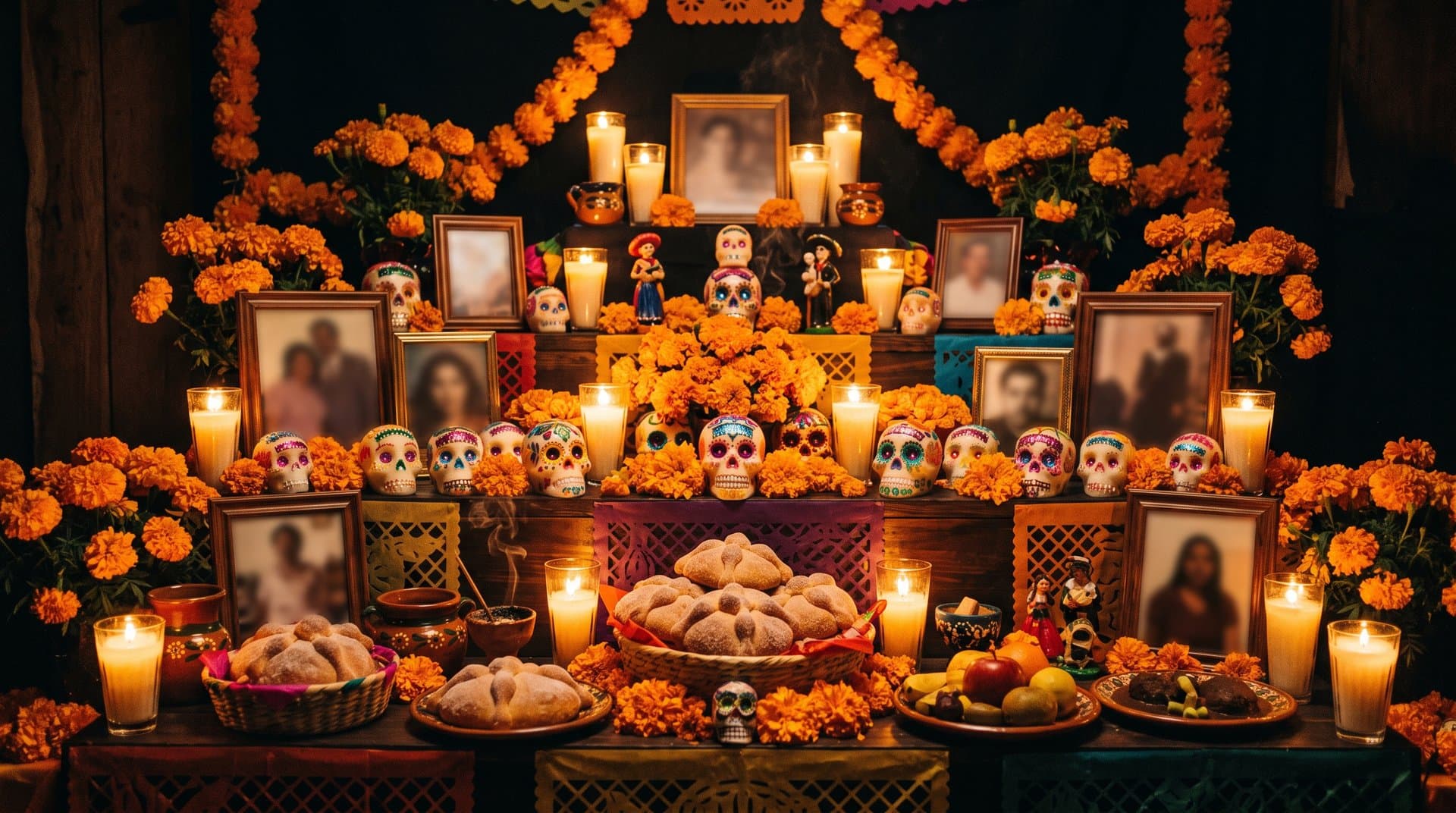
In Mexico, the dead are not the absent, mourned in silence: they are expected guests, and they have their demands. At the end of every October, families set out food and drink for them, sometimes something to smoke, and trace a path of orange petals in front of the house so they do not lose their way. The holiday rests on a simple and dizzying idea: you only truly die on the day no one remembers you anymore.
UNESCO inscribed it in 2008 as intangible cultural heritage of humanity, under a name that says where it comes from: the Indigenous festivity dedicated to the dead. It is said to have been born of the meeting of pre-conquest rites and All Saints' Day, brought by the Spanish in the sixteenth century; Mexican historians still argue over how much each contributed. An engraver, a muralist, a James Bond film, and an animated film turned it into a global image. For the families of more than one hundred and thirty thousand disappeared people, it has become something else: the day they raise an altar to someone they were never able to bury.
Each of the Dead Has a Night
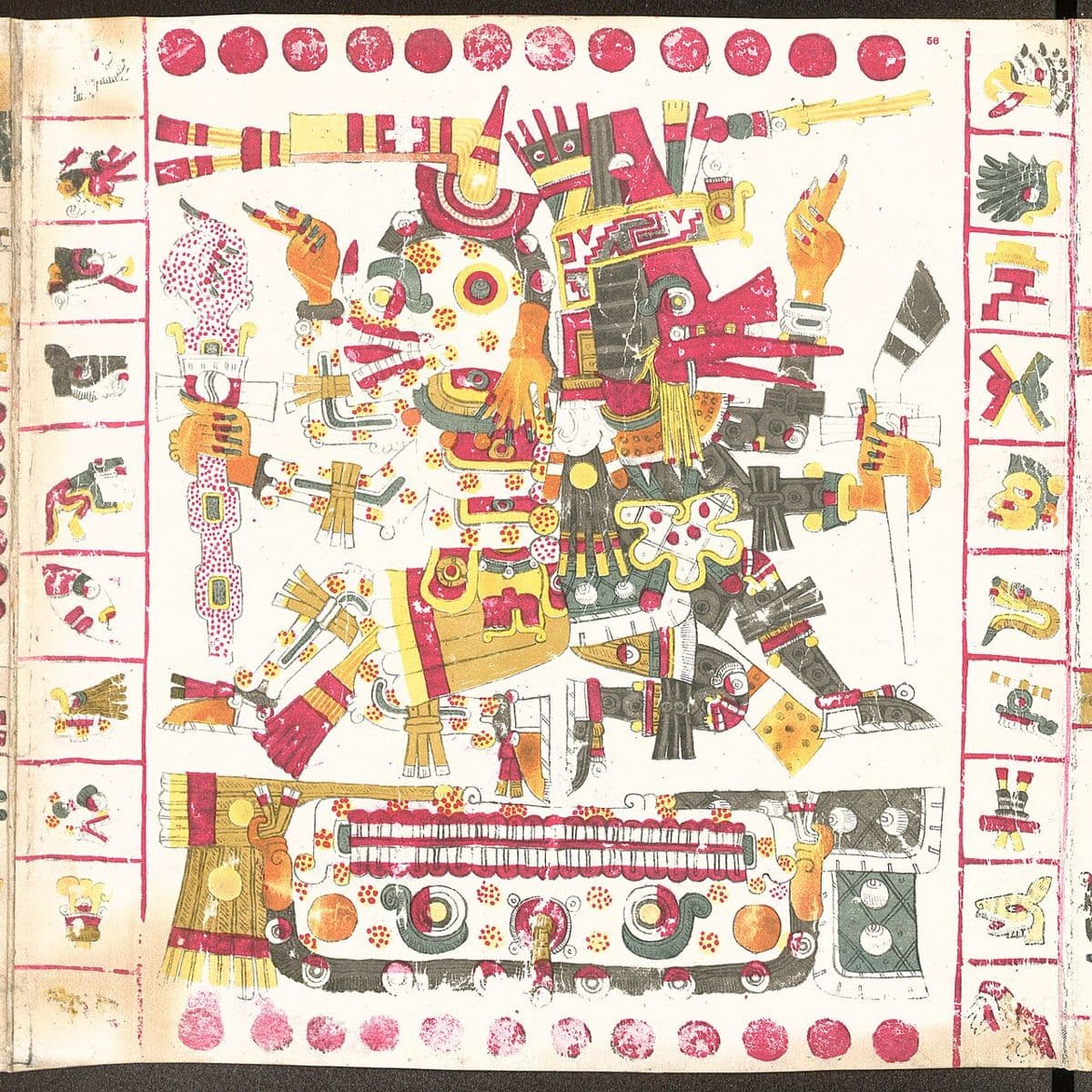
Mictlantecuhtli, lord of Mictlán, a white skeleton dotted with red, back to back with Ehécatl-Quetzalcoatl in his red beaked mask : death and life joined in a single figure
Codex Borgia, page 56, pre-Columbian manuscript (1898 facsimile), public domain
The dead do not come back in a crowd. They rise from Mictlán, the underworld of the Mexica ruled by Mictlantecuhtli, and they arrive by category: UNESCO notes that they are divided according to the cause of their death, their age, their sex, and sometimes their profession, each with its own day. The calendar changes from one village to the next. In the one published by the Mexican government, those who died tragically, through violence or accident, arrive on October 28.
On October 30 and 31 come the children who died unbaptized, on November 1 the "little dead," the children, and on November 2 the adults. Before all of them, the night of the 27th is even set aside for pets: in Mexico, the dog too has a right to its bowl from beyond the grave.
The welcome is not only a matter of tenderness. According to UNESCO, the dead can bring prosperity, an abundant maize harvest, or misfortune, illness and money troubles, depending on how they were received. The holiday falls at the end of the maize cycle, when the earth has finished giving. You honor your ancestors; you also avoid offending them.
The Mexica devoted two twenty-day months of their ritual calendar to the dead, the ninth to children and the tenth to adults, and their festival of Quecholli, in honor of the war god Mixcóatl, fell between October 20 and November 8. The lineage remains disputed all the same: Octavio Paz saw the holiday as a blending of the two traditions, while the historian Elsa Malvido traces it entirely to medieval Europe and speaks of a "Cardenist invention," after President Lázaro Cárdenas.
An Altar for a Traveler Who Can No Longer See
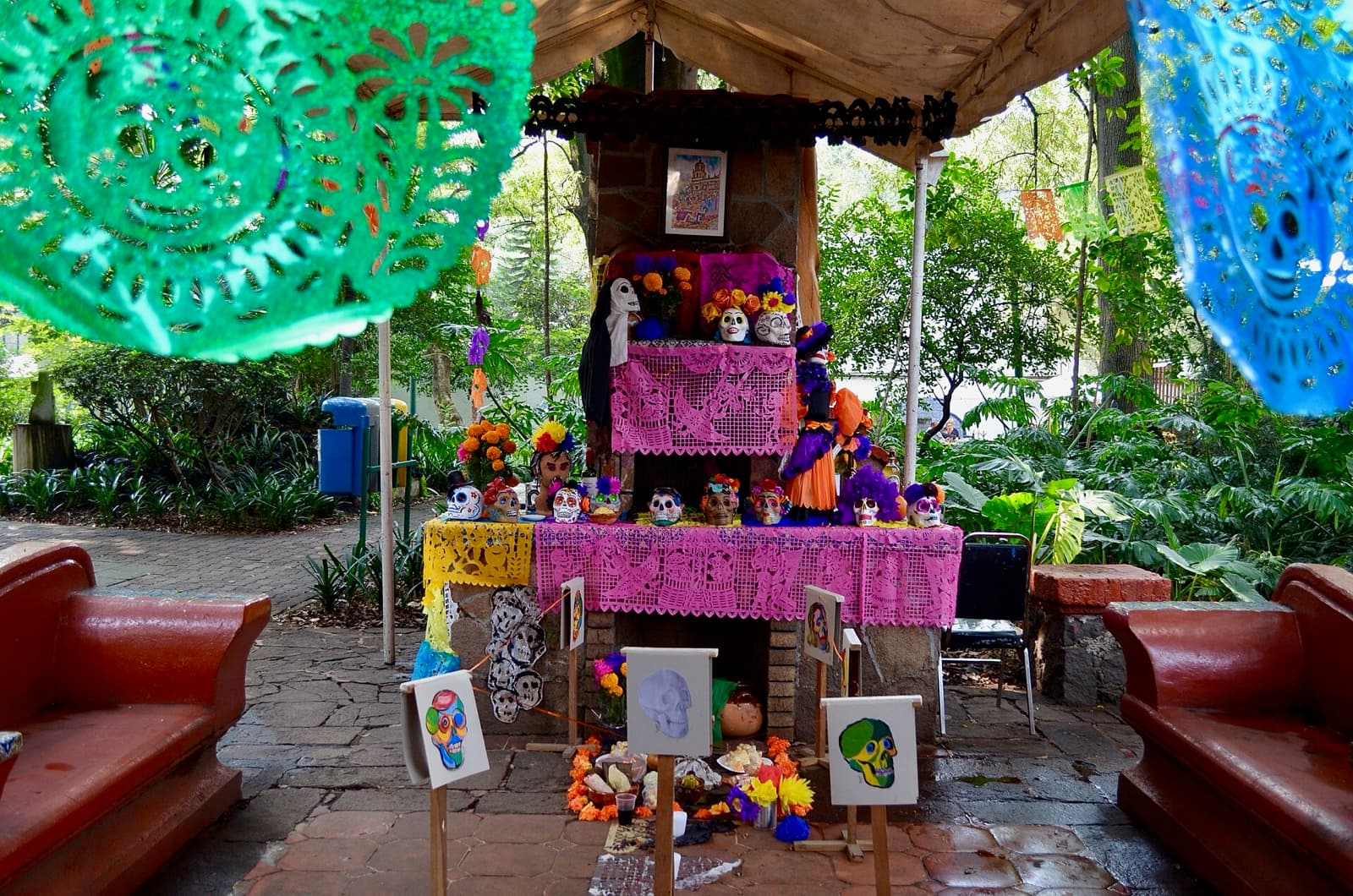
Día de Muertos ofrenda in Coyoacán (2019)
Ines Suarez R., CC BY-SA 4.0
In the house, the ofrenda is built on two levels, sky and earth; on three if you add the underworld; on seven for the seven places the soul passes through before it finds rest. Everything is designed for an exhausted traveler who has lost his eyes. Cempasúchil petals, the orange marigold (Tagetes erecta), trace the path to the altar: the dead follow their color and their scent.
Harvest announced in 2023 by the Ministry of Agriculture, on nearly 2,500 hectares: an entire field to mark the way back for the dead
A glass of water awaits him, for he arrives thirsty; a pinch of salt, so his body does not decay. The smoke of copal carries the prayers. Then come the pleasures: pan de muerto, a round brioche whose crossed strips of dough represent the bones, and whatever the deceased loved in life, mole, tamales, candy, tequila, mezcal or cigarettes. In Mexico, you don't put the dead on a diet.
| Element of the ofrenda | Origin | What it says |
|---|---|---|
| Cempasúchil petals | Pre-Columbian | The way back, by color and scent |
| Copal | Mesoamerican | The smoke that carries the prayer |
| Pan de muerto | Spanish and Indigenous | The bones of the dead, shared as a fraternal meal |
| Sugar calaveras | Colonial | The name of the deceased written on the forehead of a skull |
| Papel picado | Folk craft | The wind, in yellow for purity, in purple for mourning |
In the middle stands the photograph. An idea often associated with the holiday, more modern proverb than Aztec dogma, holds that you die three times: when the heart stops, when the body is returned to the earth, and on the day no one says your name anymore. The altar is there to hold off the third. As long as a great-grandchild sets out your portrait and cooks the dish you loved, you are not entirely gone.
A Night in the Cemetery
In San Andrés Mixquic, in the southeast of the capital, Karla is preparing her grandmother's meal: "Atole, tamales, mole, rice: those, she must not go without." On the night of November 2, the village cemetery lights up with thousands of candles. During the alumbrada, residents light them on the graves to guide the way back.
On Janitzio, an island in Lake Pátzcuaro, in Michoacán, people watch for other signs. Domingo Guzmán, who chairs the island's Indigenous council, waits for the cold, the butterflies and the ducks: when they arrive, the souls come back. But about 80% of the residents now live off tourism, and the holiday has lost its intimacy.
In the cemetery, the rezandero, the man who leads the prayers, has taken to repeating: "Don't go through there, don't step there." On the lake, four fishermen demonstrate their butterfly-wing nets, then move along the visitors' boats, a plastic jícara in hand. The dead man goes home; the tourist leaves a tip.
La Catrina :A Satire Turned Logo
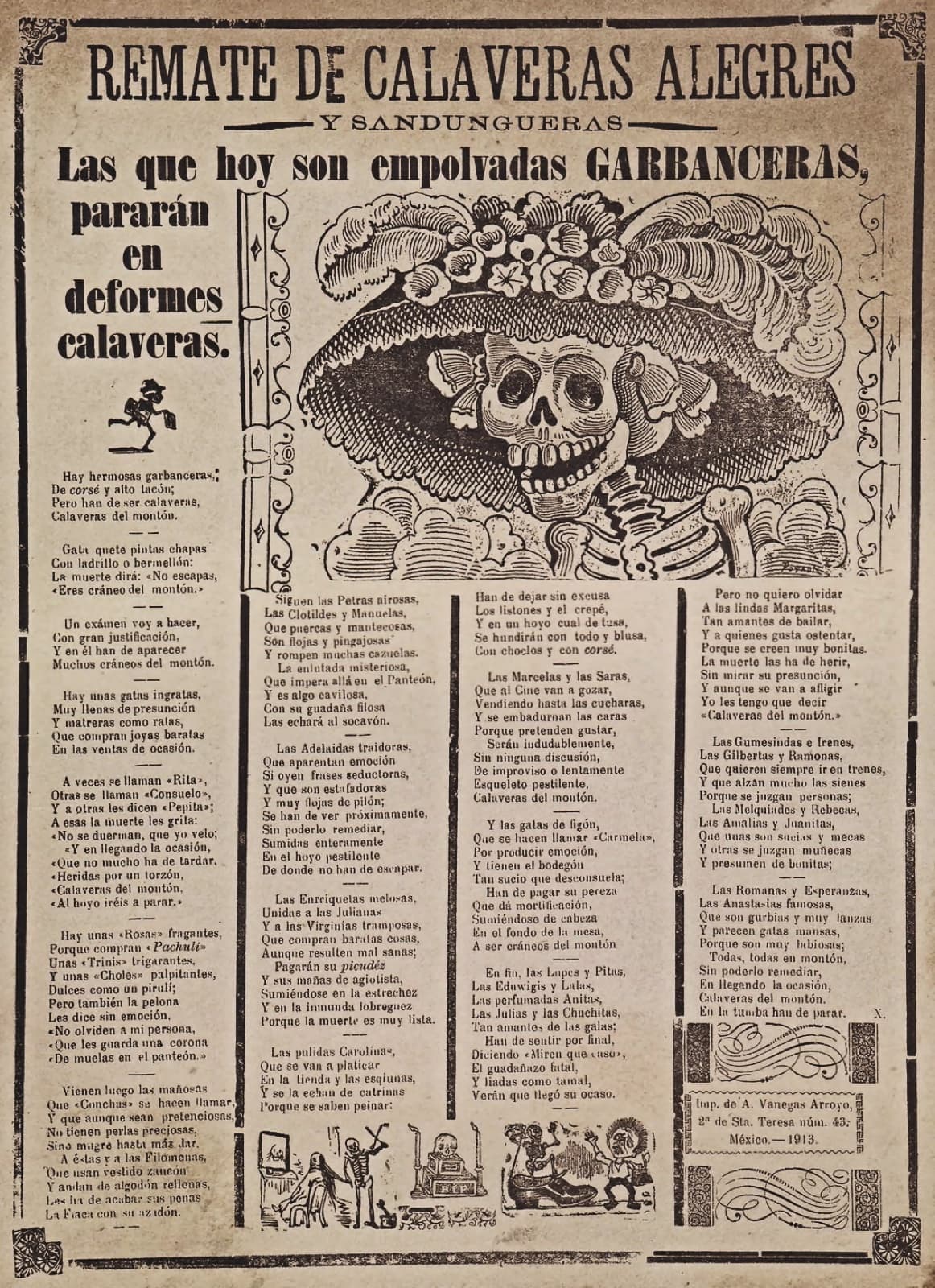
La Calavera Garbancera, engraving by José Guadalupe Posada (c. 1910-1912)
public domain
The skeleton lady in the big feathered hat comes neither from the pyramids nor from the colonial era. She emerged around 1910-1912 from the workshop of José Guadalupe Posada, an engraver of popular broadsheets under the dictatorship of Porfirio Díaz. At the time she is only a bust: a skull in a European-style hat, the Calavera Garbancera. The engraving probably mocks the elites who aped European fashions; the text printed beside it, which Posada did not write, targets the women who sold chickpeas, the garbanceras, who gave themselves the airs of great ladies.
Posada died in 1913, nearly forgotten, penniless, and ended up in an unmarked common grave. His calavera was published only after his death. The man who gave Mexico its face of death has no grave where anyone can bring him flowers.
The name Catrina, the feminine of catrín, the dandy, became attached to the engraving in a 1930 book. Diego Rivera gave her a body in 1946-1947, at the center of his mural Dream of a Sunday Afternoon in the Alameda Central: a long dress, a feathered-serpent boa that links her to Quetzalcóatl, Posada on her arm, and little Diego holding her hand. A century after her birth, the satirical weapon has become a nation's logo.
A Tradition Born of a James Bond
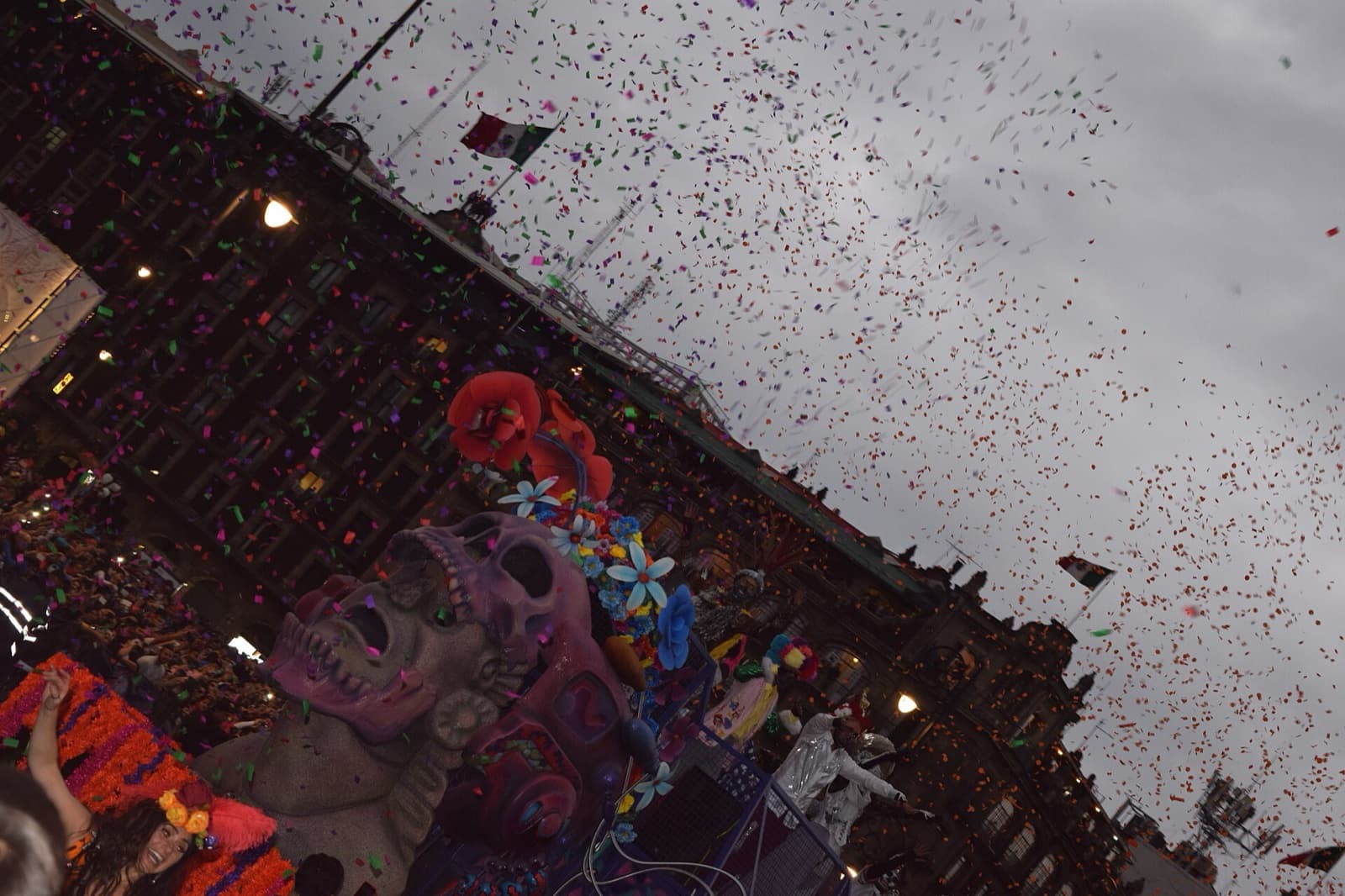
The great Día de Muertos parade in Mexico City, 2018
Gobierno CDMX, CC0
Until 2015, no great skeleton parade crossed the center of Mexico City. The holiday was lived within the family, at the cemetery, in Mixquic or Janitzio. Then Spectre, Sam Mendes's James Bond, opens on a parade of giant skeletons in the streets of the capital, invented by its screenwriters.
On October 29, 2016, Mexico City and the national tourism board organized the first real parade, bringing back the film's costumes and props. The organizers expected 135,000 spectators; the city counted 425,000. In Mexico, a tradition can be ten years old and have a license to kill.
According to the city: more than ten times what the organizers of the first parade expected
In 2017, Pixar's Coco took in more than 800 million dollars worldwide. The film makes the third death a plot device: one of its characters, Héctor, fades from the land of the dead as his daughter forgets him. The whole world learned there what Mixquic already knew.
The Dead Without Graves
In front of the Palacio de Bellas Artes in Mexico City, around the Antimonumenta, feminist collectives and families of victims of femicide and disappearance set up their ofrenda on the eve of All Saints' Day 2025: cempasúchil flowers, candles, photographs, placards bearing names. "We are here like every year to raise our voices, because today, like every year, we no longer have our daughters."
Listed in the national registry for the years 2006 to 2026, according to its March 2026 update: behind each name, a family still searching
Since 2006 and the start of the war on the cartels, the national statistics institute has counted more than 400,000 homicides in Mexico. In 2025, nearly nine victims in ten were men; in the first half of 2024, homicide was the leading cause of death among 25- to 44-year-olds (preliminary INEGI data). But it is the disappeared who have changed the holiday: their families have no body, no death certificate, no grave on which to light a candle.
The madres buscadoras, the mothers who search for their children, or their remains, themselves, have made the altar a political gesture. The search kills too: at least eight women searchers were murdered in 2022 and 2023, according to the federal Security Ministry. For these families, setting up an ofrenda means refusing to let oblivion finish what the killers began.
Ancient or reinvented, the holiday rests on a pact: the memory of the living pulls the dead back from nothingnessThe only death with no return is not the body's: it is oblivion